Obama, Vilsack, Wyden, NCBA, NPPC praise TPP agreement, others cautiously await details
October 05, 2015 |12:46 PM
President Barack Obama, Senate Finance Committee ranking member Ron Wyden, D-Ore. the National Cattlemen’s Beef Association and the National Pork Producers Council have praised the Trans-Pacific Partnership trade agreement announced this morning, while others were more cautious or critical.
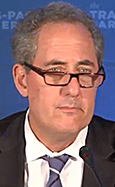 Michael Froman
At a news conference in Atlanta, U.S. Trade Representative Michael Froman noted that the U.S. Congress would not approve the agreement until 2016, but when asked how he expects presidential candidates to address the issue he declined to comment.
Froman noted that the Trade Promotion Authority law requires the administration to give the Congress 90 days notice of the final agreement and to publish it 60 days before congressional votes.
“Trade ministers from the 12 nations that make up the Trans-Pacific Partnership finished negotiations on an agreement that reflects America’s values and gives our workers the fair shot at success they deserve,” Obama said in a statement.
“This partnership levels the playing field for our farmers, ranchers, and manufacturers by eliminating more than 18,000 taxes that various countries put on our products,” Obama said.
“It includes the strongest commitments on labor and the environment of any trade agreement in history, and those commitments are enforceable, unlike in past agreements. It promotes a free and open Internet. It strengthens our strategic relationships with our partners and allies in a region that will be vital to the 21st century. It’s an agreement that puts American workers first and will help middle-class families get ahead.”
The Obama administration also said that TPP will enhance global food security and “eliminate import taxes as high as 40 percent on U.S. poultry products, 35 percent on soybeans, and 40 percent on fruit exports.”
“Additionally, TPP will help American farmers and ranchers compete by tackling a range of barriers they face abroad, including ensuring that foreign regulations and agricultural inspections are based on science, eliminating agricultural export subsidies, and minimizing unpredictable export bans.”
Agriculture Secretary Tom Vilsack added that the agreement would provide “a more level playing field in trade for American farmers.”
“The agreement would eliminate or significantly reduce tariffs on our products and deter non-science based sanitary and phytosanitary barriers that have put American agriculture at a disadvantage in TPP countries in the past,” Vilsack said.
“Failing to grasp this opportunity would be a mistake: worse than just losing out on potential gains, our producers would fall behind other countries that are negotiating their own preferential arrangements in TPP countries,” he said.
“We are committed to working with Congress within the framework of the recently-passed trade promotion authority to obtain a strong bipartisan understanding of and support for this historic trade deal that benefits farmers, ranchers, and all those who live, work and raise families in rural communities.”
Senate Finance Committee ranking member Ron Wyden, D-Ore., said he needs to read the full agreement, but he praised several sections of it.
“I’m pleased to hear reports that the deal reached today includes, for the first time, an agreement to curb currency manipulation and new and enforceable obligations on countries like Vietnam and Malaysia to uphold labor rights, including in the case of Malaysia enforceable commitments to address human trafficking,” Wyden said.
“I also understand that the agreement will include commitments to stop trade in illegal wildlife and first-ever commitments on conservation,” he said.
“Importantly, I understand that this deal will ensure that countries that are part of it can regulate tobacco without fearing intimidation and litigation by Big Tobacco,” Wyden said.
“It has been reported the agreement includes enforceable measures to promote the free flow of digital information across borders; if accurate, those provisions could constitute an important win for the Internet and the free speech it facilitates. Importantly, the impact of this deal must result in parties to it providing copyright exceptions and limitations known as Fair Use. I look forward to working with the administration and stakeholders to be sure that is ultimately the case.”
But Senate Finance Committee Chairman Orrin Hatch, R-Utah, said, “While the details are still emerging, unfortunately I am afraid this deal appears to fall woefully short.”
“Over the next several days and months, I will carefully examine the agreement to determine whether our trade negotiators have diligently followed the law so that this trade agreement meets Congress’s criteria and increases opportunity for American businesses and workers,” Hatch said.
“The Trans-Pacific Partnership is a once-in-a-lifetime opportunity and the United States should not settle for a mediocre deal that fails to set high-standard trade rules in the Asia-Pacific region for years to come.”
House Agriculture Committee Chairman Michael Conaway, R-Texas, said he and 16 colleagues had sent the negotiators a letter expressing concerns about sugar, rice, dairy and a tobacco carve-out.
“While I am encouraged to hear that U.S. livestock products such as beef and pork will see significant gains in market access, it will take a coalition of many to move TPP over the coming months,” Conaway said.
“At this time, I am skeptical that these concerns were sufficiently addressed but will remain open-minded, and I look forward to studying the agreement.”
House Ways and Means Committee ranking member Sander Levin, D-Mich., who has been critical of the TPP process, issued a balanced statement.
“Progress has been made on important issues, with the outcome on a multitude of issues still requiring deeper scrutiny, and others falling short of the results we seek,” Levin said.
“Removing tobacco from investor-state dispute settlement is a vital and welcome step in allowing countries to protect their public health. There has also been substantial progress with Vietnam and Malaysia in the areas of worker rights as we seek to ensure they comply with the enforceable standards in the agreement.”
“Unfortunately, there is still no satisfactory plan to ensure that Mexico — a country where economic competition with U.S. workers is the most intense — changes its laws and practices to comply with its obligations in the agreement,” Levin said.
“Changing NAFTA has been a top priority — we cannot miss this opportunity and hope to rely on a future dispute settlement panel to do so. The finance ministers' plan regarding currency manipulation — an issue with a major impact on U.S. jobs — is also entirely unsatisfactory.”
House Ways and Means Committee Chairman Paul Ryan, R-Wis., had earlier said he was withholding judgment on the agreement, but noted that it will be published 60 days before Congress votes on whether to approve it.
House Rules Committee ranking member Louise Slaughter, D-N.Y., said, “I have never seen a trade agreement that has benefited the American manufacturer or the American worker, and everything I have seen about the TPP suggests that it will be more of the same.”
“With an agreement reached, negotiators will no longer be able to keep the TPP hidden from public view,” Slaughter continued.
“As Americans learn more in the coming weeks and months about how the agreement will impact their day-to-day lives — with things like unsafe food imports and restricted access to affordable medicines — I am confident that we will be able to build opposition to defeat this bad trade deal.
“I’ve been working with members of the Australian and Canadian parliaments who are equally concerned with how this agreement will allow Pharma and other corporate interests to challenge our domestic laws before a panel of three unaccountable lawyers,” Slaughter said.
Rep. Rosa DeLauro, D-Conn., also said she is deeply concerned about the agreement.
“The administration will claim this agreement is a foreign policy triumph, but nothing could be further from the truth,” DeLauro said.
“The TPP has no enforceable labor, environmental, or human rights provisions. By making this deal, we are rewarding human trafficking in Malaysia, violence against LGBT people in Brunei, environmental degradation in Peru, and the further shipping of American jobs overseas to the very countries that do not play by the rules.
National Cattlemen’s Beef Association President Philip Ellis, a Chugwater, Wyo., producer, said the agreement “will boost U.S. exports and eliminate trade barriers.”
“While the full details of the partnership will not be released until the president presents it to Congress, cattle producers are assured this is a true 21st Century agreement,” Ellis said.
“The TPP will immediately reduce tariffs and level the playing field for U.S. beef exports to these growing markets. TPP is a major win not only for the beef industry, but for all U.S. export products, growing the economy while supporting jobs and investments in agriculture and technology.”
National Pork Producers Council President Ron Prestage expressed “confidence” that the agreement “will benefit all sectors of the U.S. economy and will provide enormous new market opportunities for high-quality American pork products.”
“NPPC played an active role throughout the five-plus years of negotiations,” Prestage said, “providing U.S. negotiators with key information on barriers we face in the 11 other TPP countries and offering guidance on outcomes that would ensure substantial new market access benefits for U.S. pork in those markets.”
National Chicken Council President Mike Brown was more cautious in his assessment, saying he would review the details to see if it includes NCC’s goals of strong enforcement on sanitary and phytosanitary measures and access to the Canadian market.
The American Sugar Alliance, which has been concerned about increased access for Australian sugar, said it “still needs to review the final language and verify details in the Trans-Pacific Partnership, but we are cautiously optimistic about what we’ve learned from U.S. trade negotiators.”
The USA Rice Federation, which was striving for more access to the Japanese market, said it would not have a reaction until its leaders could see the details of the agreement.
The National Milk Producers Federation and the U.S. Dairy Export Council, which have expressed fears that the agreement would bring in more dairy products to the United States than U.S. producers would gain in export markets, said it is waiting for details of the agreement to “carefully review” them, but thanked members of Congress for expressing their concerns about the dairy provisions during the last days of negotiations.
The International Dairy Foods Association, which represents dairy processors, said only that it would review the agreement as the details become available.
At a news conference of trade ministers today, New Zealand Trade Minister Tim Groser said that not all dairy tariffs were eliminated, but that the agreement “establishes a direction of travel” on dairy.
Groser said the fact that New Zealand produces only 2.5 percent of the world’s dairy products but is the world’s largest dairy exporter shows how little the dairy market has been subject to globalization. He pointed out that there is much more trade in autos than in dairy.
The deal apparently allows Canada to maintain its supply management system in dairy.
Canadian Trade Minister Ed Fast said that while the current Canadian government was very pleased with the overall agreement, the Canadian elections will be held in two weeks and that it will be up to the next Parliament to debate the TPP agreement.
At a news conference in Atlanta, U.S. Trade Representative Michael Froman noted that the U.S. Congress would not approve the agreement until 2016, but when asked how he expects presidential candidates to address the issue he declined to comment.
Froman noted that the Trade Promotion Authority law requires the administration to give the Congress 90 days notice of the final agreement and to publish it 60 days before congressional votes.
“Trade ministers from the 12 nations that make up the Trans-Pacific Partnership finished negotiations on an agreement that reflects America’s values and gives our workers the fair shot at success they deserve,” Obama said in a statement.
“This partnership levels the playing field for our farmers, ranchers, and manufacturers by eliminating more than 18,000 taxes that various countries put on our products,” Obama said.
“It includes the strongest commitments on labor and the environment of any trade agreement in history, and those commitments are enforceable, unlike in past agreements. It promotes a free and open Internet. It strengthens our strategic relationships with our partners and allies in a region that will be vital to the 21st century. It’s an agreement that puts American workers first and will help middle-class families get ahead.”
The Obama administration also said that TPP will enhance global food security and “eliminate import taxes as high as 40 percent on U.S. poultry products, 35 percent on soybeans, and 40 percent on fruit exports.”
“Additionally, TPP will help American farmers and ranchers compete by tackling a range of barriers they face abroad, including ensuring that foreign regulations and agricultural inspections are based on science, eliminating agricultural export subsidies, and minimizing unpredictable export bans.”
Agriculture Secretary Tom Vilsack added that the agreement would provide “a more level playing field in trade for American farmers.”
“The agreement would eliminate or significantly reduce tariffs on our products and deter non-science based sanitary and phytosanitary barriers that have put American agriculture at a disadvantage in TPP countries in the past,” Vilsack said.
“Failing to grasp this opportunity would be a mistake: worse than just losing out on potential gains, our producers would fall behind other countries that are negotiating their own preferential arrangements in TPP countries,” he said.
“We are committed to working with Congress within the framework of the recently-passed trade promotion authority to obtain a strong bipartisan understanding of and support for this historic trade deal that benefits farmers, ranchers, and all those who live, work and raise families in rural communities.”
Senate Finance Committee ranking member Ron Wyden, D-Ore., said he needs to read the full agreement, but he praised several sections of it.
“I’m pleased to hear reports that the deal reached today includes, for the first time, an agreement to curb currency manipulation and new and enforceable obligations on countries like Vietnam and Malaysia to uphold labor rights, including in the case of Malaysia enforceable commitments to address human trafficking,” Wyden said.
“I also understand that the agreement will include commitments to stop trade in illegal wildlife and first-ever commitments on conservation,” he said.
“Importantly, I understand that this deal will ensure that countries that are part of it can regulate tobacco without fearing intimidation and litigation by Big Tobacco,” Wyden said.
“It has been reported the agreement includes enforceable measures to promote the free flow of digital information across borders; if accurate, those provisions could constitute an important win for the Internet and the free speech it facilitates. Importantly, the impact of this deal must result in parties to it providing copyright exceptions and limitations known as Fair Use. I look forward to working with the administration and stakeholders to be sure that is ultimately the case.”
But Senate Finance Committee Chairman Orrin Hatch, R-Utah, said, “While the details are still emerging, unfortunately I am afraid this deal appears to fall woefully short.”
“Over the next several days and months, I will carefully examine the agreement to determine whether our trade negotiators have diligently followed the law so that this trade agreement meets Congress’s criteria and increases opportunity for American businesses and workers,” Hatch said.
“The Trans-Pacific Partnership is a once-in-a-lifetime opportunity and the United States should not settle for a mediocre deal that fails to set high-standard trade rules in the Asia-Pacific region for years to come.”
House Agriculture Committee Chairman Michael Conaway, R-Texas, said he and 16 colleagues had sent the negotiators a letter expressing concerns about sugar, rice, dairy and a tobacco carve-out.
“While I am encouraged to hear that U.S. livestock products such as beef and pork will see significant gains in market access, it will take a coalition of many to move TPP over the coming months,” Conaway said.
“At this time, I am skeptical that these concerns were sufficiently addressed but will remain open-minded, and I look forward to studying the agreement.”
House Ways and Means Committee ranking member Sander Levin, D-Mich., who has been critical of the TPP process, issued a balanced statement.
“Progress has been made on important issues, with the outcome on a multitude of issues still requiring deeper scrutiny, and others falling short of the results we seek,” Levin said.
“Removing tobacco from investor-state dispute settlement is a vital and welcome step in allowing countries to protect their public health. There has also been substantial progress with Vietnam and Malaysia in the areas of worker rights as we seek to ensure they comply with the enforceable standards in the agreement.”
“Unfortunately, there is still no satisfactory plan to ensure that Mexico — a country where economic competition with U.S. workers is the most intense — changes its laws and practices to comply with its obligations in the agreement,” Levin said.
“Changing NAFTA has been a top priority — we cannot miss this opportunity and hope to rely on a future dispute settlement panel to do so. The finance ministers' plan regarding currency manipulation — an issue with a major impact on U.S. jobs — is also entirely unsatisfactory.”
House Ways and Means Committee Chairman Paul Ryan, R-Wis., had earlier said he was withholding judgment on the agreement, but noted that it will be published 60 days before Congress votes on whether to approve it.
House Rules Committee ranking member Louise Slaughter, D-N.Y., said, “I have never seen a trade agreement that has benefited the American manufacturer or the American worker, and everything I have seen about the TPP suggests that it will be more of the same.”
“With an agreement reached, negotiators will no longer be able to keep the TPP hidden from public view,” Slaughter continued.
“As Americans learn more in the coming weeks and months about how the agreement will impact their day-to-day lives — with things like unsafe food imports and restricted access to affordable medicines — I am confident that we will be able to build opposition to defeat this bad trade deal.
“I’ve been working with members of the Australian and Canadian parliaments who are equally concerned with how this agreement will allow Pharma and other corporate interests to challenge our domestic laws before a panel of three unaccountable lawyers,” Slaughter said.
Rep. Rosa DeLauro, D-Conn., also said she is deeply concerned about the agreement.
“The administration will claim this agreement is a foreign policy triumph, but nothing could be further from the truth,” DeLauro said.
“The TPP has no enforceable labor, environmental, or human rights provisions. By making this deal, we are rewarding human trafficking in Malaysia, violence against LGBT people in Brunei, environmental degradation in Peru, and the further shipping of American jobs overseas to the very countries that do not play by the rules.
Industry reaction
National Cattlemen’s Beef Association President Philip Ellis, a Chugwater, Wyo., producer, said the agreement “will boost U.S. exports and eliminate trade barriers.”
“While the full details of the partnership will not be released until the president presents it to Congress, cattle producers are assured this is a true 21st Century agreement,” Ellis said.
“The TPP will immediately reduce tariffs and level the playing field for U.S. beef exports to these growing markets. TPP is a major win not only for the beef industry, but for all U.S. export products, growing the economy while supporting jobs and investments in agriculture and technology.”
National Pork Producers Council President Ron Prestage expressed “confidence” that the agreement “will benefit all sectors of the U.S. economy and will provide enormous new market opportunities for high-quality American pork products.”
“NPPC played an active role throughout the five-plus years of negotiations,” Prestage said, “providing U.S. negotiators with key information on barriers we face in the 11 other TPP countries and offering guidance on outcomes that would ensure substantial new market access benefits for U.S. pork in those markets.”
National Chicken Council President Mike Brown was more cautious in his assessment, saying he would review the details to see if it includes NCC’s goals of strong enforcement on sanitary and phytosanitary measures and access to the Canadian market.
The American Sugar Alliance, which has been concerned about increased access for Australian sugar, said it “still needs to review the final language and verify details in the Trans-Pacific Partnership, but we are cautiously optimistic about what we’ve learned from U.S. trade negotiators.”
The USA Rice Federation, which was striving for more access to the Japanese market, said it would not have a reaction until its leaders could see the details of the agreement.
The National Milk Producers Federation and the U.S. Dairy Export Council, which have expressed fears that the agreement would bring in more dairy products to the United States than U.S. producers would gain in export markets, said it is waiting for details of the agreement to “carefully review” them, but thanked members of Congress for expressing their concerns about the dairy provisions during the last days of negotiations.
The International Dairy Foods Association, which represents dairy processors, said only that it would review the agreement as the details become available.
At a news conference of trade ministers today, New Zealand Trade Minister Tim Groser said that not all dairy tariffs were eliminated, but that the agreement “establishes a direction of travel” on dairy.
Groser said the fact that New Zealand produces only 2.5 percent of the world’s dairy products but is the world’s largest dairy exporter shows how little the dairy market has been subject to globalization. He pointed out that there is much more trade in autos than in dairy.
The deal apparently allows Canada to maintain its supply management system in dairy.
Canadian Trade Minister Ed Fast said that while the current Canadian government was very pleased with the overall agreement, the Canadian elections will be held in two weeks and that it will be up to the next Parliament to debate the TPP agreement.
- Office of the U.S. Trade Representative —— Trans-Pacific Partnership Ministers’ Statement and Summary of the Trans-Pacific Partnership Agreement
- White House — Statement by the President on the Trans-Pacific Partnership
- — Fact Sheet: How the Trans-Pacific Partnership (TPP) Boosts Made in America Exports, Supports Higher-Paying American Jobs, and Protects American Workers
