Cattle producers told to work on Senate to keep COOL
October 05, 2015 |09:24 AM
BISMARCK, N.D. — The lobbyist and the lawyer for cattle producers who want to keep country-of-origin labeling for beef said here Saturday that if ranchers want to keep labeling they should organize quickly to convince the Senate to pass the bill that Sen. John Hoeven, R-N.D., and Senate Agriculture Committee ranking member Debbie Stabenow, D-Mich., have introduced.
The World Trade Organization, which has already ruled four times that the U.S. labeling program has led to discrimination against Canadian and Mexican cattle and hog producers, is scheduled to announce on November 28 the levels of damages that it believes Canada and Mexico have experienced and the value of U.S. products on which the two countries can impose retaliatory tariffs.
Hoeven and Stabenow have introduced legislation that contains the bill the House passed to repeal labeling for beef and pork, but the Hoeven-Stabenow bill also contains the standards for a voluntary label for meat from animals, born, raised and slaughtered in the United States.
The Canadians have said that even though the program is voluntary it will still discriminate against U.S. and Mexican producers because U.S. slaughterhouses are likely to buy fewer animals from those countries or pay lower prices because they must segregate them during the slaughter process in order to maintain the integrity of the labels.
Senate Agriculture Committee Chairman Pat Roberts, R-Kan., has said that a full repeal is the only legislation that will satisfy the Canadian and Mexican governments and producers.
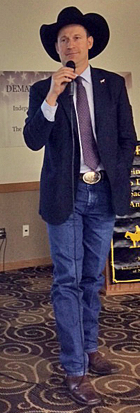 Jess Peterson
At the annual convention of the Independent Beef Association of North Dakota, which is affiliated with the U.S. Cattlemen’s Association, Jess Peterson, the Washington lobbyist for USCA, noted that neither side has the votes to get a bill through the Senate.
“It is all about 60 votes,” Peterson said, referring to the number of votes needed in the Senate to end debate on a bill. “The opposition wants to repeal COOL. They don’t have 60. We don’t have 60.”
But Peterson added that it is important to move quickly because the announcement of retaliation is likely to spur calls for immediate repeal.
“You don’t want to wait until there is nothing to do but repeal,” Peterson said. “Time is not on your side. Build your coalition, get to 60.”
“I fully believe that we move that forward packers will use that label,” Peterson added, noting that packers have told him “ “You won that battle when you got the label. There is no way we can go backward.’ ”
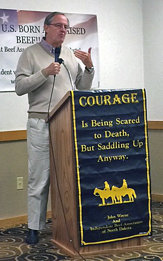 Terry Stewart
Terry Stewart, the Washington lawyer who represents U.S. Cattlemen in the labeling case, said he agreed with Peterson that “it is to your advantage to keep pressure on elected officials” to reach an agreement.
But he said the situation could also be complicated by the levels of retaliation which the WTO allows.
Stewart noted that he had traveled to Geneva recently for the public WTO hearing on the levels of retaliation.
“We are in the ‘How much money are you going to owe?’ process,” he said.
The Canadians said their damages have been about $2.5 billion per year while the Mexicans have said their damages are about $653 million per year. Each country has asked to impose retaliatory tariffs on goods valued at those amounts.
But the U.S. government calculated the Canadian losses at only $45 million per year and the Mexican losses at $48 million per year.
“We have wildly different projections on what the harm is,” Stewart said.
One wrinkle in the Canadian demand, Stewart said, is that Canada maintains that the reduced prices U.S. slaughterhouses have paid for Canadian cattle have led to lower prices in Canada, and producers there want to be compensated for that.
The U.S. government has said this is outside the scope of the trade case, and there is no precedent for the WTO to award damages based on domestic losses, Stewart said.
The attitudes of the three countries may depend on the amount of retaliation allowed and the length of retaliation would depend on how the matter is resolved.
“You absolutely need Mexico and Canada to sign off. If they do not buy off retaliation will be in place for years,” Stewart said.
But he also noted that the “the United States is an important country” and it is always possible that the resolution could depend on other matters.
Canada is likely to give the United States some time to see whether Congress takes action, and it is also possible resolution of the case could become an issue in the Trans-Pacific Partnership negotiations.
Sen. John Hoeven, R-N.D., who also spoke to the group, did not address the details of the case directly, but said, “I continue to talk to everybody to come up with a solution so we can label and not have countervailing duties.”
Hoeven emphasized that his bill with Stabenow includes the House repeal bill but adds the voluntary labeling program for meat from animals born, raised and slaughtered in the United States.
Canada, he noted, has a similar voluntary program called “Product of Canada.”
Canadian Agriculture Minister Gerry Ritz says there is a difference between the U.S. and Canadian program, but Hoeven said, “I think it is pretty much the same thing. I think it is WTO compliant because we do repeal mandatory COOL.”
Sen. Heidi Heitkamp, D-N.D., another speaker, said the situation is “complicated by the processors. This isn’t about WTO compliance, this is about eliminating the competitive edge we would have by labeling their products.”
The World Trade Organization, which has already ruled four times that the U.S. labeling program has led to discrimination against Canadian and Mexican cattle and hog producers, is scheduled to announce on November 28 the levels of damages that it believes Canada and Mexico have experienced and the value of U.S. products on which the two countries can impose retaliatory tariffs.
Hoeven and Stabenow have introduced legislation that contains the bill the House passed to repeal labeling for beef and pork, but the Hoeven-Stabenow bill also contains the standards for a voluntary label for meat from animals, born, raised and slaughtered in the United States.
The Canadians have said that even though the program is voluntary it will still discriminate against U.S. and Mexican producers because U.S. slaughterhouses are likely to buy fewer animals from those countries or pay lower prices because they must segregate them during the slaughter process in order to maintain the integrity of the labels.
Senate Agriculture Committee Chairman Pat Roberts, R-Kan., has said that a full repeal is the only legislation that will satisfy the Canadian and Mexican governments and producers.
At the annual convention of the Independent Beef Association of North Dakota, which is affiliated with the U.S. Cattlemen’s Association, Jess Peterson, the Washington lobbyist for USCA, noted that neither side has the votes to get a bill through the Senate.
“It is all about 60 votes,” Peterson said, referring to the number of votes needed in the Senate to end debate on a bill. “The opposition wants to repeal COOL. They don’t have 60. We don’t have 60.”
But Peterson added that it is important to move quickly because the announcement of retaliation is likely to spur calls for immediate repeal.
“You don’t want to wait until there is nothing to do but repeal,” Peterson said. “Time is not on your side. Build your coalition, get to 60.”
“I fully believe that we move that forward packers will use that label,” Peterson added, noting that packers have told him “ “You won that battle when you got the label. There is no way we can go backward.’ ”
Terry Stewart, the Washington lawyer who represents U.S. Cattlemen in the labeling case, said he agreed with Peterson that “it is to your advantage to keep pressure on elected officials” to reach an agreement.
But he said the situation could also be complicated by the levels of retaliation which the WTO allows.
Stewart noted that he had traveled to Geneva recently for the public WTO hearing on the levels of retaliation.
“We are in the ‘How much money are you going to owe?’ process,” he said.
The Canadians said their damages have been about $2.5 billion per year while the Mexicans have said their damages are about $653 million per year. Each country has asked to impose retaliatory tariffs on goods valued at those amounts.
But the U.S. government calculated the Canadian losses at only $45 million per year and the Mexican losses at $48 million per year.
“We have wildly different projections on what the harm is,” Stewart said.
One wrinkle in the Canadian demand, Stewart said, is that Canada maintains that the reduced prices U.S. slaughterhouses have paid for Canadian cattle have led to lower prices in Canada, and producers there want to be compensated for that.
The U.S. government has said this is outside the scope of the trade case, and there is no precedent for the WTO to award damages based on domestic losses, Stewart said.
The attitudes of the three countries may depend on the amount of retaliation allowed and the length of retaliation would depend on how the matter is resolved.
“You absolutely need Mexico and Canada to sign off. If they do not buy off retaliation will be in place for years,” Stewart said.
But he also noted that the “the United States is an important country” and it is always possible that the resolution could depend on other matters.
Canada is likely to give the United States some time to see whether Congress takes action, and it is also possible resolution of the case could become an issue in the Trans-Pacific Partnership negotiations.
Sen. John Hoeven, R-N.D., who also spoke to the group, did not address the details of the case directly, but said, “I continue to talk to everybody to come up with a solution so we can label and not have countervailing duties.”
Hoeven emphasized that his bill with Stabenow includes the House repeal bill but adds the voluntary labeling program for meat from animals born, raised and slaughtered in the United States.
Canada, he noted, has a similar voluntary program called “Product of Canada.”
Canadian Agriculture Minister Gerry Ritz says there is a difference between the U.S. and Canadian program, but Hoeven said, “I think it is pretty much the same thing. I think it is WTO compliant because we do repeal mandatory COOL.”
Sen. Heidi Heitkamp, D-N.D., another speaker, said the situation is “complicated by the processors. This isn’t about WTO compliance, this is about eliminating the competitive edge we would have by labeling their products.”
