Obama food aid, ag development agenda hits wall at House Ag Committee
October 01, 2015 |12:23 PM
The attempts by the Obama administration, congressional foreign affairs committees and some international development groups to make permanent changes to the U.S. system of food aid and overseas agricultural development hit a wall Wednesday at a House Agriculture Committee hearing to provide a forum for the views of a variety of commodity and humanitarian groups involved in food aid.
House Agriculture Committee Chairman Michael Conaway, R-Texas, made it clear from an opening statement that he believes the attempts to give the U.S. Agency for International Development more flexibility to shift food aid from the delivery of commodities to cash assistance and the development of a bill, the Global Food Security Act, to authorize USAID’s Feed the Future agricultural development program have been done without enough involvement from either farmers or agricultural lawmakers.
Conaway also asked the witnesses at the hearing to take a position on the Global Food Security Act.
 Laura Dills
Laura Dills, representing Catholic Relief Services, was the only witness to endorse the bill, saying CRS hopes it would lead to greater coordination between Feed the Future and food aid.
Dills also said that she considers monetization — the sale of food for development purposes — to be “extremely risky” due to market and political conditions and that CRS uses it only when that is the way it can receive funds.
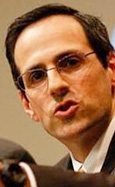 Lucas Koach
Lucas Koach, the senior policy adviser for Feed the Hungry, said his group supports “the strategy” behind the bill, but wants to maintain the constituency of farm, humanitarian and maritime interests that lobby for food aid.
Koach also said there seem to be good indicators from a pilot program on regional and local purchases of food for aid, but that policymakers need to proceed with caution because there can be problems such as aflotoxin contamination.
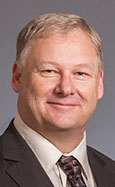 Wade Cowan
American Soybean Association President Wade Cowan, a Brownfield, Texas producer, said the Global Food Security Act “as currently written falls short of achieving a whole-of-government approach” that is supposed to be its aim.
USA Rice Food Subcommittee Chairman James William Warshaw, a Lake Charles, La., producer, said, “It is a pretty simple answer. Agriculture has to have a seat at the table in these discussions.”
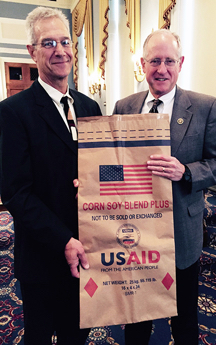 John Didion, CEO of Didion Milling, a Johnson Creek, Wis., firm, poses with House Agriculture Committee Chairman Michael Conaway, R-Texas, with an example of the bags in which U.S. food aid is distributed.
John Didion, CEO of Didion Milling, a Johnson Creek, Wis., firm, said that in-kind food aid allows the use of “nutrient-dense” products his company makes and that hungry people need.
Conaway said there is going to be “struggle in this arena” and that a shift from in-kind food aid to cash “removes the natural support” from U.S. producers.
The provision of U.S. food aid provides “an emotional attachment” that is important to the American people’s support for the program.
Conaway noted that a recent House Agriculture subcommittee hearing had made it “clear that reviews of cash-based assistance are few and far between, and that efforts have only just begun to evaluate the benefits of the flexibility provided in the 2014 farm bill. Those findings underscored my view that the continued push for added program flexibility is premature.”
He also said that the USAID, the Agriculture Department and the Transportation Department’s Maritime Administration have not responded fully to requests from the committee “to seek all the facts surrounding rumored negotiations between USAID and the maritime industry regarding a potential agreement that would increase funding to participants in the Maritime Security Program in exchange for unprecedented levels of cash assistance within Food for Peace.”
Conaway noted that he and House Agriculture Livestock and Foreign Agriculture Subcommittee Chairman David Rouzer, R-N.C., had sent letters to those agencies requesting documents and communications related to those negotiations.
“Unfortunately, we have yet to receive a substantive production of documents,” he said.
U.S. law requires 50 percent of U.S. food aid to be shipped in U.S. ships, and Conaway also said the committee will hold a hearing later this fall on the role of food aid in maintaining the U.S. maritime industry.
A spokesman for Agriculture Secretary Tom Vilsack declined to comment on Conaway’s statement.
The Global Food Security Act, a bill to authorize Feed the Future through September 2016, passed the House Foreign Affairs Committee in April, but that has moved no further.
The bill’s lead author is Rep. Chris Smith, R-N.J., and the lead Democrat is Rep. Betty McCollum, D-Minn.
Advocates for Feed the Future, the Obama administration’s agricultural development program at USAID, want that program authorized permanently, but have supported the short-term bill as the best that could be achieved at this time.
The legislation would establish a “whole-of-government” food security strategy and says the president “shall coordinate the development and implementation” of the strategy. Critics have said that means the role of the Agriculture Department in food aid would be diminished, with USAID likely to take the lead.
Senate Foreign Relations Committee Chairman Bob Corker, R-Tenn., and Sen. Chris Coons, D-Del., have introduced a Food for Peace Reform Act that would transfer current food aid authorities from the farm bill into the Foreign Assistance Act, allow the government to use food produced in other countries or cash to feed people as well as U.S. food , allow USAID to ship food on “readily available vessels” and end the use of monetization or sale of food aid for development purposes.
House Agriculture Committee Chairman Michael Conaway, R-Texas, made it clear from an opening statement that he believes the attempts to give the U.S. Agency for International Development more flexibility to shift food aid from the delivery of commodities to cash assistance and the development of a bill, the Global Food Security Act, to authorize USAID’s Feed the Future agricultural development program have been done without enough involvement from either farmers or agricultural lawmakers.
Conaway also asked the witnesses at the hearing to take a position on the Global Food Security Act.
Laura Dills, representing Catholic Relief Services, was the only witness to endorse the bill, saying CRS hopes it would lead to greater coordination between Feed the Future and food aid.
Dills also said that she considers monetization — the sale of food for development purposes — to be “extremely risky” due to market and political conditions and that CRS uses it only when that is the way it can receive funds.
Lucas Koach, the senior policy adviser for Feed the Hungry, said his group supports “the strategy” behind the bill, but wants to maintain the constituency of farm, humanitarian and maritime interests that lobby for food aid.
Koach also said there seem to be good indicators from a pilot program on regional and local purchases of food for aid, but that policymakers need to proceed with caution because there can be problems such as aflotoxin contamination.
American Soybean Association President Wade Cowan, a Brownfield, Texas producer, said the Global Food Security Act “as currently written falls short of achieving a whole-of-government approach” that is supposed to be its aim.
USA Rice Food Subcommittee Chairman James William Warshaw, a Lake Charles, La., producer, said, “It is a pretty simple answer. Agriculture has to have a seat at the table in these discussions.”
John Didion, CEO of Didion Milling, a Johnson Creek, Wis., firm, said that in-kind food aid allows the use of “nutrient-dense” products his company makes and that hungry people need.
Conaway said there is going to be “struggle in this arena” and that a shift from in-kind food aid to cash “removes the natural support” from U.S. producers.
The provision of U.S. food aid provides “an emotional attachment” that is important to the American people’s support for the program.
Conaway noted that a recent House Agriculture subcommittee hearing had made it “clear that reviews of cash-based assistance are few and far between, and that efforts have only just begun to evaluate the benefits of the flexibility provided in the 2014 farm bill. Those findings underscored my view that the continued push for added program flexibility is premature.”
He also said that the USAID, the Agriculture Department and the Transportation Department’s Maritime Administration have not responded fully to requests from the committee “to seek all the facts surrounding rumored negotiations between USAID and the maritime industry regarding a potential agreement that would increase funding to participants in the Maritime Security Program in exchange for unprecedented levels of cash assistance within Food for Peace.”
Conaway noted that he and House Agriculture Livestock and Foreign Agriculture Subcommittee Chairman David Rouzer, R-N.C., had sent letters to those agencies requesting documents and communications related to those negotiations.
“Unfortunately, we have yet to receive a substantive production of documents,” he said.
U.S. law requires 50 percent of U.S. food aid to be shipped in U.S. ships, and Conaway also said the committee will hold a hearing later this fall on the role of food aid in maintaining the U.S. maritime industry.
A spokesman for Agriculture Secretary Tom Vilsack declined to comment on Conaway’s statement.
The Global Food Security Act, a bill to authorize Feed the Future through September 2016, passed the House Foreign Affairs Committee in April, but that has moved no further.
The bill’s lead author is Rep. Chris Smith, R-N.J., and the lead Democrat is Rep. Betty McCollum, D-Minn.
Advocates for Feed the Future, the Obama administration’s agricultural development program at USAID, want that program authorized permanently, but have supported the short-term bill as the best that could be achieved at this time.
The legislation would establish a “whole-of-government” food security strategy and says the president “shall coordinate the development and implementation” of the strategy. Critics have said that means the role of the Agriculture Department in food aid would be diminished, with USAID likely to take the lead.
Senate Foreign Relations Committee Chairman Bob Corker, R-Tenn., and Sen. Chris Coons, D-Del., have introduced a Food for Peace Reform Act that would transfer current food aid authorities from the farm bill into the Foreign Assistance Act, allow the government to use food produced in other countries or cash to feed people as well as U.S. food , allow USAID to ship food on “readily available vessels” and end the use of monetization or sale of food aid for development purposes.
Witness testimony
- Laura Dills, deputy regional director of program quality, East Africa Regional Office, Catholic Relief Services, Baltimore, Md.
- Lucas Koach, senior policy advisor, Food for the Hungry, Washington, D.C.
- John Didion, CEO, Didion Milling, Johnson Creek, Wis.
- Jeff Peanick, CEO, Breedlove Foods Inc., Lubbock, Texas
- Wade Cowan, president, American Soybean Association, Brownfield, Texas
- James William Warshaw, chairman, Food Aid Subcommittee, USA Rice, Lake Charles, La.
