Moran wants more money for FSMA as FDA says lack would imperil foreign food safety and fairness
September 16, 2015 |11:59 PM
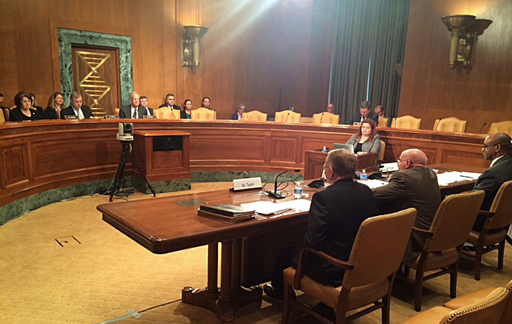
Sen. Dianne Feinstein, D-Calif., Senate Agriculture Appropriations Subcommittee ranking member Jeff Merkely, D-Ore., and Senate Agriculture Appropriations Subcommittee Chairman Jerry Moran, R-Kan., listen to testimony from Food and Drug Administration officials on the Food Safety Modernization Act today. (Jerry Hagstrom/The Hagstrom Report)
Senate Agriculture Appropriations Subcommittee Chairman Jerry Moran, R-Kan., said today that if congressional budget caps are raised he favors more funding for the Food and Drug Administration to implement the Food Safety Modernization Act.
And at a hearing Moran chaired, FDA officials said lack of funding would make it difficult to make foreign foods as safe as U.S. foods and to create a level playing field between U.S. and foreign producers.
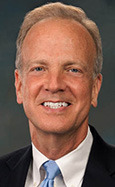
Moran said during the hearing and in conversation with reporters afterward that he considers more funding for the FDA to be “a top priority” in order to assure food safety. He told reporters he had become more interested in the food safety issue since he became chairman of the subcommittee and because it affects so many people.
Under FSMA, FDA is supposed to switch from solving food safety problems when they occur to preventing them, and Moran said he has developed a “level of faith” that the FDA team wants to “foster compliance” rather than emphasizing “penalizing offenders.”
But he also warned that often for regulators “the joy of penalizing becomes too great.”
Moran pointed out at the hearing that FDA has gotten 8 percent more for its food operations, including 4 percent more for FSMA implementation in the last five years, while other programs under the subcommittee’s jurisdiction have remained flat or been cut. Those increases have been smaller than President Barack Obama’s budget requests, however.
FDA Acting Commissioner Stephen Ostroff and FDA Food Commissioner Michael Taylor said that implementing the foreign supplier verification system under FSMA will be one of the hardest sections of the law to implement.

“There is no good outcome for partial funding,” Taylor said, adding that the agency needs the money in fiscal 2016 when implementation begins.
But Taylor noted that implementing foreign verification will be one of the most complicated parts of FSMA.
The law makes U.S.-based importers “legally responsible” for food safety on imported products, he said.
But Taylor added that implementing the verification system for imported food will be more difficult than implementing the domestic provisions because FDA already has a domestic food inspection system but will have to reach agreements with foreign countries for the verification of food safety in those countries and then check those agreements.
Educating the 88,000 food importers about their responsibilities will also take resources, Taylor said.
The FDA must go through the complicated process of establishing relationships with foreign governments in order to be assured that food produced in those countries is inspected properly, Taylor said, because “There’s no amount of foreign inspection that Congress will ever pay for us to do.”
FDA must achieve relationships with foreign governments in order to assure the safety of imported food, he added.
Taylor also said that FDA needs to hire employees to audit the food safety inspection systems in foreign countries.
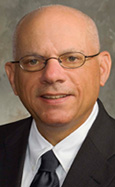
In more general testimony, Ostroff said that incidences of food-borne illness has remained unchanged, but said that with FSMA the government has the “tool” to improve food safety.
He testified that assuring food safety has become more complex than when the FDA was established in 1906 because “we now have a vast, complex and global food system in which changing technology, changing consumer preferences and behavior, and supply chains that extend around the world make food safety a bigger challenge than ever before.”
“We also have seen rapid expansion in the local food movement with may small-scale growers and processors coming into the market in response to consumer demand for locally and sustainably grown food,” Ostroff said.
He said FDA would “work with the regulated industry,” but added, “That does not mean we won’t use the stick when we need to use the stick.”
The guidance for the animal and human food rule will be “almost an operating manual,” Taylor said. The guidance will come out early next year “well ahead” of compliance requirements, he added.
Moran also asked the officials to detail how they had spent the additional money they had been given in the last five years.
Taylor noted that FDA had increased the capacity of the technical staff at the Center for Food Safety and Applied Nutrition. He said FDA has also begun to increase its presence overseas.
But he also noted that the law does not allow FDA to develop farm-to-table traceability.
Taylor added that FDA has been an enforcement agency, but its employees are public health professionals who are shifting to a culture of preventing food-borne illness.
Ostroff and Taylor said FSMA will not allow FDA to operate with fewer people, but will require many current employees to be “redeployed.”
Moran said he is “not opposed to strong enforcement” because Kansas farmers and ranchers “cannot afford” the public’s unwillingness to buy certain foods when rumors indicate that they may be unsafe.
