Obama presents Humanities medals to Waters, McMurtry, Fly and Ruiz
September 11, 2015 |02:26 PM
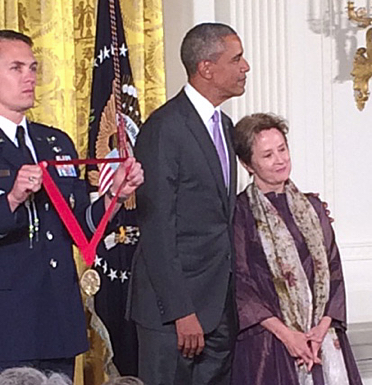
President Barack Obama introduces National Humanities Medal winner Alice Waters. (Jerry Hagstrom/The Hagstrom Report)
President Barack Obama presented the National Humanities Medal on Thursday to four people important to agriculture, food and rural America:
- Alice Waters, the Berkeley, Calif. chef and restaurant owner who started the school garden movement now known as The Edible Schoolyard Project
- Larry McMurtry, author of stories of the American West, including “Lonesome Dove” and the screenplay of “Brokeback Mountain”
- Everett Fly, a San Antonio, Texas, landscape architect who has brought attention to long-forgotten small black towns and neighborhoods across the country
- Isabel Ruiz, a California scholar who has chronicled the lives of immigrant women cannery workers.
Obama started off the ceremony for all 21 recipients of the National Medal of Arts and National Humanities Medal by noting, “I always do pretty good with writers and scientists. That’s sort of my crew.”
“One of our great poets, Emily Dickinson, once said that ‘truth is such a rare thing, it is delightful to tell it.’ The truth is so rare, it is delightful to tell it — and that’s especially true in Washington.
“The men and women that we honor today, recipients of the national medals for the arts and the humanities, are here not only because they’ve shared rare truths, often about their own experience, but because they’ve told rare truths about the common experiences that we have as Americans and as human beings.
“They span mediums and methods,” he said. “We have artists, actors, writers, musicians, historians, a landscape architect, and a chef. Without them there would be no Edible Schoolyard, no Jhumpa Lahiri novels, no really scary things like ‘Carrie’ and ‘Misery.’ ”
Obama said the recipients all have one thing in common: “They do what they do because of some urgent inner force, some need to express the truth that they experience, that ‘rare truth.’ And as a result, they help us understand ourselves in ways that we might not otherwise recognize. They deepen and broaden our great American story and the human story.”
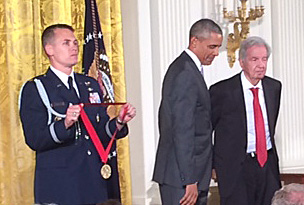
President Barack Obama with National Humanities Medal winner Larry McMurtry. (Jerry Hagstrom/The Hagstrom Report)
“So we celebrate writers like Larry McMurtry, who grew up on a Texas ranch without books but went on to pen a multitude of memoirs and essays, more than 30 novels, and co-wrote screenplays for films like ‘Brokeback Mountain.’
"He wrote about the Texas he knew from his own life, and then the old West as he heard it through the stories of his grandfather’s — on his grandfather’s porch. And in ‘Lonesome Dove,’ the story of two ex-Texas Rangers in the 19th century, readers found out something essential about their own souls, even if they’d never been out West or been on a ranch.”
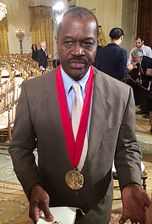
Everett Fly speaks to reporters after the event. (Jerry Hagstrom/The Hagstrom Report)
“We celebrate historians like Everett Fly, who studied to become both a building and landscape architect, and who got his start studying forgotten African American towns and communities.
"Deep in the stacks of the National Archives, he encountered a map of a freedman’s village that is now Arlington National Cemetery, which inspired him to research further."
“ 'Once I got to the National Archives and saw all of those records,' ” Everett says, 'I knew I just had to keep on working.' And because he kept on working, we have come to know some 1,300 African American and Native American towns and structures across our country."
At the end of the ceremony, Obama said he had gotten “promises for at least a couple signed books and added, “I think Alice said she’s going to cook me something. Nothing unethical.”
Waters, whose Chez Panisse restaurant in Berkeley, Calif., is well known, and McMurtry, who runs a book store in Archer, Texas, as well as continuing to write, did not give interviews after the event, but others did.
Fly, who studied at the Harvard Graduate School of Design, said he had begun his work as a broad survey of black settlements, and received a National Endowment for the Humanities grant in 1980 to do travel and research.
“Some towns had been abandoned or destroyed and some still existed,” he said.
That study has resulted in an architectural practice focused on the communities that want to preserve the communities or note their existence.
He has also worked for the National Park Service, which declared Nicodemus, Kan., a town to which formerly enslaved African Americans were encouraged to move after the Civil War. Nicodemus is the oldest and only remaining black settlement west of the Mississippi River.
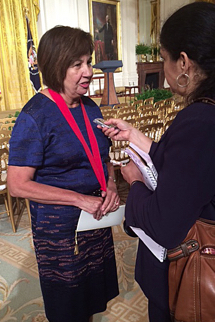
Vicki Lynn Ruiz is interviewed after the medal ceremony. (Jerry Hagstrom/The Hagstrom Report)
Ruiz, who got her doctorate from Stanford, said that her work on Hispanic-American life began when she was a graduate student on a trip to Mexico.
There she met a woman named Luisa Moreno, who had organized the United Cannery, Agricultural, Packing, and Allied Workers of America in the 1930s in Southern California. That resulted in her book, "Cannery Women, Cannery Lives."
“The public perception, unfortunately, is that Latinas arrived [in the United States] the day before yesterday,” she said. “It is important that we don’t have historical amnesia.
The medals are administered by The National Endowment for the Arts and the National Endowment for the Humanities, which were established in 1965 as independent federal agencies.
Obama noted that when President Lyndon Johnson signed the bill creating the NEA and NEG 50 years ago this month, he said “In countless American towns there live thousands of obscure and unknown talents. What this bill really does it to bring active support to this great national asset.”
NEA supports artistic excellence, creativity and innovation that benefit of individuals and communities. NEH focuses on humanities research, public programs, education, and preservation projects.
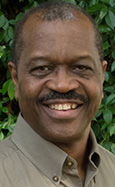

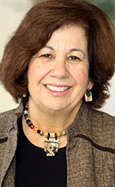
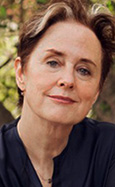
From left: Everett Fly, Larry McMurtry, Vicki Lynn Ruiz, Alice Waters
Official citations
A military aide read the official citations for all the recipients of the National Humanities Medal and the National Arts Medal. Here are the citations for Fly, McMurtry, Ruiz and Waters.
Everett L. Fly — The 2014 National Humanities Medal to Everett L. Fly for preserving the integrity of African American places and landmarks. A landscape architect, Mr. Fly has worked tirelessly to win historical recognition for Eatonville, Fla., Nicodemus, Kan., and other sites central to African American history, preserving an important part of our broader American heritage.
Larry McMurtry — The 2014 National Humanities Medal to Larry McMurtry for his books, essays, and screenplays. Mr. McMurtry’s work evokes the character and drama of the American West with stories that examine quintessentially American lives.
Vicki Lynn Ruiz — The 2014 National Humanities Medal to Vicki Lynn Ruiz for her contributions as a historian. In monographs and edited volumes, Dr. Ruiz has pioneered the history of 20th-century Latinas in a distinguished career that began with collecting oral testimony from Mexicana and Mexican American women who worked in U.S. canning factories.
Alice Waters — The 2014 National Humanities Medal to Alice Waters for celebrating the bonds between the ethical and the edible. As a chef, author and advocate, Ms. Waters champions a holistic approach to eating and health, and celebrates integrating gardening, cooking and education, sparking inspiration in a new generation.
— Everett L. Fly
— National Park Service — Nicodemus
— Simon & Schuster — Larry McMurtry
— Booked Up, Inc.
— University of California, Irvine — Vicki Lynn Ruiz
— “Cannery Women, Cannery Lives: Mexican Women, Unionization, and the California Food Processing Industry, 1930-1950”
— Chez Panisse
— The Edible Schoolyard Project
