Vilsack praises Clinton, reveals more personal history
August 26, 2015 |11:15 PM
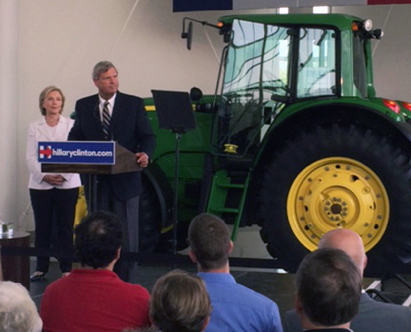
Agriculture Secretary Tom Vilsack, a former governor of Iowa, introduces Hillary Clinton at the Democratic presidential candidate’s campaign event today at the FFA Enrichment Center at Des Moines Area Community College. (Jerry Hagstrom/The Hagstrom Report)
ANKENY, Iowa — Did Agriculture Tom Vilsack praise Hillary Clinton enough and reveal enough about himself today to win serious consideration as her running mate if she gets the Democratic nomination?
Or did his enthusiastic introduction simply reflect a long professional and personal history with Clinton?
These seemed to be the questions of the day in Iowa as Vilsack introduced Clinton here during a day devoted to her agricultural and rural agenda.
“Hillary Clinton is a listener,” Vilsack said, as he introduced the Democratic front-runner at the FFA Enrichment Center at the Des Moines Area Community College.
When Clinton traveled around Iowa, Vilsack noted, she heard that Iowans are concerned about substance abuse and incorporated that into her rural agenda.
Vilsack, who has revealed before that he was adopted from an orphanage in Pennsylvania and that his adoptive mother suffered from alcohol and drug addiction, said that at one point he was separated from his mother and lived with his father. His mother later recovered, he noted.
“I personally know the pain of addiction,” Vilsack said. “I like the fact that I have a presidential candidate who listens.”
He noted that in his last conversation with his father before he died, he announced he had been admitted to law school, and his father said he didn’t know how he would pay for it.
Vilsack said his father had sold everything to put him through undergraduate college. Only Social Security, veterans benefits and student loans “allowed me to have a career in law” and come to Iowa [his wife’s home state] and practice, he said.
Noting that Clinton has made college accessibility and relief from student debt issues in her campaign, Vilsack said, “I like the fact she understands the importance of education. I like the idea that my presidential candidate has a plan to open that door, who believes today it is shut.”
Seeming to address questions about whether Clinton’s wealth from speaking engagements and books combined with her husband’s has made her remote from the average person, Vilsack said, “She grew up in the middle class, she has never left the middle class in terms of her values and concerns, understanding the critical importance to the country.”
“She is the first presidential candidate that I know who will speak to the specific needs of rural America. Today she’ll lay out a plan to improve opportunities,” he said.
Clinton’s toughness
Vilsack then shifted to Clinton’s prospects to win a general election, and seemed to be addressing concerns that a female candidate might not be tough enough.
“It is important to invest in rural America, but you can have the greatest ideas in the world but you have to get elected,” he said.
“I know something about that — it takes toughness,” he said. “I know no one who is more tested.”
In a thinly veiled reference to the controversy about Clinton’s handling of emails while secretary of State, he said. “You don’t have to worry about whether she is tough enough to handle trumped up charges.
“That is with a small ‘t’,” he said, making a reference to Republican hopeful Donald Trump. “Or negative ads, she knows what is takes. She is the best candidate to win this election.”
Vilsack also said that a president has to inspire and to deliver and that Clinton can do that.
“Even if you win, the president has to do two really important things, she has to inspire and she has to deliver,” he said.
“Ask hundreds of thousands and millions who were inspired by her words all over the world,” he said, noting that 12 million children are being fed due to the Feed the Future program that the Obama administration established while Clinton was secretary of state, Vilsack said.
Under her guidance, the U.S. Agency for International Development reached out to developing countries not only to expand farm production, but to “make sure farm families are well fed,” he said.
Personal connections
Vilsack also revealed personal connections with Clinton that go back decades.
He recalled that as he drove up to today’s event, he thought of the number of children who got health insurance while he was governor of Iowa — apparently his proudest accomplishment when he led the state between 1999 through 2006.
Vilsack said he might never have become governor if Hillary Clinton, then first lady, did not participate in a fundraising event for him in Washington in 1998.
Noting that he was way behind in the polls when the event took place, Vilsack said Clinton “did not have to do that” and she did not “have to realize” that if the campaign “turned around,” it would need the money to gets its message out.
Clinton also came to Iowa the weekend before the election and “did a get-out-the-vote rally that allowed me to be the first [Democratic] governor elected in 30 years.”
Vilsack said he believes Clinton went all-out for him because “she is incredibly loyal.” He also noted that her connections to his family go back to her work on the congressional committee dealing with the Watergate scandal when she worked with Tom Bell, the brother of his wife, Christie.
“If she is that loyal to Tom Bell and to Christie, think how loyal she will be to all of you,” Vilsack said. “She will fight for the middle class, to expand health care services, to expand economic opportunity.”
“I am here today because when I got elected governor I went to the White House and sat with Bill Clinton and he said “never forget the folks who got you there.”
“Hillary, I have not forgotten. This is a woman who will listen to us, who will fight for us, make sure.”
As she began her speech, Clinton responded:
“I think you can tell by the reception that your former governor just received how highly regarded you are, Tom, for the work that you did here in Iowa, and I would add for the work that you are now doing around the country. Talk about somebody who studies a problem, asks for advice about what will work, puts together teams, collaborates, and then delivers: he is exhibit A.”
“What I’m about to talk about, the agenda that I am putting forth for rural America, is very much in line with what Tom did here in Iowa and what he is doing at the Department of Agriculture. And I am honored to have his friendship and his support in this campaign.”
