Kerry re-opens U.S. embassy in Havana
August 14, 2015 |12:03 PM
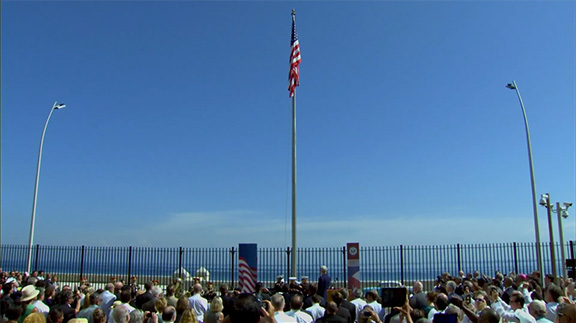
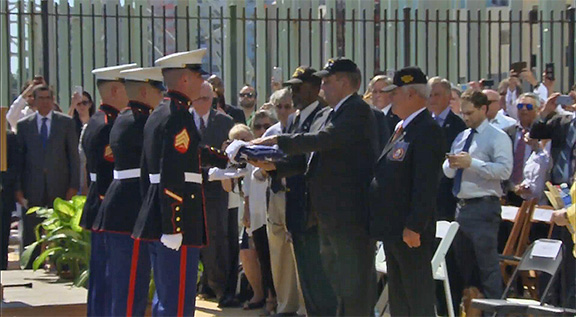
The American flag flies over the U.S. embassy in Havana this morning for the first time in 54 years. Below, three retired U.S. Marines who lowered the flag when the embassy closed in 1961 hand the flag to a team of Marines who raised it today. (From State Department video)
Three retired U.S. Marines who lowered the flag when the embassy closed in 1961 handed the flag to the team of Marines who raised it.
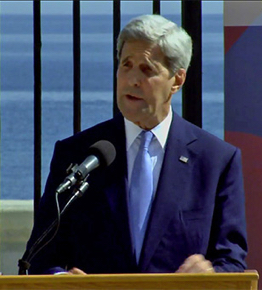
In his speech, Kerry noted that the U.S. embargo on trade with Cuba remains in place and that only Congress can lift it. U.S. agricultural and food products are exempted from the embargo, but farm groups have noted that there would be more demand for food if the embargo is lifted and economic activity increases.
Sen. Amy Klobuchar, D-Minn., who was in the delegation accompanying Kerry and who has introduced a bill to end the embargo, said in a news release today, “Everywhere I go in Cuba — from art stands to store fronts — I see one date: Dec. 17, 2014 — the day our two countries agreed to start opening up relations.”
“It’s just another day on the calendar for most Americans, but for Cubans, that day — and the hope it has inspired — is one they will always remember.
“Today, August 14, 2015, will now take on even greater historic significance,” Klobuchar said. “Raising the American flag outside the U.S. Embassy in Cuba represents a new era of relations between our two countries and it was an honor to see it firsthand. Now it is time to continue moving forward by passing my bipartisan bill to lift the embargo, boost U.S. exports, and allow Cubans greater access to American goods.”
Sen. Jeff Flake, R-Ariz., who also traveled with Kerry, said in a statement, “The United States will be able to do much more to protect and serve U.S. citizens in Cuba and encourage a better future for the Cuban people with an American flag flying over our embassy in Havana. More specifically, I hope this move will hasten the end of U.S. imposed restrictions on Americans traveling to the island. The more U.S. travel to Cuba, the better.”
Senate Agriculture Committee ranking member Debbie Stabenow, D-Mich., noted in a news release that she had visited Cuba twice, and applauded Kerry for going to Cuba for the ceremony.
“The commitment to democratic ideas and human rights that we share as Americans are best realized through engagement and our embassies represent a visible reminder of those principles. We must continue moving forward with our new policy on Cuba. That includes ending the trade embargo which would create new economic opportunities for U.S. exporters and businesses,” she said.
John Kavulich, president of the U.S. Cuba Trade and Economic Council, cautioned in a statement that companies seeking to do business in Cuba “should use the Embassy of Republic of Cuba in Washington, D.C., the Embassy of the United States in Havana, and many no-cost, often internet-based information providers” and avoid the use of consultants who may be “two-bit hustlers.”
“The government of the Republic of Cuba does not encourage the use of consultants; there is a preference to manage relationships directly, absent of ‘third-party interference’” said Kavulich, whose group has worked on liberalizing economic relations with Cuba for decades.
Kavulich, whose analyses show that U.S. agricultural exports to Cuba are down 37 percent from last year, said “There remains an unhealthy, irrational, destructive and unreasonable expectation by executives of United States companies as to what is commercially permitted and prohibited — both by the United States and by the Republic of Cuba; what changes (expansions) can reasonably be expected by the Obama administration during its remaining months; and what the Republic of Cuba will permit in terms of the initiatives announced by President Obama in December 2014 and its own (removal of the dual currency, for example).”
“There is no sustained good from ratcheting expectations to an extreme whereby the Republic of Cuba will have so little likelihood to develop a pathway, implement a pathway and then maintain a pathway…. that the result will be to implant an unfair view of the country as forever unwilling and unable to engage,” Kavulich said.
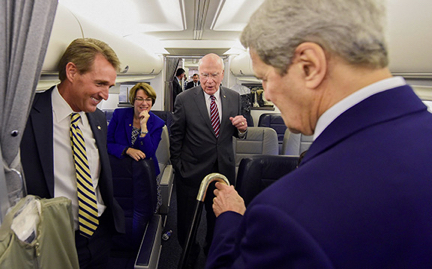
Secretary of State John Kerry, right, still recovering from a broken leg, shows Sens. Jeff Flake, R-Ariz., Amy Klobuchar, D-Minn., and Patrick Leahy, D-Vt., a cane once used by the late Sen. Edward M. Kennedy before the group departed from Andrews Air Force Base this morning for Cuba to preside over a flag-raising ceremony at the U.S. Embassy and engage in a series of diplomatic meetings. (State Department)
