Experts: Consumers much more concerned about HFCS and GMOs than sugar
August 04, 2015 |07:02 PM
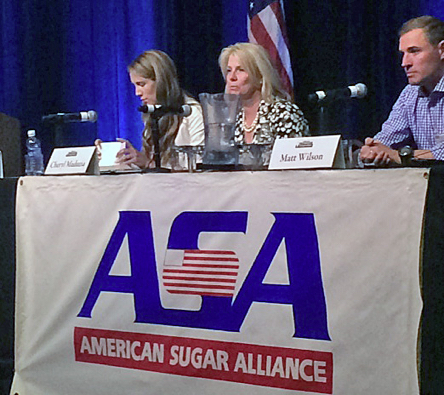 From left, Courtney Gaine, vice president of scientific affairs for the Sugar Association, Cheryl Maduzia, vice president of Acosta, and Matt Wilson, manager of global consumer insight for General Mills, discuss consumer behavior and government regulations at the American Sugar Alliance meeting today. (Jerry Hagstrom/The Hagstrom Report)
SANTA ANA PUEBLO, N.M. — Concern about “wellness” is leading consumers to take some steps to avoid sugar consumption, but they are trying much harder to avoid artificial sweeteners, high-fructose corn syrup and genetically modified organisms, food industry executives said here today at the American Sugar Alliance’s International Sweetener Symposium.
Wellness has moved from being a trend to being the standard by which consumers make their food choices, Matt Wilson, manager of global consumer insight for General Mills, said during a panel discussion.
“We’re witnessing a wellness trend in food that’s dominating the consumer conversation, with an awareness and concern over sugar consumption growing,” said Wilson, who noted that he follows “headwinds and tailwinds” for the entire company and advises, but does not report to. the divisions that make the many General Mills branded products.
Wilson’s presentation showed that while 11 percent of consumers are making “a major effort” to avoid sugar, higher percentages of consumers are making “a major effort” to avoid other products: 26 percent for artificial sweeteners, 24 percent for high-fructose corn syrup and 21 percent for genetically modified organisms.
Both Wilson and Cheryl Maduzia, vice president of research for the Acosta Sales and Marketing Company, said consumers want to eat “real food.”
The long-term cost efficiencies in food manufacturing no longer apply as consumers seek more natural and organic foods, Maduzia said. In addition, more and more consumers are buying food through e-commerce.
“This is eating like 1941 — they want fresh food, minimally processed,” Wilson said, adding that awareness of GMOs is rising.
Consumers eating “real food” are less concerned with calories, Wilson said.
Addressing how sugar “fits into the wellness space,” Wilson said people are “subjective” about sugar. They are concerned about their daily intake, but for some it also has a “health halo” unless it is made in a laboratory.
“While there’s an increasing interest in natural sweeteners that overlaps with this wellness trend, indulgence is not declining,” Wilson said. “Having a few indulgence snacks throughout the week is part of a happy life.”
The experts noted that consumers get a lot of information, and the government’s new dietary guidelines and package labeling will be coming next.
But as Maduzia noted, everyone in the food business needs “to understand the consumer is king.”
Courtney Gaine, vice president of scientific affairs for the Sugar Association, who chaired the panel, said that she believes the Food and Drug Administration’s proposal to set a daily value for “added sugars” lacks scientific justification.
The consumer concerns are providing momentum behind changing government policies, Gaine said.
“What’s concerning is that the U.S. dietary policies for sugar that are on the table right now are not evidence-based, but rather are emotions-based,” she concluded.
