Vilsack tells entrepreneurs to work with farmers
July 29, 2015 |06:58 PM
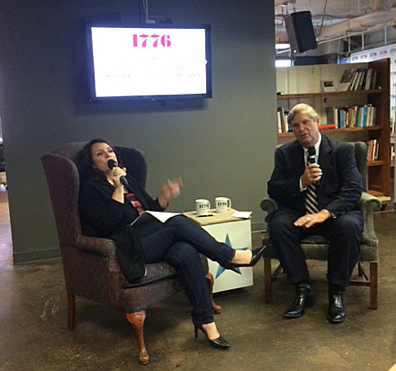
Donna Harris, cofounder and co-CEO of 1776, a venture capital fund started by Microsoft and other companies and universities, interviews Agriculture Secretary Tom Vilsack today at the 1776 office in Washington. (Jerry Hagstrom/The Hagstrom Report)
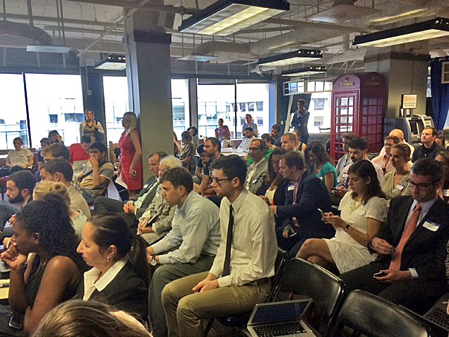
A crowd listens to Agriculture Secretary Tom Vilsack speak on "food innovation” at the 1776 office in Washington. (Jerry Hagstrom/The Hagstrom Report)
Budding entrepreneurs should “work with farmers” to solve problems in agriculture rather than criticizing them, Agriculture Secretary Tom Vilsack told a mostly youthful audience today at an innovation lab in Washington.
He was interviewed by Donna Harris, the cofounder and co-CEO of 1776, a venture capital fund started by Harris and Evan Burfield to encourage entrepreneurship worldwide in fields in which government is involved.
The 1776 office is on the 12th floor of an office building on 15th Street in downtown Washington, but is structured as a large open space and has been decorated to make it look like a warehouse.
Vilsack’s hour-long talk was billed as “Food Innovation: A Chat with Tom Vilsack, Agriculture Secretary.” Members of the audience submitted questions on cards.
“I want the folks who are here who are not farmers to understand what it is like to be a farmer,” Vilsack said.
Farmers, he said, love the land, are devoted to what they do, wake up thinking they are good stewards and then pick up the newspaper and read criticisms or concerns about them and “feel a bit underappreciated.”
He asked the group to help farmers develop ways to feed the world and treat animals humanely.
Harris asked Vilsack if farm subsidies could be justified when there is so much food waste. Noting that large portions are one of the issues in food waste, he said when he was flying through Chicago he had been served bread he didn’t want. He also said people need to understand that they can use food longer than the “sell by” dates companies put on labels.
Vilsack said that his wife recently made him chicken salad before she left on a work trip, and that he wondered some days later whether it was still safe to eat. He said he looked up chicken salad on USDA’s app, and found that cooked chicken could be kept for several days.
He also questioned whether the term “farm subsidies” is correct, and said a farm safety net is necessary in order to make sure there is a domestic food supply.
A really good baseball hitter fails seven times and gets paid millions, Vilsack said, but if there’s a hail storm, not enough rain or a pest comes in from somewhere else, the farmer doesn’t get paid, he noted.
“It is a risky business,” Vilsack said, and the crop insurance “relationship” with farmers is needed “so we can continue to enjoy the security of being a food-secure nation.”
Americans talk about the overdependence on foreign oil, “but we never talk about the overdependence we have on other countries for food, because we don’t have an overdependence,” Vilsack said.
The purpose of a risk management system, he added, is to keep farmers in business.
Harris said she got many questions from the audience about his views on genetic modification. Vilsack said that asking him to choose between genetically modified foods and organic foods would be like asking him to decide which of his two sons he loved best.
“I love them both equally,” Vilsack said.
But he pointed out that Michael Dykes of Monsanto was in the audience, and said he believes that the companies that developed GMO seeds “did not do the best job of marketing.” Dykes nodded in agreement.
Vilsack said he believes the best way to inform consumers of whether GMOs are in a product would be through the kind of app that 90 food companies led by Hershey are working on to list all ingredients and other information.
Vilsack also said he hopes entrepreneurs can come up with ways to address global food security, food waste and revive the rural economy.
Answering questions from Harris and the audience, Vilsack said:
- The U.S. Forest Service is encouraging the construction of multistory wooden buildings that are more fire resistant in the past.
- A Pittsburgh grocery store is taking vegetables that are too old to market, extracting water from them, and using the energy to start an urban farm.
- The regulatory system may look different in the future because it may set standards and publicize the levels to which companies are complying, and leave it up the marketplace to decide with whom to do business. He gave an example of the salmonella level in chicken, and said companies such as Costco could decide which companies to buy from.
- GPS systems can provide greater efficiency because studies have shown that farmers may think they are driving straight, but they may be 30 feet off.
- Entrepreneurs should understand the Federal Register because “There is a gold mine of opportunity there.”
- USDA is helping urban farmers with microloans up to $50,000.
- Entrepreneurs should link up with land-grant colleges and USDA state Rural Development offices if they have ideas that could address agricultural problems.
