Historically black land-grant schools commemorate second Morrill Act of 1890
July 17, 2015 |04:31 PM
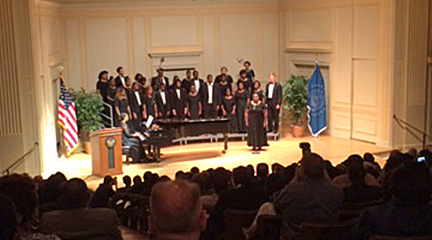 The University of Maryland Eastern Shore Concert Choir performs at the Library of Congress Thursday at the commemoration of the 125th anniversary of second Morrill Act, which created the historically black land-grant colleges and universities. (Jerry Hagstrom/The Hagstrom Report)
The 125th anniversary of the signing of the second Morrill Act, which created the historically black land-grant educational institutions, was commemorated on Thursday with a program at the Library of Congress attended by the presidents of the universities.
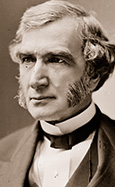
The program noted that Rep. Justin Smith Morrill, R-Vt., introduced the first Morrill Act to create land-grant colleges in 1862, and after being elected to the Senate, sponsored the second Morrill Act in 1890 so that former slaves in the Confederate states would have an opportunity to get an education.
“Through 125 years of history, having overcome barriers to their very existence, the 1890 land-grant institutions have not merely persevered but have excelled in the provision of outstanding research, education, and partnerships that are helping to sustain our country and our world,” Agriculture Secretary Tom Vilsack wrote in a letter published in the program.
Vilsack also spoke at the event, and announced that USDA is making a $1 million initial investment to support three virtual Centers of Excellence with the Council of 1890 Colleges.
“When Congress passed the act in 1890 creating additional land-grant universities, they were creating access to economic mobility through educational opportunity for all,” he said. “These schools have been instrumental in growing our nation into a multicultural economic power.”
“The three new Centers of Excellence will build on this legacy of cooperation and success to help sustain our nation for the next 125 years and beyond.”
Vilsack said the centers will increase coordination and collaboration between USDA and the 1890s schools. One center will focus on small farms, ranches and forest landowners in high poverty areas. A second will support science, technology, engineering, agriculture and mathematics students. A third will focus on global food security.
He also noted that USDA provided more than $132 million in funding to 1890s schools through 350 different awards last year and is assisting 55 scholars from the 1890s schools in agencies throughout USDA with scholarships worth approximately $35,000 each.
More than 600 land-grant university graduates are employed at USDA, he added.

Audrey Rowe, the administrator the Food and Nutrition Service, noted in her speech at the commemoration that the event was especially meaningful to her because she had received “a quality education studying under some of our leading social justice advocates and educators of the ’60s and ’70s” at Federal City College, an historically black land-grant institution which is now part of the University of the District of Columbia.
“My experience at FCC led me to a professional career focused on improving the quality of life for poor and low-income children and families,” Rowe said.
She noted several universities participate in USDA research programs and that USDA needs more research on strategies to encourage participants in the Supplemental Nutrition Assistance Program to make healthier food choices.
“Together we can meet the challenges of hunger and obesity,” Rowe said.
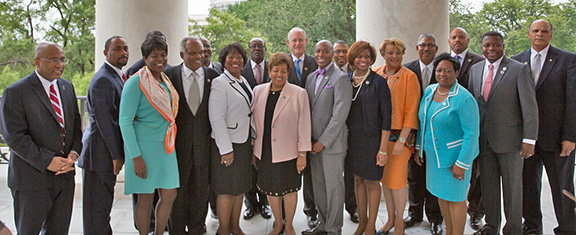 House Agriculture Committee Chairman Michael Conaway, R-Texas, center, with guests at the recognition of the 125th anniversary of the 1890 land-grant universities. (House Agriculture Committee)