River lock projects seen as crucial to corn, soybean farmers
July 14, 2015 |01:26 PM
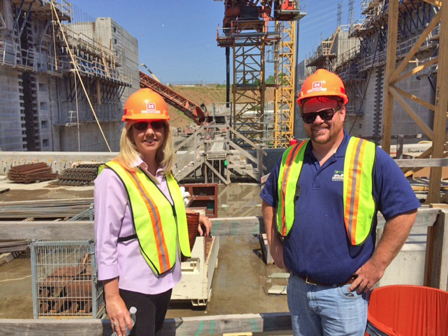 Laura Knoth of the Kentucky Corn Growers Association and Brent Burchett of the Kentucky Soybean Board view the modernization of the Kentucky Lock near Paducah. (Jerry Hagstrom/The Hagstrom Report)
PADUCAH, Ky. — When farmers in this part of the country want to get a sense of the great public works that the government can build and at the same time get mad as hell over Congress’ current dysfunction, all they have to do is drive a few miles to look at the Kentucky Lock or the Chickamauga Lock in nearby Tennessee.
The sight of the Art Moderne architecture of the locks is a testament to the pride that President Franklin Roosevelt’s New Deal administration took in constructing them in the 1940s as part of the Tennessee Valley Authority project to reduce flooding and improve navigation. What has been described as a stairway of nine dams and locks turned the Tennessee River into a 652-mile long river highway that has allowed corn and soybean farmers to get inputs and transport their products to market for generations.
But now the locks need to be updated, and the farm leaders say Congress and the U.S. Army Corps need to get that job done as fast as possible or the United States will lose its agricultural competitiveness.
“About 60 percent of U.S. soybean exports pass through Mississippi River ports,” said Brent Burchett, the program director of the Kentucky Soybean Promotion Board during a tour of the locks for journalists sponsored by the Waterways Council Inc.
“We are in direct competition with Brazil for global soybean customers, and thanks largely to our efficient inland waterways transportation network, we can overcome our cost disadvantages on labor, land, and regulatory compliance,” Burchett said.
Today when farmers go near the locks they see crumbling concrete and structures that do not raise and lower barges as efficiently as they should. Moving the barges through the locks is already slower than it used to be, and there are fears they could break down.

Even though maintenance and modernization of locks and dams would seem logical, infrastructure improvements have been deferred for decades, as environmentalists questioned the very idea of interfering with natural water flows and taxpayer groups questioned spending the money.
In 2014 Congress passed the Water Resources Reform and Development Act, which farm leaders have described as the most important bill passed in that session after the farm bill.
WRRDA set up cost-share formulas for the modernization of the locks and dams. A tax bill the same year included a 9 cent increase in the 20 cents per gallon of diesel “user fee” that barge owners pay into the fund.
Now the issues are getting the U.S. Army Corps of Engineers to release already available funds and convincing Congress to appropriate money for fiscal year 2016 and beyond.
On the tour, Kentucky soybean and corn leaders said modernizing the locks is vital for U.S. competitiveness, and they are pushing hard for the Army Corps and Congress to make decisions.
“When our farmers host international soybean buyers at their farms, the buyers say timely, predictable delivery can be just as important as price. A failure at any of the locks along this system could cost U.S. soybean farmers up to $45 million in lost revenue,” said Burchett.
“One-third of the corn produced by Kentucky farmers is destined for export through New Orleans,” added Laura Knoth, executive director of the Kentucky Corn Growers Association and the Kentucky Small Grain Growers Association.
“Every delay that occurs at an inefficient or unreliable facility, even if it’s hundreds of miles from New Orleans, compromises our ability to deliver on the promises made to foreign customers,” Knoth said. “The world sees our failing infrastructure, and our competitors are capitalizing on it.”
“Our grain can lock through as many as eight facilities before it departs Kentucky’s waterways,” Knoth added. “That is eight opportunities for that cargo to stop because of a failure or be delayed because of an outdated, inefficient facility.”
Sen. Lamar Alexander, R-Tenn., who chairs the energy and water subcommittee of the Senate Appropriations Committee, and Rep. Chuck Fleischmann, R-Tenn., have expressed intense frustration at the Army Corps’ slowness in committing money for the project.
At what is known locally as the “Chick lock,” concrete has expanded and become less safe because of the type of material used in its construction 75 years ago.
In late June the Army Corps released $3 million to allow construction work to begin on the Chick lock this year. It’s a small amount of the total needed, but the decision gave Alexander, Fleischmann and waterways and farm leaders hope that future funding will be more consistent.
“The funding will be used for prep work so that the Corps can begin replacing the lock, which is important not just to Chattanooga, but to all of East Tennessee because of the number of jobs affected,” Alexander told the Times Press.
“If Chickamauga Lock were to fail it would throw 150,000 trucks on I-75 and increase the cost of shipping goods for Oak Ridge, Y-12, and manufacturers across the state.”

Fleischmann told reporters during the tour that since Congress passed WRRDA he has been optimistic but “vigilant” about funding for the locks.
Meanwhile at the 1945-era Kentucky Lock, the lowermost lock on the Tennessee River and the gateway for the 12 locks located upstream on the Tennessee and Cumberland rivers, construction has already started on an addition that will allow larger vessels to travel through the lock in a timely fashion.
The existing Kentucky Lock is 600 feet long, and since most of the tows carrying products from 20 states are longer than that, they must perform a time-consuming double lockage that takes four to six hours to transit. The new lock will be 1,200 feet.
Construction on the addition to the lock has been continuous since it began in 1998, and it even got $58 million under the American Recovery and Reinvestment Act of 2009 to complete lock design and undertake construction work. The original completion date was set for 2007, officials said, but has now been set for 2023 because funding and work have been in fits and starts.
For now, the action on the locks and dams is in the appropriations process. The Waterways Council and its farm allies have praised both the fiscal year 2016 House and Senate Energy and Water Development appropriations bills, but the lobbyists worry that Congress’ inability to finalize appropriations bills could put the funding in jeopardy.
In June the groups also sent the appropriators a letter asking them to fund the Navigation and Ecosystem Sustainability Program, which allows the Army Corps to integrate commercial navigation with ecosystem management.
Both the farm and waterways groups are also waiting for the Army Corps to send Congress a report on its priority projects, a system that is supposed to allow for local input while not requiring Congress to go back to the earmark system. Once a project is on the list it can be specified in appropriations bills, but the Army Corps is late in completing the list.

Waterways Council President Michael Toohey is optimistic about the trend in government action.
“The allocation of $3 million to Chickamauga Lock from fiscal year 2015 discretionary construction funds, and the full utilization of Inland Waterways Trust Fund resources contained in both the House and Senate fiscal year 2016 Energy and Water Appropriations bills, demonstrates the landmark impact of WRRDA 2014,” Toohey told The Hagstrom Report in an email Monday.
“While Congress struggles with the annual appropriations process, WCI remains confident that a bipartisan agreement will be reached to continue the record levels of investment in modernizing our inland waterways transportation system,” he added.
The Chickamauga and the Kentucky locks are not the only ones important to farmers, of course. One of the most important elements in WRRDA was to change the cost-share formula for the Olmsted Locks and Dam project between Illinois and Kentucky from the usual 50-50 public-private split to an 85-15 division. The need to fund the massive Olmsted project had interfered with other lock and dam projects for years.
Mike Steenhoek, executive director of the Soy Transportation Coalition, said in an email that “the segments of the inland waterway system that are most consequential to the movement of soybeans and corn are the Upper Mississippi River, the Illinois River, and the Ohio River. These three segments all funnel into the lower Mississippi River from St. Louis to the Gulf of Mexico.”
Steenhoeck said that “58 percent of soybean exports and 67 percent of corn exports depart from the Gulf of Mexico port region — by far the largest port region for the two commodities. As a result, agricultural groups have historically, and continue to, focus on locks and dams along the above three segments.”
- Waterways Council letters to Senate and House Appropriations Committees
- U.S. Army Corps of Engineers — Chickamauga Lock Addition Project
- — Fact Sheet
- — Kentucky Lock Addition Project
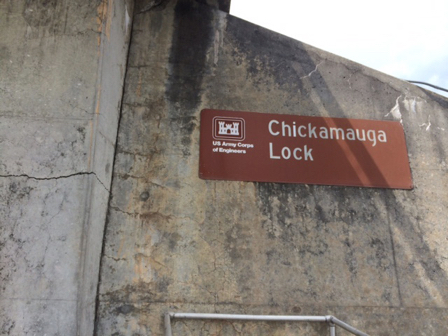 The Chickamauga Lock opened in 1940, and cracks in its concrete structure show its age. (Jerry Hagstrom/The Hagstrom Report)
Maj. Brad Morgan of the U.S. Army Corps of Engineers looks at the aging steel and concrete at the Chickamauga Lock. (Jerry Hagstrom/The Hagstrom Report)
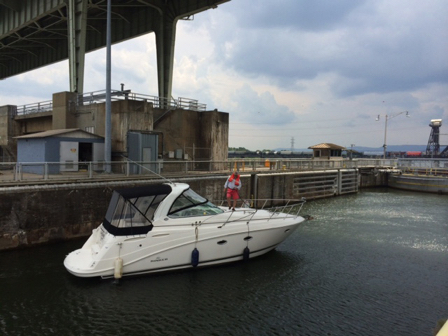
A pleasure boat goes through the Chickamauga Lock. (Jerry Hagstrom/The Hagstrom Report)

The gate opens for a coal barge. (Jerry Hagstrom/The Hagstrom Report)
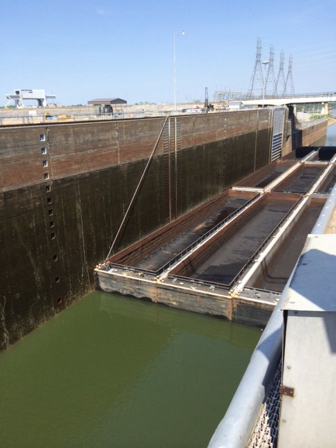
A coal barge goes through the Kentucky Lock. When corn and soybeans go through the lock they are in covered barges. (Jerry Hagstrom/The Hagstrom Report)
