Expo Milano the ag and food trip of the year
July 03, 2015 |12:15 AM
EXPO MILANO 2015
Editor’s note: For your reading pleasure in advance of the holiday weekend, Jerry Hagstrom reports on the sights and tastes of Milan when he visited Expo Milano 2015 last week.
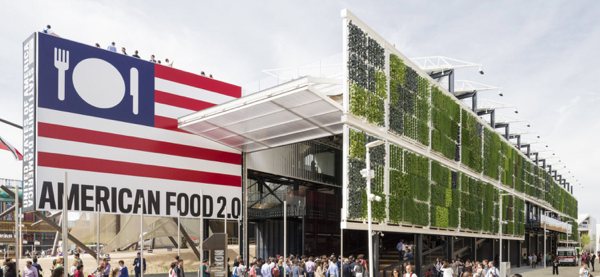 The most striking feature of USA Pavilion at Expo Milano 2015 is the 9,250-square-foot vertical farm, right, where 42 different varieties of vegetables, grains and herbs are being grown. (USA Pavilion)
By JERRY HAGSTROM
MILAN — When Agriculture Secretary Tom Vilsack and a presidential delegation arrive today at the Expo Milano 2015 to participate in a conference and celebrate Independence Day, they will find:
- A USA Pavilion telling the story of American food that attracts 25,000 to 30,000 people per day and last month received its one millionth visitor.
- “Art and Food,” a separate museum exhibition that includes posters by Lester Beall commissioned by the old Rural Electrification Administration in the 1930s to convince rural Americans that electricity would improve their lives.
- Lobster rolls sold in food trucks behind the USA Pavilion and at McDonald’s.
- A James Beard American Restaurant in downtown Milan that features gourmet food prepared by the most famous and emerging U.S. chefs and Italian chefs trying their hand at American recipes.
- USA Pavilion staff still trying to raise another $20 million because the U.S. government agreed to participate in the expo only if the $60 million budget for it came from the private sector.
Expo Milano: Feeding the Planet, Energy for Life opened May 1 and continues through October 31. It is technically a “universal exhibition,” granted that status by the Board of International Expositions, but is usually called a world’s fair, following in the tradition of the 1851 "Great Exhibition of the Works of Industry of All Nations" in London and the world’s fairs in Chicago 1933-34, New York 1939-40, Seattle 1962 and New York 1964.
Since 1967, when an “expo” was held in Montreal (which took the name for its baseball team), the fairs have been given that name. They are sanctioned only every five years and often have themes such as this year’s about feeding the world in the face of population growth and environmental questions.
The Milan expo has exhibits from 140 nations arranged by country and also by products such as rice and coca and themes such as Pavilion Zero, which offers a travel experience into the earth’s crust, via caves that have been rebuilt in almost total darkness, where at the center there is the "valley of civilization.”
The USA Pavilion, by all accounts one of the hits of the expo, has the theme “American Food 2.0: United to Feed the Planet.”
The U.S. exhibition stresses that U.S. agriculture is highly diverse, ranging from genetically modified crops grown on a mass scale to the organic and local foods that are growing in popularity.
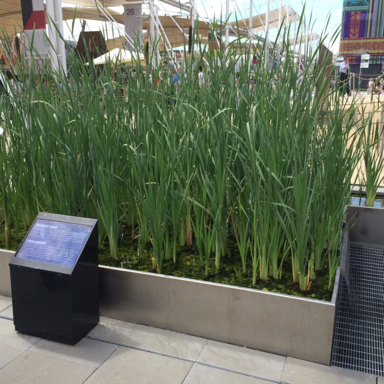 The Aquatic Garden in the forecourt of the USA Pavilion is planted with a field of cattails. Native Americans foraged aquatic plants such as pickerelweed, common sweet flag, and cattails as a source of vitamins, minerals, fat, protein, and starch. Once used for flour, eaten like potatoes, and mixed into salads, cattails are on the menu again as part of a revival of Native American ingredients in the United States. (Jerry Hagstrom/The Hagstrom Report)
Architect James Biber designed the building to pay homage to an American barn. The most unusual aspect of the building is the green vertical farm employing hydroponic towers on which 42 different varieties of vegetables, grains and herbs are grown. The towers are constantly moving, but the greenery can be picked.
Inside there’s a walkway made from wood repurposed from the Coney Island boardwalk, a “food security game” that invites participants — particularly students — to figure out how to address various food problems (including genetic modification as an answer), and an animated Great American Foodscape video showing the diversity of food region-by-region in the United States.
In what may be a ploy to attract the local attendees, the animated displays also show how Italian immigrants affected American eating habits, from their role in bringing pasta to the United States to the canned spaghetti and meat balls popular in the 950s convenience era to the handmade, fresh pasta meals of today.
But the organizers acknowledge that none of these exhibits is as popular as the one immediately inside the front door: a video of President Barack Obama welcoming everyone to the exhibit. The video is played constantly on a loop and the attendees from all countries to try to take selfies of themselves with Obama.
Upstairs there’s a rooftop terrace that most visitors do not see, but that can hold 300 people for dinner.
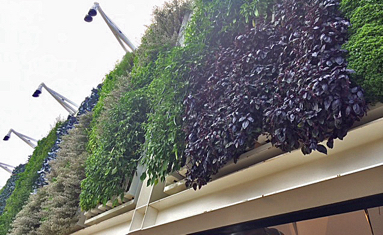 The vertical farm uses almost 1,500 4-foot towers planted with a crop, hung on a series of movable frames, and watered through a drip irrigation system. Seeds of dark leafy greens, grains and herbs were germinated specifically for the Expo crop wall to suggest opportunities to grow nutritious produce on a vertical plane. All crops will be harvested multiple times during the six-month Expo. (Jerry Hagstrom/The Hagstrom Report)
The pavilion’s management and program is directed by Dorothy Hamilton, the founder and CEO of ICC, who is president of the pavilion; San Francisco businessman Charlie Faas, who is CEO, and James Beard Foundation Executive Vice President Mitchell Davis, who is chief creative officer.
Overseeing the operation for the State Department is Douglas Hickey, a San Francisco venture capitalist who has the title of commissioner general with the rank of ambassador.
The officials acknowledged that they are still raising money, but say they hope the attendance and success of the entire expo should help raise enough to get into the black before the expo closes at the end of October.
Faas noted that the programming at the pavilion has attracted varied audiences, as the schedule for the second half of June showed:
- First Lady Michelle Obama brought her Let’s Move initiative against childhood obesity to a worldwide audience.
- Jack Bobo, the senior adviser to the Department of State on biotechnology, talked about communicating to skeptical people.
- Richard McCarthy, the executive director of Slow Food USA, talked about “Slow Going in a Fast Food Nation.”
- And, as one of the 120 student ambassadors brought to the expo by the University of Southern California Marshall School of Business noted in a blog post, “the USA Pavilion made history by celebrating the first LGBT event in the 154-year history of universal expositions.”
The lesbian, gay, bisexual and transgender event featured drag queens and speakers, and guests included Giuseppe Sala, commissioner of the government of Italy for the expo, and Simon Nugent, member of the Gay & Lesbian Equality Network board in Ireland.
Hickey said it has been a pleasure to entertain the many ambassadors and business delegations who have visited the pavilion.
The expo, Hickey said, “is the United Nations without the rules.”
