SNA members brief congressional staff
June 16, 2015 |12:12 AM
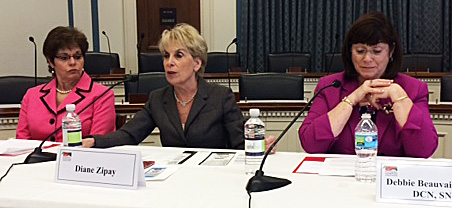
Members of the School Nutrition Association explained their position on school nutrition to congressional staff in Washington last week. From left are President Julia Bauscher, Diane Zipay from Omaha, Neb., and Debbie Beauvais, Rochester, N.Y. (Jerry Hagstrom/The Hagstrom Report)
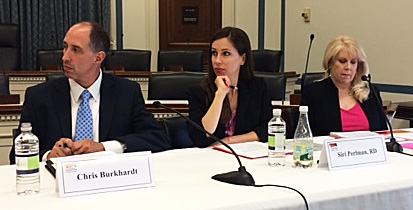
From left, Chris Burkhardt from Liberty Township, Ohio, Siri Perlman from Encinitas, Calif., and Lynn Harvey from the North Carolina Department of Public Instruction. (Jerry Hagstrom/The Hagstrom Report)
Six members of the School Nutrition Association came to Washington last week to brief House and Senate staff on SNA’s agenda for changes to school meals under the reauthorization of child nutrition programs.
The child nutrition programs, which includes school meals, the special supplemental nutrition for women, infants and children known as WIC and some commodity distribution programs, are scheduled for reauthorization this fiscal year. The programs expire on September 30, although in the past when they have expired Congress has continued the programs through appropriations.
The SNA members, who hold positions at various levels in the schools and state government, gave examples to bolster the group’s agenda for changes to school meal rules under the 2010 Healthy Hunger-Free kids Act. The proposals have been presented to members of Congress and their staffs on many occasions.
In general, the briefers said they are experiencing financial problems because some of the middle-class students who pay almost the full cost of their lunches are no longer eating school lunch because they don’t like the sodium reductions and the calorie restrictions.
Many also don’t eat the half-cup of fruits and vegetables they are required to take, the briefers said. There has even been a drop off in free school breakfast, they said, because students don’t like the whole-grain biscuits, grits and corn-based products.
The briefers did not raise the issue of childhood obesity, which led First Lady Michelle Obama to champion the campaign to make school meals healthier in 2010.
But when asked about the issue, Lynn Harvey, the chief of school nutrition services in the North Carolina Department of Public Instruction, said the state is doing a pilot project to teach seventh and eighth grade students about food.
The program is wonderful, Harvey said, “but we see significant costs.”
Asked about briefings done by school food service directors who say they have successfully implemented the healthier meals, SNA President Julia Bauscher, the director of school and community services in the Jefferson County Public Schools in Louisville, Ky., said she is “happy” those schools have been successful, but that school nutrition programs “are extremely diverse.”
Asked why middle-class students have dropped out when it was middle-class parents who led the movement to make school meals healthier, Chris Burkhardt, the director of child nutrition and wellness in Liberty Township, Ohio, said the students who eat school meals less may be “the working poor” who cannot afford the increased prices required because Congress insisted that schools no longer use the payments for free and reduced price students to keep the price for middle-class students low.
Burkhardt said he has lost 15 percent participation in regular meals and 26 percent in the a la carte business.
Debbi Beauvais, the supervisor of school nutrition services for a district in Rochester, N.Y., said the whole-grain rich requirements initially forced her to get rid of flavored wraps with tomato basil and spinach because food companies could not provide them. As the year progressed, the industry began to produce wraps that met the requirements, but the number of students paying the full price for lunch had dropped off.
Students who have to pay full price are not happy with 100 percent whole grain pasta and smaller portions, Beauvais said.
“In the eyes of parents, prices are going up for less food,” she said.
Of fruits and vegetables going in the trash, she said, “There is no point in making them take it if they are not going to eat it.”
Fast-food trucks have begun pulling up at schools, some students have started ordering pizza to be delivered from their cell phones, and some parents have begun bringing fast food to school, so the school has had to “police that,” Beauvais said.
Siri Perlman, a nutrition specialist at the San Dieguito Union High School in Encinitas, Calif., noted that affluent school districts like hers do not qualify for the equipment grants that lower income schools get, but still need to buy the equipment.
Perlman said that under the new rules, snacks are priced higher and serving sizes are smaller. There are peculiarities to the new standards, she said, adding that she cannot sell a hummus pack because it has more than 30 percent fat, but that she can sell Sour Gummy Bears.
Diane Zipay, the director of nutrition services for the Westside Community Schools in Omaha, Neb., said she cannot serve a turkey sandwich as an a la care item because the salt content would be too high.
But Zipay noted that when she started working in school lunch a quarter century ago, the image of school lunch was worse than the reality.
She said she did an informal survey at a mall in which people told her that school lunch was “bad-tasting, low-nutrition served by mean old lunch ladies.”
That was not true then and is not true today, Zipay said.
“What parents say and what the reality is — there is a real disconnect,” she said.
