McCarthy promises to finish clean water rule, won’t ‘overextend into agriculture’
April 13, 2015 |06:04 PM
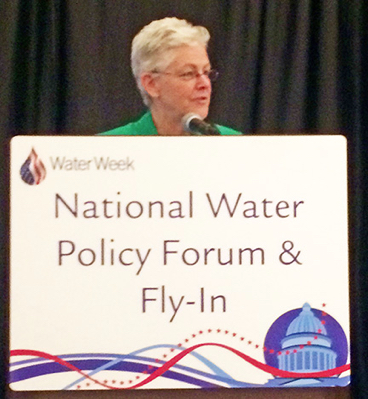
Environmental Protection Agency Administrator Gina McCarthy at the National Water Policy Forum in Washington today. (Jerry Hagstrom/The Hagstrom Report)
Despite congressional opposition, Environmental Protection Agency Administrator Gina McCarthy said today that the Obama administration will finish the clean water rule that EPA sent to the Office of Management and Budget on Friday.
House Transportation and Infrastructure Committee Chairman Bill Shuster, R-Pa., and Rep. Bob Gibbs, R-Ohio, the committee’s Water Resources and Environment Subcommittee chairman, today introduced legislation to stop EPA from finalizing the rule.
House Agriculture Committee Chairman Michael Conaway, R-Texas, also announced he is an original sponsor of the legislation.
“We are going to get it over the finish line,” McCarthy told the National Water Policy Forum, Fly-In & Expo, a gathering of water resource agency executives and industry professionals in Washington.
“The final rule will provide the clarity you have asked us to [provide]. We will nail it,” McCarthy added.
EPA officials will make sure “we are not overextending ourselves into agriculture,” she said, but devoted most of her comments to issues of direct concern to water agencies.
McCarthy acknowledged that “many groups have legitimate concerns” that the proposed rule was too broad, but she never used the rule’s original name, Waters of the United States or WOTUS.
She said the rule would will provide clarity on its application to “conveyances, aqueducts and canals” and municipal separate storm sewer systems, which are important to municipalities and water distribution agencies.
“Our intent was never to make your job more difficult,” she said. The agency will be careful in crafting the final rule by looking at every one of the million comments EPA has received, she said.
The rule is one “we are going to be proud of,” she said, adding that people won’t be surprised about it unless they thought there would not going to be any changes from the original rule.
McCarthy said the clean water rule process had taught her that it “is not good enough to say what we are [doing] but that we are not doing this, this and this.”
Repeating statements she has made previously, McCarthy said the Supreme Court had told EPA to clarify some of its regulations.
“Streams and wetlands are still vulnerable to pollution,” she said, adding that the American people “rely on them for our drinking water resources.”
“We want to protect those source waters so the downstream users don’t have to pay the cost of excess pollution that is being contributed up stream,” McCarthy said.
She urged the water professionals to tell members of Congress that there needs to be more investment in water infrastructure.
The country has never spent enough in this area, McCarthy, and “the backlog has gotten larger and larger as time has gone on.”
McCarthy also noted that EPA has created a new Water Infrastructure and Resiliency Finance Center and that the Agriculture Department’s Rural Utilities Service is part of it.
The center will serve as a resource to communities to improve their wastewater, drinking water and storm water systems, particularly through innovative financing and increased resiliency to climate change, according to the EPA website.
McCarthy said she does not see any difference among water, energy and environmental issues because they “all end up the same.”
Of the way that EPA reaches settlements with municipalities and other groups over conflict, McCarthy said that telling someone “ ‘you’ll like the consent decree’ is like telling a little kid you’d like broccoli.”
But she added, “I like broccoli, by the way."
