French Embassy celebrates UNESCO listing for French gastronomy
April 01, 2015 |02:27 PM

Jerry Hagstrom, left, enjoys a digestif (after-dinner drink) with Emily Heil of The Washington Post and Christophe Malvezin, agricultural counselor at the French embassy at the Goût de France celebration on March 19.
GOÛT de FRANCE
Editor’s note: Jerry Hagstrom was invited to the residence of the French Ambassador to the United States on March 19 for the Goût de France celebration of French gastronomy. Here he recounts the evening and notes that the celebration had a connection to someone he met early in his career in Washington. (Photos by Jerry Hagstrom/The Hagstrom Report)
By JERRY HAGSTROM
When I walked into French Ambassador Gérard Araud’s residence on March 19 for the Goût de France celebration of French gastronomy, I did not realize that the evening would take me back over 30 years of experiences with the French Embassy in Washington.
I mentioned to the ambassador and Christophe Malvezin, the agriculture counselor at the embassy, that I have known Catherine Colonna, the current French ambassador to Italy, since she was a press aide at the French Embassy in Washington in the 1980s.
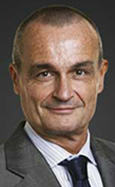
Araud immediately noted that Colonna had been the French ambassador to UNESCO (the United Nations Educational, Scientific and Cultural Organization) in 2010 when UNESCO agreed to add the French gastronomic meal to its Representative List of the Intangible Cultural Heritage of Humanity.
At that time, Malvezin was a top agriculture aide to then-French President Nicolas Sarkozy and the two worked together to convince UNESCO officials that the listing was appropriate.
When I met Colonna, I had just co-authored, with Neal R. Peirce, “The Book of America: Inside Fifty States Today,” and was a political writer at National Journal.
Colonna had just graduated from France’s famed Institut d’Études Politiques de Paris and the École Nationale d’Administration, and joined the Foreign Ministry. She had been assigned to Washington as her first post, a signal that she would be a rising star. I still remember her command of English being the finest I have ever encountered in a diplomat from a non-English speaking country.
But comprehending American presidential politics is still a challenge for the best-educated diplomat and we had many conversations during the elections of those years.
We continued our friendship after she returned to France. After several years of posts in the Foreign Ministry, she became the spokeswoman for French President Jacques Chirac for nine years, and later was French minister of European Affairs and ambassador to UNESCO.

Catherine Colonna is a rarity in a foreign ministry — a farmer’s daughter — and my favorite memory is a weekend visiting her father on the family farm in the Touraine Loire Valley area of France. (As I shifted to agriculture reporting, we had many off-the-record conversations about European Union, French and U.S. farm policy.)
Somehow I had missed UNESCO’s declaration that the French meal deserved heritage listing. But I learned online that the U.N. agency had honored the French gastronomic meal because it is a festive occasion involving togetherness, and that it must include “the careful selection of dishes from a constantly growing repertoire of recipes; the purchase of good, preferably local products whose flavors go well together; the pairing of food with wine; the setting of a beautiful table; and specific actions during consumption, such as smelling and tasting items at the table.”
“The gastronomic meal should respect a fixed structure, commencing with an apéritif (drinks before the meal) and ending with liqueurs, containing in between at least four successive courses, namely a starter, fish and/or meat with vegetables, cheese and dessert.”
The listing also notes that “gastronomes who possess deep knowledge of the tradition and preserve its memory watch over the living practice of the rites.”

Geoff Earle of The New York Post listens as French Ambassador to the United States Gerard Araud explains the Goût de France. Behind Earle is famed chef Michel Richard, who was a guest.
As a group of journalists and others sat down to dinner in the newly renovated ambassador’s residence on Kalorama Road, Araud explained that the French Ministry of Foreign Affairs and International Development had started the Goût de France (Good France) in partnership with Michelin-star chef Alain Ducasse to showcase the well-balanced French-style meal all over the world.
The project was inspired by Auguste Escoffier, who created the “Dîners d’Epicure” (Epicurian Dinners) in 1912, with the goal of serving the same menu, on the same day, in several cities around the world. More than 1,300 restaurants in 150 countries were selected to participate in the celebration, with 45 in the United States.
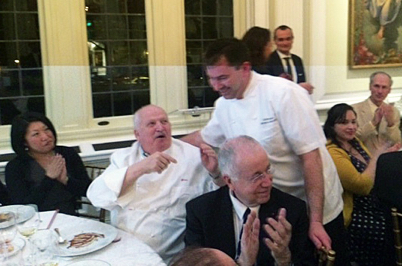
Christophe Tanneau-Kervran, head chef of the French ambassador’s residence, greets Michel Richard.
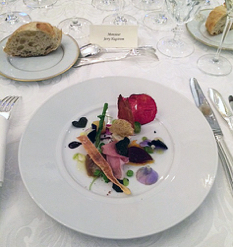
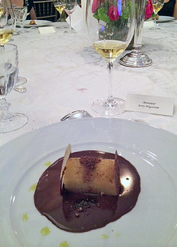 Left: A salad composition of seasonal vegetables with winter truffle and Bayonne ham strips. Right: Ariane apple and Guanaja chocolate oncteux.
At the residence, chef Christophe Tanneau-Kervran designed a menu featuring two French products recently approved for commercial exportation to the U.S.: Ariane apples and Bayonne ham.
Champagne preceded the dinner, followed by five wines introduced by Séverine Bonnie, a member of the family that owns Château Malartic-Lagravière in Bordeaux.
Araud noted that the United States is the biggest market for French gastronomic exports outside of the European Union, with an average growth of 8 percent per year, totaling 4 billion dollars in 2014.
The evening, the ambassador said, would be a celebration of French gastronomy worldwide, affirming “values of sharing conviviality, pleasure and respect for good food and togetherness.”
Jean Robert Pitte, president of the French Mission for Food Heritage and Culture, explained that the French meal as we know it today evolved in the 18th and 19th centuries and the idea of pairing food and wine emerged in the late 19th and early 20th centuries.
Pitte said that 60 percent of the French people still sit down for lunch.
“Gastronomy is a kind of national sport,” Pitte said. “It is food shared with people of different ages.”
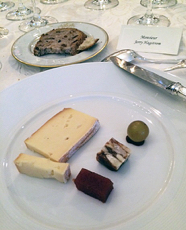
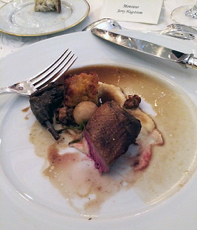
Left: Saint Nectaire cheese with grilled nut and raisin bread. Right: Roasted squab breast and its leg confit with Semolina corn cake with parsnip mousseline and squab jus.
Meanwhile, Catherine Colonna was presenting her own “Goût de France” celebration at her residence in Rome. Her event was extraordinary because French President François Hollande loaned her his chef.
Immediately after the dinner I sent my friend a note telling her how thrilled I was to know she had played a key role in establishing the UNESCO listing for the wonderful meal we had at the embassy in Washington.
She sent a picture of her event (below), along with a note reflecting her agricultural heritage: “I am probably the only French ambassador who has drawn milk from a cow!”
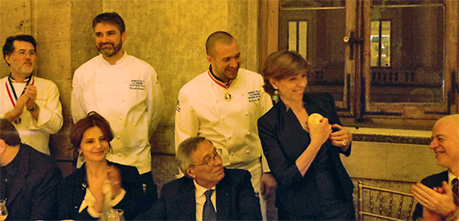
French Ambassador to Italy Catherine Colonna receives the “Chef of the Chefs” medal from Guillaume Gomez, the chef at France’s Élysée Palace, the residence of French President François Hollande. The occasion was the Goût de France dinner at the Palazzo Farnese, the French Embassy in Rome, and Holland loaned his chef to Colonna for the event. (French Embassy, Rome)
