Grandin: Animals should be bred for ‘optimal’ production
March 15, 2015 |05:23 PM
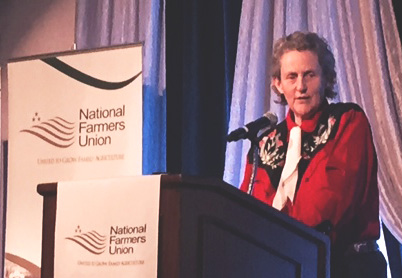 Temple Grandin addresses the National Farmers Union convention Saturday in Wichita. (The Hagstrom Report)
WICHITA — Reacting to the scandal surrounding the U.S. Meat Animal Research Center in Nebraska, meat industry consultant Temple Grandin said here on Saturday that meat animals should be bred for “optimal rather than maximum” production.
In January, a New York Times story alleged abuse of cattle, pigs and lambs in a program to increase birth rates.
Asked by The Hagstrom Report to comment on the USMARC situation, Grandin noted that she has not visited the center since the late 1980s and believes that “some of the stuff they dredged up is ancient history.”
But Grandin, a Colorado State University professor of animal science, added that she has learned that sometimes there are employees who don’t want to change the ways that they handle animals, and that such employees should be let go.
She added she believes the meat industries are trying to get too much productivity out of animals.
“There’s a point where you’re pushing biology too hard,” she said, noting that she believes there can be “biological overload” in some of these breeding techniques in which the industry is trying to breed for certain characteristics.
“Maybe we’d better back off a tiny bit on productivity” and breed some resistance to disease back in the animals, she said.
Grandin noted that in her speech she had talked about being an “associative thinker” and that she looks “across species” as she considers these issues.
Grandin, who is autistic and is famed for her ability to relate to animals and figure out ways to handle them more humanely, especially in slaughterhouses, emphasized in a speech to the National Farmers Union that society needs all kinds of people.
“I am a photo realistic visual thinker,” she said. “I can’t do algebra.”
“Everybody is not the same,” she added.
She also showed pictures of her brain compared with the “average” brain that vividly displayed that her brain functions differently than most.
“The genetics of personality traits are like a music mixing board,” she said.
Too many kids are labeled autistic, dyslexic or suffering from Asperger’s or another condition, she said.
“I am worried that our educational system will screen them out. We need them as problem solvers,” she said.
Grandin said there is too much emphasis on the children’s “deficits” rather than on developing their strong points.
“I am a professor first and the autism comes second,” said Grandin, who has combined advising people on dealing with autism at the same time she has been a consultant to the meat industry and a professor.
“Art class was my salvation in elementary school,” she said. “Carpentry and horses saved me in high school.”
Her visual thinking, she said, led her to notice that “cattle are afraid of things that others do not notice.”
Cattle may be used to seeing men on horses but if they never see a man on foot until they get to an auction barn they become afraid and are dangerous, she said.
She also noted, as she has in other speeches, that too few kids today are taught to do practical things with their hands such as sewing and woodworking. Too many policymakers, she said, get their degrees in political science or philosophy and their thinking is “abstract.”
“I don’t think it is good when a Harvard graduate’s goal is to work for Goldman Sachs,” she said, adding that they should want to “solve things.”
Of the current interest in local foods, Grandin said, she believes some of the interest is in the fear of what might happen if food does not arrive in big stores like Walmart.
“Big is fragile,” she said, noting that during the recent labor problems on the ports on the West Coast, “beef was rotting.”
