Vetter asks crop farmers to lobby for TPA as Hill disagreements continue
March 03, 2015 |05:07 PM
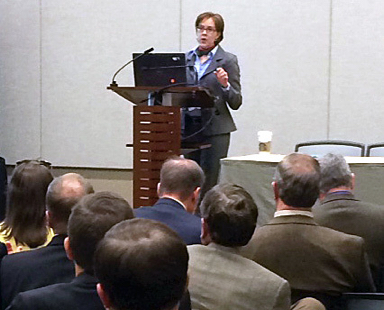
Chief U.S. Agriculture Negotiator Darci Vetter addresses the Commodity Classic in Phoenix on Saturday. (Jerry Hagstrom/The Hagstrom Report)
PHOENIX — Chief U.S. Agriculture Negotiator Darci Vetter asked crop farmers attending the Commodity Classic here this weekend to help her convince Congress to grant President Barack Obama trade promotion authority so that the Trans-Pacific Partnership and Trans-Atlantic Trade and Investment Partnership agreements can be completed.
Under TPA, the U.S. trade representative and his staff have the authority to negotiate trade pacts with the understanding that Congress will vote only yes or no on the agreements, not try to amend them.
Speaking to about 60 corn, soybean, wheat, and sorghum farmers in a break-out session on Saturday, Vetter said she assumed that the farmers’ decision to attend her meeting meant that they were already committed to free trade.
In her opening remarks, Vetter asked the farmers to “talk to your neighbors … your editorial boards.”
Later, in response to a question, Vetter asked the farmers to telephone their members of Congress and to call on them in Washington.
As a former aide to then-Senate Finance Committee Chairman Max Baucus, D-Mont., Vetter said she knows that “it’s one thing to get the same emails [from organized groups], it’s another to see an individual.”
Vetter said the Obama administration needs to finish the TPP agreement “this year” and “we need to get TPA this spring.”
In 2016, Vetter noted, the U.S. political calendar will make it difficult to convince Congress to focus on a trade agreement, and other countries will also face challenges.
Vetter made the cases for TPP and T-TIP that she has presented at many recent farm gatherings. She told the farmers that TPP will offer opportunities to export to Asia not only feed grains, but the meat that is produced with their feed grains, as the countries develop their own meat industries.
“There’s a lot at stake,” Vetter said, adding that she needs the structure of TPA to get TPP “across the finish line.”
But she also faced some tough questions from a few farmers.
One soybean farmer asked what issues opponents are raising and how growers who favor TPA can counter them.
Vetter said that on the left, members of Congress are raising concerns about labor and the environment, but that as the negotiator for the environmental section of the U.S.-Chile free trade agreement, she believes the environmental regulations in TPP are much stronger.
She also said that it is much better to have U.S. labor and environment standards in the agreement than the lower standards the Chinese might propose for the countries in its region.
On the right, Vetter said, some members don’t want to give TPA to Obama, and some maintain that TPA is not constitutional.
But Vetter noted that all presidents since Gerald Ford have been granted TPA so that they can finalize agreements, and that members of Congress have opportunities to give trade negotiators direction and to see the agreements as they are being negotiated.
Vetter acknowledged that negotiations on geographical indicators and generic products are difficult in both TPP and T-TIP.
The United States would like a definition of generic products such as some cheeses in TPP and a system to challenge a country’s decision to declare a geographic indicator for a product, but that remains “an uphill battle,” Vetter said.
In T-TIP, European countries are trying to put in place a system under which certain cheeses that have been produced in the New World for a long time would have geographic indicator designations.
The United States, Vetter said, is determined not to “stop commerce” for meats, cheeses, and wines that officials believe have common names.
The European Union’s moratorium on new approvals for genetically modified seeds and products is a “frustration” in the T-TIP negotiations, she said, calling on the European Union to approve 13 pending applications.
The GMO issues are “a thorn in the side” of the T-TIP negotiations, she said.
