Flake, Shaheen, Duncan introduce bill to cut crop insurance
February 12, 2015 |05:47 PM
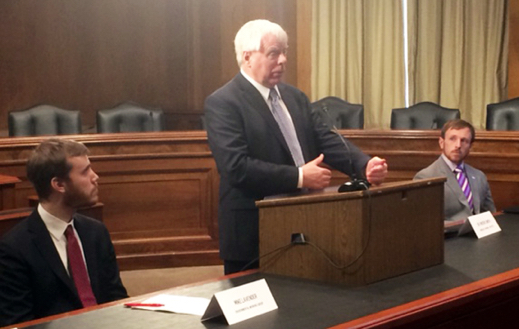 Vincent Smith of the University of Montana and the American Enterprise Institute talks about crop insurance at a briefing for congressional staff, while Mike Lavender of the Environmental Working Group (left) and Andrew Moylan of the R Street Institute listen. (Jerry Hagstrom/The Hagstrom Report)
Sens. Jeff Flake, R-Ariz.; Jeanne Shaheen, D-N.H.; and Rep. John Duncan, R-Tenn., today introduced companion bills that would eliminate subsidies for the harvest price option in the crop insurance program.
Under the harvest price option, which is known in farm circles as the HPO, if the actual harvest price of a crop is higher than the insured planting price established earlier in the season, the payout is recalculated based on the higher price.

“Making a living in agriculture is not easy or predictable. That’s why there are safety-net programs like traditional crop insurance,” Flake said in a news release. “But HPOs are not safety-net programs: They put taxpayers on the hook for billions of dollars even when huge profits are being made.”
“Big agro businesses and insurance corporations have a sweet deal with our crop insurance. In an era of very few small farms, the largest corporate farms collect the lion’s share of the money, creating an unfair playing field for family farmers,” said Duncan. “Ninety-nine percent of the people in my district do not get subsidies from the federal government to run their businesses.”
“We’re proposing a commonsense reform with the potential to save taxpayers nearly $20 billion,” said Shaheen. “This is a smart, pragmatic bill that will provide our current crop insurance program with a much-needed fix. We ought to act on it immediately to save taxpayer dollars.”

The Harvest Price Subsidy Prohibition Act is also supported by a coalition of left- and right-wing groups, including Heritage Action, the R Street Institute, the American Enterprise Institute, FreedomWorks, the National Taxpayers Union, Campaign for Liberty, Taxpayers Protection Alliance, Center for Individual Freedom, Coalition to Reduce Spending, Less Government, Taxpayers for Common Sense, Club for Growth and the Environmental Working Group.
President Barack Obama’s fiscal year 2016 budget includes provisions to reduce but not eliminate subsidies for the HPO and another provision to cut back on crop insurance coverage when a farmer can’t plant a crop due to weather problems.
The president’s budget estimates that those provisions would save $16 billion over 10 years, while Flake, Shaheen and Duncan said their provision would save $19 billion over 10 years.
At a briefing attended by about 15 congressional aides, Vincent Smith, a University of Montana professor and visiting scholar at the American Enterprise Institute, said that “there is not a lot of difference in budgetary effect” between the two proposals.

Smith also said afterward that ideally he would like to “can” the entire crop insurance program and replace it with a disaster program like the one for livestock producers.
At the briefing, Andrew Moylan of the R Street Institute discounted criticism that the savings on crop insurance are relatively small. Moylan said that if concern about savings is limited to big-ticket items such as Medicare and the defense budget, “we will be nihilists.”
Mike Lavender of the Environmental Working Group said that subsidizing “such a significant portion of the premium subsidy” leads farmers to plow up new land or plant on marginal land “because they don’t have as much risk in the game.”
The crop insurance industry, in a joint statement by the American Association of Crop Insurers, the Crop Insurance and Reinsurance Bureau, and National Crop Insurance Services, said, “This is just another example of agriculture opponents trying to erode the risk management tools on which farmers depend.”
The crop insurance groups said the HPO is similar to property insurance that allows indemnities to be paid on property appreciation and true replacement cost.
“This protection is a vital tool that enables farmers to participate in forward contracting, which reduces farm risks and helps food and fuel manufacturers stabilize their supply chains. Insuring crops at replacement cost also provides farmers the means to purchase feed for their farm animals to replace lost crops – purchases that must be made at a harvest price,” the groups said.
