Scuse defends Mexico sugar suspension agreements
February 09, 2015 |03:32 PM
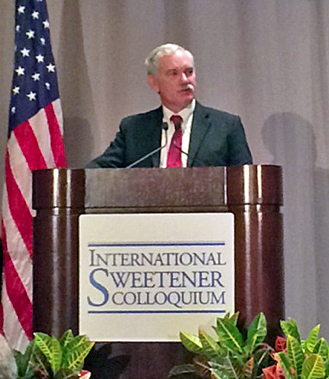 Agriculture Undersecretary for Farm and Foreign Agricultural Services Michael Scuse addresses the Sweetener Users Association in Orlando, Fla., this morning. (Jerry Hagstrom/The Hagstrom Report)
ORLANDO, Fla. — Agriculture Undersecretary for Farm and Foreign Agricultural Services Michael Scuse today vigorously defended the suspension agreements that the Obama administration has negotiated with Mexico to settle cases that U.S. sugar growers brought saying Mexico was shipping subsidized sugar to the United States.
In a speech to the Sweetener Users Association here, Scuse said the negotiated settlement “allows Mexico to export duty-free all the sugar we require and implement the sugar program as intended.”
Scuse’s statement is important because two sugar refiners petitioned the U.S. International Trade Commission to stop implementation of the settlement on the grounds that it does not provide them enough raw sugar to process.
USDA does not have control of that process, which is expected to proceed over the next several months and could still result in the agreements being stopped.
After Scuse’s speech today, Mike Gorrell, the head of Imperior Sugar Company, one of the companies that filed the suit, declined to comment, citing the legal process.
In a news release, the Sweetener Users thanked Scuse for noting that “USDA is required by law to provide adequate supplies of sugar at reasonable prices” and for his management of the “flawed U.S. sugar program over the years.”
But the group said that “With total imports of sugar to date down significantly this year, the investigations have had a lasting, negative impact on the already unstable U.S. sugar market.”
“What’s worse, the subsequent suspension agreements in the cases will only contribute to the many problems resulting from current U.S. sugar policy through increased restrictions on the flow of imports,” the Sweetener Users said.
“We are encouraged by the undersecretary’s recognition that USDA may need to consider tariff-rate quota adjustments if uncertainty in the market continues.”

But Jack Roney, the chief economist for the American Sugar Alliance, whose members filed the original suit, told The Hagstrom Report “We are delighted with Secretary Scuse’s support of the suspension agreement and that [the Agriculture Department] will be able to manage the sugar program at zero cost for the next 10 years.”
The suspension agreements are in place for only five years, but Roney noted that government budget officers working on a 10-year basis assume that the agreements will stay in place.
He added that he believes “if the agreements work they will stay in place.”
Roney said that in a presentation he is scheduled to make to the users’ group later this week he will make the point that the U.S. sugar price has stayed the same for the past decades, even though the cost of production has doubled. He said the sugar growers have used technological improvements to address those costs, but that there is a limit to the impact of technology.
(There have, however, been highs and lows within that time.)
A managed trade agreement with Mexico can help because these agreements specify how much sugar can be imported and when, avoiding sudden and unexpected inflows of Mexican sugar, Scuse said.
“USDA views the suspension agreements as the best outcome” of the situation, Scuse said. He noted that because the sugar program in the farm bill allows farmers to forfeit sugar to the government when the sugar price plummeted USDA had to make payments to sugar farmers.
“There should not be a repeat of 2013 that required a significant expenditure of funds to address the volume of sugar in the marketplace,” Scuse said. “I definitely do not want to go through another year like that and do not want that to happen again.”
In addition, Scuse said that the ITC investigation “jeopardizes the trade flows of these past 20 years.”
“We do not want a trade dispute with out third largest trading partner, Mexico,” he said, adding that he “appreciates Mexico during the strenuous and trying negotiations.”
The Sweetener Users Association has opposed the suspension agreement on the grounds that there should be free trade in sugar between the United States and Mexico. The North American Free Trade Agreement calls for free trade in sugar but other U.S. laws do not permit subsidized imports.
Thomas Earley, vice president of Agralytica, a consulting firm, told The Hagstrom Report that “[the Mexicans] were dumping and they were subsidizing to some degree as defined in our trade laws.”
But Earley added that “the standards for dumping are somewhat artificial.”
