Conaway talks Vilsack testimony, crop insurance, farm bill coalition, biotech and morals
February 03, 2015 |04:19 PM
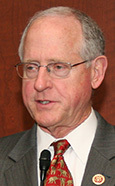
House Agriculture Committee Chairman Michael Conaway, R-Texas, discussed a wide range of issues today in a speech to the National Association of State Departments of Agriculture Winter Policy Conference and in remarks to reporters afterward.
Vilsack, Massad to appear before House Ag next week
Agriculture Secretary Tom Vilsack will testify before the committee next Wednesday, February 11, and Commodity Futures Trading Commission Chairman Timothy Massad will testify before the committee on Thursday, February 12, Conway said.
Vilsack’s testimony marks the beginning of oversight hearings on USDA functions, while Massad’s testimony will precede reauthorizing of the Commodity Futures Trading Commission.
Froman to brief House Ag on trade
Trade Representative Michael Froman will brief the House Agriculture Committee Wednesday on trade issues, including trade promotion authority, Conaway said.
He told the nation’s agriculture commissioners that the briefing would take place, and then later told reporters that a briefing for the full committee was needed because there are so many new members.
The briefing will be open only to committee members, Conaway said.
Budget Committee should give number, no instructions
Conaway said he hopes that if the House Budget Committee undertakes budget reconciliation it will give him an amount of money to cut from the programs under the committee’s jurisdiction without any instructions on what to cut.
He declined to say whether he would take any cut entirely from the Supplemental Nutrition Assistance Program (SNAP), the biggest program at USDA, which accounts for about 70 percent of USDA spending.
Conaway said President Barack Obama’s budget proposal, which includes a cut to the crop insurance program, has no chance of being approved by Congress, but did not rule out a cut to crop insurance in reconciliation.
Conaway said he didn’t need to comment on the details of the president’s proposal because it is “dead on arrival.”
He said the committee “will be as fair as we can” to all programs under the administration’s jurisdiction.
“Right now we don't have to cut anything,” Conaway added.
Ag needs urban alliance without SNAP
Agriculture interests need to form a new rural-urban coalition that is not dependent on votes for the SNAP before the 2018 farm bill comes up for consideration, Conaway said.
He explained his view that the coalition of urban interests supporting SNAP (commonly known as food stamps) and the farm community had worked in the past because SNAP spending was increased, but did not work for the 2014 farm bill because SNAP was cut slightly.
“Production agriculture drug that bill across the finish line almost single handedly,” Conaway said. “We have to create an urban-rural alliance to pass the next farm bill that is not based on SNAP.”
Conaway noted that the Housed passed the farm programs and SNAP separately, but then put them back together in the final bill, and that some members voted against the final bill because the two were put together again.
“2018 won’t be easier,” Conaway said. “There won’t be new money to be had.”
Whether the farm program and the nutrition programs should be in separate bills will be part of the “conversation” during the oversight hearings on the SNAP program, he added.
(The vote on final House passage of the farm bill conference report shows, however that a considerable number of urban Democrats voted for the farm bill while some Republicans did not. There were 251 votes for the bill — 162 Republicans and 89 Democrats — and 166 votes against it — 63 Republicans and 103 Democrats.)
Conaway made the remarks in response to a comment from Louisiana Agriculture Commissioner Mike Strain, who said he believes the farm program and SNAP should be in separate bills.
Biotech education needed
In addition to an educational effort on the “partnership” between agriculture and urban America, Conaway said, “the agriculture community also needs to engage in education efforts on biotechnology” and on “the story of how broccoli gets from the field to the grocery store.”
He said there is a “monster disconnect” between scientists and the American people and that a “huge education effort” is needed on biotechnology.
“Africa is 100 percent organic and the people are starving to death because of a lack of food,” Conaway said.
Referring to the bill introduced by Rep. Mike Pompeo, R-Kan., that would put FDA in charge of any labeling of products with genetically modified ingredients and pre-empt state labels, Conway said this Congress will have to take up “the labeling issue at some time.”
Conaway added that he is “a 10th Amendment guy,” but “you can’t have 50 different labels” for biotech products.
The House Agriculture Committee does not have jurisdiction over the biotech labeling bill since any program would be handled by the Food and Drug Administration, but Conaway told reporters that on a variety of issues he will use his “a bully pulpit” position to educate the American people.
He cited the Endangered Species Act and the Waters of the United States rule as other issues on which he would take this approach. On WOTUS, Conaway said “I don’t know I will have a hearing.”
Conaway said the $18 trillion federal debt should “drive efficiencies.”
Asked by a commissioner about agricultural research and cuts in the number of Animal Plant and Health Inspection Service employees who must certify food for export, Conaway said, “research is great but every agency is going to have less money” because the next generation of Americans can’t be saddled with debt.
A moral campaign
Conaway ended his presentation to NASDA with comments that he has made to other groups about the level of morality in the country.
John Adams, the second president and one of the founding fathers, wrote that “only a moral people can govern,” Conaway noted. He told the commissioners when they sing “God Bless America” they should think about what they are asking God to do at a time when the family unit is deteriorating and entertainment is filled with “the filth that comes out of Hollywood.”
He also questioned whether God could be asked “to bless the killing of 57 million kids” through abortion since the Supreme Court’s 1973 Roe v. Wade decision.
Conaway said he lives by a Judeo-Christian ethic and that he believes that since World War I there has been no country that has done more for the world and asked for so little than the United States.
That leadership is “God’s mission for this country,” Conaway said, and that he does not expect equal leadership to come from “Russia, China or a country with jihadist nonsense.”
But he said the United States won’t be able to fulfill that function unless Americans are “a blessable people.”
