Farm leaders: Agriculture key to normalizing relations with Cuba
January 08, 2015 |07:17 PM
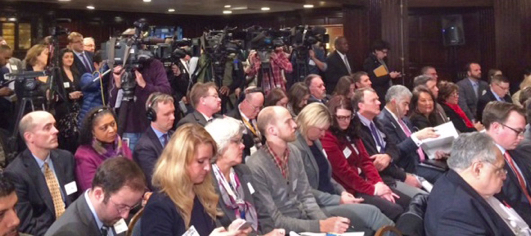 The press conference announcing the formation of the U.S. Agriculture Coalition for Cuba attracted a large crowd today at the National Press Club in Washington. (Jerry Hagstrom/The Hagstrom Report)
Agriculture Secretary Tom Vilsack and a bipartisan group of senators and House members joined farm leaders today to launch the U.S. Agriculture Coalition for Cuba to work for normalization of trade relations between the United States and the Republic of Cuba.
The news conference, held at the National Press Club, attracted more agricultural lobbyists and a wider range of reporters than any other agricultural event in recent memory, including most farm bill news conferences.
The speakers thanked President Barack Obama for announcing on December 17 that he intends to ease banking regulations on agricultural sales to Cuba and re-establish diplomatic relations, but they also made clear that their ultimate goal is to repeal the laws that restrict trade between Cuba and the United States.
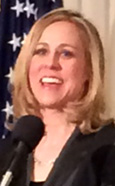
The coalition will actively engage “to end the embargo,” said Devry Boughner Vorwerk, the chair of USACC and a vice president of Cargill.
The United States should also import “what Cuba produces well,” added Paul Johnson, executive director of the Illinois Cuba Working Group and president of Chicago Foods International LLC.
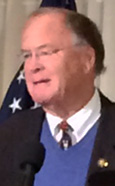
Rep. Sam Farr, D-Calif., the ranking member on the House Agriculture Appropriations Subcommitte, said he believes agricultural and banking interests must lead the charge on Capitol Hill for changes to the Cuba policy.
“The politics will be motivated by the agriculture interest,” Farr said, plus the financial institutions wanting to do business directly, including the use of credit cards.
“Business people are going to have to use their political voices,” Farr added.
Neither the government nor private sector leaders offered much new information on the issues surrounding Cuba, but their presence together and their determination signaled that there is a lot of support in the agriculture community for Obama’s actions, and that members of Congress who oppose normalization of relations with Cuba will face opposition in rural America.
Vilsack noted that the changes Obama has promised to banking laws that require exporters to go through third-country banks “will make our products more price-competitive.”
He also noted that 50 years have passed since Soviet Union leader Nikita Kruschev visited Iowa and saw “the extraordinary power of American agriculture.”
Vilsack said he believes that exposure to U.S. food products will lead Cubans to ask questions about why their system is not more productive.
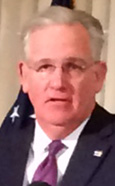
Missouri Democratic Gov. Jay Nixon, who traveled to Washington for the event, said “When it comes to Cuba, we are not on a level playing field. We cannot ignore 11 million customers 90 miles from our country.”
Nixon said support for normalizing relations with Cuba is not only bipartisan in Congress, but “extremely bipartisan” among the nation’s governors.
Farr said he appreciated Obama’s “boldness” in doing everything within his power to change relations with Cuba, but added making changes will not be easy.
“Cuba is going to be overwhelmed,” and in the United States “the battle is going to be in Congress,” Farr said.
Cuban-Americans are opposing the liberalization of relations, he noted, even though they can travel to Cuba freely and send money to Cuban relatives who can make investments.
Farr said he is going to start a new bipartisan Cuba Working Group in the House.
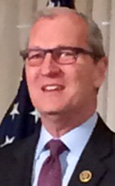
Rep. Kevin Cramer, R-N.D., said he believed he had been invited because, while other Republicans initially expressed opposition to Obama’s announcement he said “it doesn’t sound dumb to me.”
He said that “what motivates me and motivates me to come out so early” on Cuba is not just the sales of North Dakota peas, lentils, beans, durum and potatoes but “the opportunity to influence an oppressed country.”
Cramer noted that there are risks to establishing trade relations with Cuba, which used to be a large sugar exporter to the United States.
“North Dakota also grows sugar beets,” Cramer noted. “We are very sensitive to the importance of fair, free trade.”
Rep. Rodney Davis, R-Ill., noted that he had traveled to Cuba as a congressional aide, and said he believes that after 54 years a new approach is needed so that the Castro regime will no be able to use the United States as a “scapegoat” for the failures of Communism.
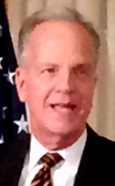
Sen. Jerry Moran, R-Kan., noted that when he was in the House he was one of the sponsors of the amendment in 2000 that allowed the export of U.S. agricultural products to Cuba.
When Cubans don’t buy American food, he said, “it is not that the Cubans are not getting agricultural goods. They are getting them from someone else.”
Moran noted that he had stopped introducing measures for improved relations with Cuba while Cuba was holding Alan Gross, a U.S. Agency for International Development contractor, but is now taking up the charge again.
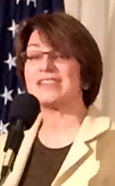 Sen. Amy Klobuchar, D-Minn.
Sen. Amy Klobuchar, D-Minn., who sponsored a Cuba trade bill in 2011, said that Minnesota’s unemployment rate of only 3.1 percent is due “a lot” to agricultural exports.
Cuba is not a partisan issue, Klobuchar said, and the Senate should not block the confirmation of an American ambassador to Cuba.
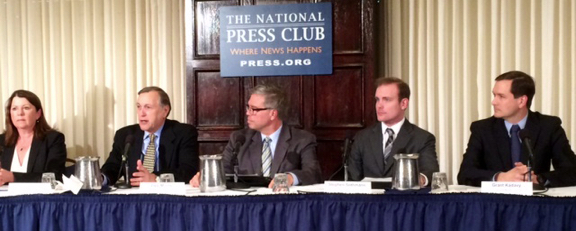 Discussing the importance of improving trade and diplomatic relations with Cuba are, from left, Betsy Ward, CEO of the USA Rice Federation; Alan Tracy, president of U.S. Wheat Associates; Dale Moore, executive director of public policy for the American Farm Bureau Federation; Stephen Sothmann, president of the U.S. Hide & Leather Association representing the North American Meat Institute, and Grant Kadavy, president of Cargill Americas. (Jerry Hagstrom/The Hagstrom Report)
An industry panel pledged to work with Congress on the Cuba issue.
USA Rice Federation CEO Betsy Ward noted that Cubans eat 200 pounds of rice per year compared to 27 pounds in the United States. Ward said that the rice industry had been the first to enter the Cuba market after the 2000 changes, but that sales have dwindled to nothing under the current rules.
U.S. Wheat Associates President Alan Tracy said that Obama’s changes put the U.S. government “in the position of fostering trade rather than frustrating it.”
Dale Moore, executive director for public policy at the American Farm Bureau Federation, said he doesn’t think there is any farm group that doesn’t have a position of lifting the embargo that has been in place since 1961.
Stephen Sothmann, president of the U.S. Hide & Leather Association, who represented the North American Meat Institute, said that increasing prosperity in Cuba would help the meat industry, especially poultry.
The first thing that people buy as they become more affluent, Sothmann said, is animal protein, and increases in tourism would also create more of a market. European and Asia tourists in Cuba could also get a taste of “Texas rib eye and Iowa pork tenderloin,” he said.
Cargill Americas President Grant Kadavy said the United States competitively sells corn to Mexico, but not to Cuba. Cargill has built more than 70 schools in Vietnam, he said, but has not had the opportunity in Cuba.
During a question-and-answer session, Boughner Vorwerk said that the coalition will not have an office, but that she and Johnson will be spokespersons.
Several speakers also said that the Cubans should be able to buy on credit, even though John Kavulich, the senior policy director of the U.S. Cuba Trade and Economic Council, has noted that Cuba has not always paid other countries on time for its purchases.
Tracy said the decision to offer credit would be up to the individual companies, but they should have the ability to extend it if they wish. Tracy said the most important issues are “the hoops” through which Cuba has to go to buy American farm products such as the use of third party banks and paying before the goods leave the United States. Ships that serve Cuban and U.S. ports also have restrictions, he said.
“These are some of the things we’d like to see fixed,” Tracy said. “We don’t expect to have our full trade relationship restored over night.”
▪ U.S.-Cuba Trade and Economic Council, Inc. — Economic Eye on Cuba: 2014-2001 U.S. Export Statistics for Cuba
▪ U.S. Agricultural Coalition for Cuba
