Farm Bureau gives Vilsack an award as he speaks on trade, water, COOL
January 12, 2015 |08:14 PM
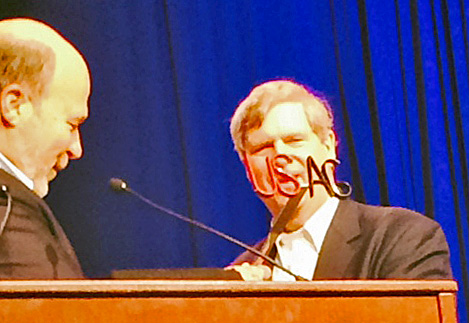 Agriculture Secretary Tom Vilsack, right, accepts a special "US AG" branding iron from American Farm Bureau Federation President Bob Stallman. The award recognized Vilsack for his performance in office. (Jerry Hagstrom/The Hagstrom Report)
SAN DIEGO — The American Farm Bureau Federation, though legally a nonpartisan organization, is known as Republican-leaning. But today its leaders gave Agriculture Secretary Tom Vilsack, a Democrat, an award for his performance in office.
Farm Bureau President Bob Stallman, noting a saying in his native Texas that ranch hands “ride for the brand,” presented a plaque and a custom “ US AG” branding iron to the secretary because “you have ridden for the brand” of American agriculture.
Vilsack had not been informed of the award in advance and was clearly surprised and a bit overcome with emotion.
After thanking the nearly 5,000 Farm Bureau members in attendance, Vilsack noted that he is most proud of having received a patriot’s award from the National Guard when he retired as governor of Iowa. The branding iron will go next to that award, he said.
The secretary also gave Stallman a check for his Farm Bureau dues, and noted that the bill had arrived in the mail just as he was leaving for the convention.
The award presentation capped Vilsack’s two days of appearances here at which he was interviewed by Stallman in a “town hall” session on the trade show floor on Sunday and spoke to the Iowa Farm Bureau breakfast today before receiving his award in front of the entire convention and holding a news conference.
Vilsack made clear at each appearance that trade is the administration’s top priority at this time, and he spoke of the need to convince Congress to pass trade promotion authority.
The Trans-Pacific Trade Partnership is particularly important, he said, because the number of middle class consumers in the 12 countries participating in TPP is expected to grow to 2 billion.
If the United States does not take steps to secure the TPP market, Vilsack said, the failure would create a void that China would like to fill with a trade agreement with the other Asian countries.
China, he said, “will be interested in selling stuff” but not in the labor and environmental standards that are in the TPP agreement. If those countries sign an agreement with China and not the United States “that will put us as at a competitive disadvantage,” he said.
Vilsack added, however, that the negotiators need to see “life” from the Canadians in the TPP negotiations.
Longer term, Vilsack said, he hopes that the Trans-Atlantic Trade and Investment Partnership agreement will be completed, but he noted that the European insistence on geographical indicators and their unwillingness to accept genetic modification are difficult to overcome.
He also talked about the potential for farm sales to Cuba now that President Barack Obama has announced his intention to re-establish full diplomatic relations. But Vilsack noted that the gains would be limited until Congress repeals the embargo that bans most American trade with Cuba.
Vilsack also told the Iowa Farm Bureau that he and farmers should make the general public more aware of everything that USDA and farmers do on water issues.
(The secretary made that statement just as Des Moines Water Works announced its intention to sue several rule counties over discharges into a river that provides the water supply for Des Moines. See story below.)
Noting that farmers and USDA are using conservation tillage, buffers and cover crops to protect watersheds, Vilsack said he cannot think of another industry that is as “invested in water stewardship” as agriculture, and asked if “the golf course guys, the lawn care guys” are doing as much as farmers on water.
On the controversy over country-of-origin labeling for red meat, Vilsack said it is clear that the law says USDA is supposed to guarantee that meat labeled American is “totally American,” which means that imported animals have to be segregated during processing.
But the World Trade Organization has said that segregation discriminates against Canadian and Mexican cattle and pigs. Unless the United States wins a WTO appeal, Vilsack said, Congress will have to change the law to avoid retaliatory tariffs.
The fiscal year 2015 appropriations bill requires USDA to make recommendations to Congress by May 1, and Vilsack said the report will urge Congress to either repeal the meat section of the COOL law or give USDA the authority to use more “generic labeling.”
Vilsack also said he believes that the real issue in the meat industry is the conflict between the big and small producers, with the smaller producers having a hard time making a profit. He suggested that creating better markets for smaller producers in the schools, hospitals and other institutions may be a way to reduce the conflict within the industry.
John Masswohl, director of government relations for the Canadian Cattlemen’s Association, said Canadian cattlemen would prefer that Congress repeal the law and later discuss “replacing it in a calm environment.”
Canada, he noted, has voluntary labeling, which has resulted in branded promotion of Canadian meat.
