Johnson to Catholics: Ag can come together around soil research
November 10, 2014 | 05:34 PM
ST. PAUL — All of agriculture can unite around the need for research on soil, National Farmers Union President Roger Johnson told a Catholic Rural Life conference here last week.
“There has never been a deep discussion across agriculture about what’s in that soil,” Johnson said Thursday at a conference entitled “Faith, Food & the Environment: The Vocation of the Agricultural Leader.”
Johnson added that he believes that “big, traditional, organic and small agriculture” can come together on the issue of soil research.
Noting that the amount of public funding for agricultural research has declined in the last three to four decades, Johnson said, “If there is one area where people can get together, it independent research.”
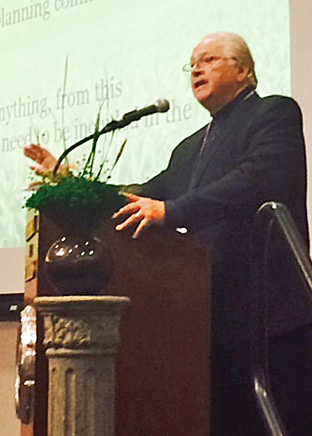 Minnesota Farmers Union President Doug Peterson addresses the Catholic Rural Life conference last week in St. Paul, Minn. (Jerry Hagstrom/The Hagstrom Report)
Minnesota Farmers Union President Doug Peterson added that he believes research needs to be “publicly funded” so that it will be a public good rather than funded by corporations that “demand a quid pro quo.”
The conference brought together 70 rural leaders from 14 states, half of them farmers, to begin writing a document on the “vocation of the agricultural leader” — a Catholic concept that farming and producing food contains a spiritual element to it. It was held on the campus of the University of St. Thomas.
The conference was sponsored by Catholic Rural Life, with funding from the Minnesota, North and South Dakota, Montana and Wisconsin Farmers Union chapters.
The document will be presented to Pope Francis, who is preparing an encyclical on ecology and the environment.
The Rev. Michael Czerny, chief of staff to the president of the Pontifical Council for Justice and Peace at the Vatican, told the attendees, “You will tell the Holy See about agriculture.”
The document that the conferees will produce follows a Vatican-produced handbook for business leaders that includes three-dozen questions that business leaders should ask themselves once a month, Czerny said.
It should apply production, marketing and environmental principles and include such matters as whether genetically modified organisms “can make their contribution” to food and whether “migrant workers are treated with human dignity.”
Czerny said the concept of agrarian reform, which used to be considered redistribution of land, could be applied to climate change.
Although analysts often talk about the need to feed 9 billion people or more by 2050, Fred Kirschenmann, who holds the title of distinguished fellow at the Leopold Center for Sustainable Agriculture at Iowa State University, told the conferees that the world already produces enough food to feed 10 billion people.
The problem, he said, is “not a production problem,” but poverty, distribution of food and waste.
Kirschenmann said he is also not certain that the population will grow as much as some of the demographers say because the Earth will not be able to sustain such a large population.
Quoting Aldo Leopold, for whom his center is named, he said, “Nature abhors the density of any species.”
Humans, Kirschenmann added, “are not the conquerors of the land.”
Clifford Canku, a retired North Dakota State University professor and elder of the Sisseston Wahpeton Dakota Oyate, said Native Americans believe there is “a spiritual connection to wild rice and turnips” and that the commercial sale of wild rice by non-Indians is a “desecration.”
Calvin DeWitt, a professor at the University of Wisconsin Nelson Institute for Environmental Studies and an evangelical Christian, said, “Creation is a symphony” of life cycles.
The conference also included a 90th anniversary celebration of Catholic Rural Life, an organization founded by Edwin O’Hara, a Catholic priest who grew up on a farm and served as a chaplain in World War I.
O’Hara saw so many soldiers from rural America during the war that he decided an organization was needed to encourage the church to provide the same level of ministry, school and health services to rural Catholics as the church provided in cities.
At a dinner a video was shown in which Cardinal Timothy Dolan of the Archdiocese of New York, who wrote his dissertation on O’Hara, said that rural America has “a rhythm of life that is conductive to spirituality.” Dolan also said that rural marriages tend to be “solid” and produce big families.
James Ennis, executive director of Catholic Rural Life, noted that the organization works on an ecumenical basis because rural people need to work together. The invited farm leaders included many non-Catholics, and speakers included Jon Anderson, the bishop of the Southwestern Minnesota Synod of the Evangelical Lutheran Church in America, and Harold Kravitz, a Twin Cities rabbi who works with Mazon, the Jewish response to hunger.
The 90th anniversary dinner also recognized the contributions of Gene Paul, a Winona, Minn., farmer who is a church deacon and has been a leader of the National Farmer’s Organization for more than 40 years.
Paul, who has spoken to many seminarians about rural life, noted that despite all the scientific advances the world is still filled with mysteries such as “How does a seed grow? How can a mother in the animal world recognize her young?”
The conference also brought out modern controversies within the Catholic church.
Mary Schlosser, a North Dakota farmer and Catholic, said the church spends too much time fighting abortion and should promote “pro-life” measures such as feeding the nation.
While some conservative Catholics have expressed disappointment in some of the initiatives of Pope Francis, Schlosser held up a fan with the pope’s picture on it and said, “The pope gives us hope.”
▪ Catholic Rural Life
“There has never been a deep discussion across agriculture about what’s in that soil,” Johnson said Thursday at a conference entitled “Faith, Food & the Environment: The Vocation of the Agricultural Leader.”
Johnson added that he believes that “big, traditional, organic and small agriculture” can come together on the issue of soil research.
Noting that the amount of public funding for agricultural research has declined in the last three to four decades, Johnson said, “If there is one area where people can get together, it independent research.”
Minnesota Farmers Union President Doug Peterson added that he believes research needs to be “publicly funded” so that it will be a public good rather than funded by corporations that “demand a quid pro quo.”
The conference brought together 70 rural leaders from 14 states, half of them farmers, to begin writing a document on the “vocation of the agricultural leader” — a Catholic concept that farming and producing food contains a spiritual element to it. It was held on the campus of the University of St. Thomas.
The conference was sponsored by Catholic Rural Life, with funding from the Minnesota, North and South Dakota, Montana and Wisconsin Farmers Union chapters.
The document will be presented to Pope Francis, who is preparing an encyclical on ecology and the environment.
The Rev. Michael Czerny, chief of staff to the president of the Pontifical Council for Justice and Peace at the Vatican, told the attendees, “You will tell the Holy See about agriculture.”
The document that the conferees will produce follows a Vatican-produced handbook for business leaders that includes three-dozen questions that business leaders should ask themselves once a month, Czerny said.
It should apply production, marketing and environmental principles and include such matters as whether genetically modified organisms “can make their contribution” to food and whether “migrant workers are treated with human dignity.”
Czerny said the concept of agrarian reform, which used to be considered redistribution of land, could be applied to climate change.
Although analysts often talk about the need to feed 9 billion people or more by 2050, Fred Kirschenmann, who holds the title of distinguished fellow at the Leopold Center for Sustainable Agriculture at Iowa State University, told the conferees that the world already produces enough food to feed 10 billion people.
The problem, he said, is “not a production problem,” but poverty, distribution of food and waste.
Kirschenmann said he is also not certain that the population will grow as much as some of the demographers say because the Earth will not be able to sustain such a large population.
Quoting Aldo Leopold, for whom his center is named, he said, “Nature abhors the density of any species.”
Humans, Kirschenmann added, “are not the conquerors of the land.”
Clifford Canku, a retired North Dakota State University professor and elder of the Sisseston Wahpeton Dakota Oyate, said Native Americans believe there is “a spiritual connection to wild rice and turnips” and that the commercial sale of wild rice by non-Indians is a “desecration.”
Calvin DeWitt, a professor at the University of Wisconsin Nelson Institute for Environmental Studies and an evangelical Christian, said, “Creation is a symphony” of life cycles.
The conference also included a 90th anniversary celebration of Catholic Rural Life, an organization founded by Edwin O’Hara, a Catholic priest who grew up on a farm and served as a chaplain in World War I.
O’Hara saw so many soldiers from rural America during the war that he decided an organization was needed to encourage the church to provide the same level of ministry, school and health services to rural Catholics as the church provided in cities.
At a dinner a video was shown in which Cardinal Timothy Dolan of the Archdiocese of New York, who wrote his dissertation on O’Hara, said that rural America has “a rhythm of life that is conductive to spirituality.” Dolan also said that rural marriages tend to be “solid” and produce big families.
James Ennis, executive director of Catholic Rural Life, noted that the organization works on an ecumenical basis because rural people need to work together. The invited farm leaders included many non-Catholics, and speakers included Jon Anderson, the bishop of the Southwestern Minnesota Synod of the Evangelical Lutheran Church in America, and Harold Kravitz, a Twin Cities rabbi who works with Mazon, the Jewish response to hunger.
The 90th anniversary dinner also recognized the contributions of Gene Paul, a Winona, Minn., farmer who is a church deacon and has been a leader of the National Farmer’s Organization for more than 40 years.
Paul, who has spoken to many seminarians about rural life, noted that despite all the scientific advances the world is still filled with mysteries such as “How does a seed grow? How can a mother in the animal world recognize her young?”
The conference also brought out modern controversies within the Catholic church.
Mary Schlosser, a North Dakota farmer and Catholic, said the church spends too much time fighting abortion and should promote “pro-life” measures such as feeding the nation.
While some conservative Catholics have expressed disappointment in some of the initiatives of Pope Francis, Schlosser held up a fan with the pope’s picture on it and said, “The pope gives us hope.”
▪ Catholic Rural Life
