Ezekiel Emanuel: McDonald’s, Coca-Cola, Disney show impact of first lady’s Let’s Move campaign
October 27, 2014 | 06:09 PM
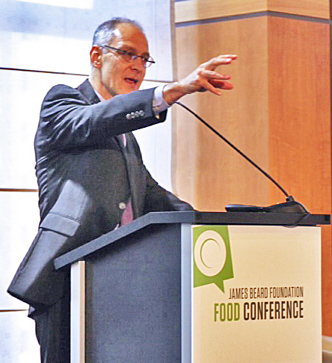
Ezekiel Emanuel addresses the James Beard Food Conference today in New York City. (Obama Foodorama/Edward Gehman Kohan)
NEW YORK CITY — The recent lower earnings reports from McDonald’s and Coca-Cola are the “best indications” the success of First Lady Michelle Obama’s “Let’s Move” campaign, Ezekiel Emanuel said here today at the James Beard Food Conference.
“Whatever you think about the successes and failures of Let’s Move, and it has had challenges … the best indications are poor earning levels at McDonald’s and Coke,” noted Emanuel, a physician and former White House health policy adviser, who is now a vice provost and medical school professor at the University of Pennsylvania.
He also said the fact that neither company seems to have a firm strategy to address the issue, plus the Disney Company’s decision to emphasize healthier food indicate “an important change in attitude that is shaping the country.”
“In five years there has been a big change in this country. When we launched the first lady’s Let’s Move initiative, the goal was to change childhood obesity in a generation,” Emanuel said.
“We wanted to focus on children. We wanted to focus on childhood to intervene early. We knew it would not be overnight,” he said, noting that McDonald’s “has been around for 50 years.”
Speaking more broadly, Emanuel said that when he was one of the architects of the Affordable Care Act during the first two years of the Obama administration, “I always viewed the work on nutrition as connected to the work on health care reform.”
“Nutrition is a public health problem not best dealt with in the physician office,” Emanuel said. “Like smoking it needs to be addressed in a public health way.”
Changing food policies within the federal government is difficult, Emanuel said, telling the conference attendees “don’t minimize [restaurant] menu labeling” that is in the Affordable Care Act even though it has not been finalized or the $15 million earmarked for the prevention trust fund, even though it has been raided for other things.
He said one of the biggest problems in working on health care in the federal government is that health policy is divided among so many agencies including the Food and Drug Administration, the Federal Trade Commission and the Agriculture Department.
“Not all these agencies agree all the time and they have their own interest groups and priorities,” he said.
In trying to make changes in Washington, “the most important thing is to have people in the White House to bridge these agencies who can convene them regularly with a clear and unrelenting mission. Fortunately this administration has had them.”
Emanuel, whose brother Rahm Emanuel was President Barack Obama’s chief of staff at the time the Affordable Care Act was developed, played a role in the administration’s shift from the “Food Pyramid” for dietary advice to “My Plate,” which replaced it in 2011.
That change, he said, was an example of the importance of the White House working across agency lines.
“I had a lot of degrees after my name and I still couldn’t figure [the pyramid] out,” Emanuel said. “There was a whole set of bureaucracy that was invested in the pyramid.”
“The first thing we did was hold a meeting at the White House on how you change people’s behavior,” he said. Executives from Weight Watchers and the designers of the pyramid were among those invited.
It became clear, Emanuel said, that everyone in the room believed “the pyramid sucked.”
“Getting people to agree it was a bad idea was important about moving forward,” he added. “We wanted simple. One of the things that corrupted the pyramid was that we tried to put too much into it.”
Emanuel said he was able to get consensus on the change to My Plate, which recommends that half a plate be fruits and vegetables, “because we could drive it from the White House.”
Trying to address advertising to children on TV “was much harder to do,” Emanuel said, because there was “lots of money” involved and the rise of social media could undermine efforts to reduce advertising.
The regulatory process is easier than getting a piece of legislation through Congress, he said, but getting a regulation through the process takes two years, he noted.
It was determined that it would be “easier” to get the private sector to act on its own, Emanuel said, but that effort ultimately failed when the Federal Trade Commission withdrew a proposal for volunteer guidelines on children’s food advertising.
Emanuel noted that he and Sam Kass, who was a deputy White House chef and is now the White House nutrition adviser, tried to work with the Grocery Manufacturers Association on front-of-the-package labeling.
“I am still waiting to see it,” Emanuel said. “I greatly regret that we could not force the federal agencies to change it.”
