War over school lunch rules will continue into 2015
September 10, 2014 | 06:10 AM
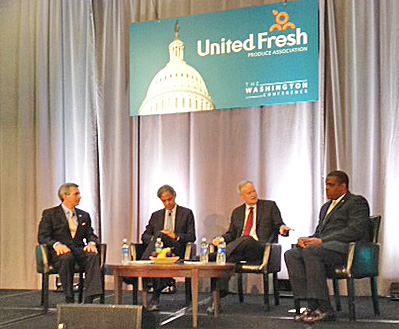
From left, retired Rear Adm. Jamie Barnett of Mission: Readiness, Eduardo Sanchez of the American Heart Association, United Fresh CEO Tom Stenzel, and National PTA President Otha Thornton discuss school meals rules at the United Fresh Produce Association luncheon Tuesday. (Jerry Hagstrom/The Hagstrom Report)
The war over healthier school meal rules appears likely to intensify as Congress considers the fiscal year 2015 and 2016 Agriculture appropriations bills and reauthorization of child nutrition programs.
On Tuesday the United Fresh Produce Association hosted a luncheon at which Mission Readiness, the American Heart Association and the National PTA urged fruit and vegetable growers to defend the programs on their visits to Capitol Hill this week.
Leaders of those groups said the school meal rules are vital to fighting obesity and improving children’s health, and they cited a poll released Monday that showed 72 percent of American parents support the healthier school meal and snack rules while 91 percent support requiring schools to include a serving of fruits or vegetables with every meal.

“You are going to walk the hallowed halls of Congress,” retired Rear Adm. James A. “Jamie” Barnett, leader of Mission: Readiness, said to the fruit and vegetable growers and executives. “Retreat is not an option. This is too important.”
But the same afternoon, Patti Montague, CEO of the School Nutrition Association which represents the school food service directors and the companies that make school foods, put out a news release.
It said SNA welcomed the results of the poll, which had been financed by the Pew Charitable Trusts, the Robert Wood Johnson Foundation, and the American Heart Association, but that “we don’t think parents would want their cafeteria staff to force children to take foods they don’t want on their tray, particularly when it contributes to an estimated $684 million in food waste each year.”

Montague said that a study recently published in Public Health and Nutrition, researchers from Cornell and Brigham Young Universities found that forcing students to take a fruit or vegetable with each school meal, as opposed to offering and encouraging these choices with each meal, results in a nearly 100 percent increase in waste.
But while SNA used the study for justification of its proposal that the fruit and vegetable requirement be dropped, the study says that schools should do more to encourage the children to eat fruits and vegetables. (See link.)
At the United Fresh luncheon, Barnett said “Childhood obesity is a national security problem. It borders on a crisis.”
Noting that the military says 70 percent of Americans between the ages of 17 and 24 are not fit for service and that being overweight or obesity is the biggest single reason, Barnett said that the problem of weight “seriously impacts the ability to recruit.”
The current U.S. armed forces “are fit and able to do what we need, but we have to look towards the future. It will require we grownups take action now. Kids consume up to half their calories in school.”
The school lunch room, Barnett said, should be viewed “as a classroom to develop healthy lifestyles.”
“Whenever change is made there will be people who lead, people who follow and people who resist,” Barnett said, adding that he was not impressed when Congress intervened to require that the Agriculture Department consider the tomato sauce on pizza to be a vegetable.
Barnett said there would be “some tough sledding ahead” because “opponents will chip away” at the rule.

Eduardo Sanchez, the chief science and medical officer for the American Heart Association, said the latest studies have shown that “childhood obesity has leveled out” but “leveling out does not mean we are in a good place. It means we need to reverse it. The Healthy Hunger-Free Kids Act is making a difference that has to be protected.”
Healthy eating habits developed when children are young can last a lifetime, he said.
Noting that children exhibit levels of high blood pressure and diabetes that were not seen 30 years ago when he was in medical school, Sanchez said these problems should be addressed outside the medical setting.
“Prescriptions for fruits and vegetables should be written just like medications,” he said.
Sanchez urged the United Fresh members to take Congress a three-point message:
- Fruits and vegetables are essential for good health and are the right medicine
- Protect fruits and vegetables in healthy school meals
- Do not repeal the requirement that children select a half-cup of fruits and vegetables at breakfast and lunch.
Instead of retreating, Sanchez said, “let’s make the kind of adjustments teams make at half time. Teams don’t retreat. They figure out how to do it better.”

National PTA President Otha Thornton, a retired Army lieutenant colonel who worked in the White House, said PTA’s support of healthier school meals is in the tradition of an organization that promoted kindergarten and child labor laws.
“It takes courage to buck any system,” Thornton said, noting that the school meals program has a budget of $10 billion per year.
“Fighting for the healthier school meals is right,” Thornton said. “That is exactly what we are doing, preparing for a fight.”
Offering waivers, which the House Republicans have proposed for schools that say they are losing money in their lunch program, “is in essence rolling back national standards,” Thornton said. “The children need the same standards” no matter what state they are in, he said.
“Tell lawmakers to maintain the current standards,” Thornton said. “Tell the lawmakers to do right by our children.”
He also urged the fruit and vegetable producers to partner with PTA once they get back home to encourage healthy meals in the schools. All 4.3 million parents who belong to PTA could become lobbyists for healthy meals, he said.

United Fresh CEO Tom Stenzel, who chaired the discussion, said in a news release that “There can be no going back to water down the modest requirement that children take at least one-half cup of fruit or vegetable at breakfast and lunch. Instead, we should be looking for ways to reach our public health goal of half the plate being fruits and vegetables, not just half a cup.”
▪ Public Health and Nutrition study — Default options, incentives and food choices: Evidence from elementary-school children
▪ School Nutrition Association — Protect School Meal Programs
