Vilsack announces $200 million SNAP employment program
August 25, 2014 | 06:30 PM
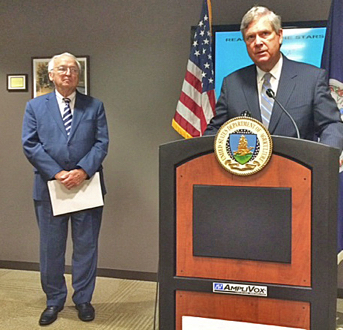 Agriculture Secretary Tom Vilsack, right, announces $200 million in grants to help food stamp beneficiaries get job training. At left is Agriculture Undersecretary for Food, Nutrition and Consumer Services Kevin Concannon. (Jerry Hagstrom/The Hagstrom Report)
ARLINGTON, Va. — Fulfilling a key provision in the 2014 farm bill, Agriculture Secretary Tom Vilsack announced here today that USDA is asking states to apply for $200 million in grants to conduct employment and training pilot projects and evaluations for beneficiaries of the Supplemental Nutrition Assistance Program, better known as SNAP or food stamps.
During the farm bill debate, some conservative Republican House members attempted to make eligibility for SNAP more difficult or to link receipt of food stamps to work. When the House went to conference with the Senate, however, the final bill instead included a provision to improve education and training programs for SNAP beneficiaries.
Educating and training people and connecting them to jobs is “the right way” to reduce the cost of the SNAP program, rather than restricting eligibility, Vilsack said. State grant applications are due by November 24, and the winners would be expected to put the programs into effect by October 1, 2015 for a period of three years.
Vilsack made the announcement today at an Arlington County Employment Center, which he described as one of the best in the nation in finding jobs for the unemployed. After taking a tour, Vilsack noted that the center places 80 percent of the people who come there for help.
The Agriculture Department already spends about $400 million per year in a little-known employment and training program for SNAP beneficiaries. The idea behind the new grants is to find better ways to connect the unemployed who are getting SNAP benefits with jobs.
USDA already has a division that runs the employment and training programs, and staff in that division will decide which states get the 10 pilot projects, but the farm bill also provided $35 million of the $200 million for outside evaluation of the pilot projects.
Vilsack said he expects universities to apply for the funds. The solicitation for the evaluation contract was also released today and proposals are due October 1.
The purpose of the projects is to “do a better job” of finding ways for people to reduce their need for food stamps, Vilsack said.
The evaluators will be expected to finish their work before Congress writes the next farm bill in 2018, Vilsack said, but he added that he believes the information will be available much earlier.
“Many SNAP participants are struggling to find work, and a large percentage already have a job but are getting paid so little that they still need assistance to put food on the table,” Vilsack said.
“When provided the opportunity to obtain additional skills many SNAP recipients are able to obtain a good job and transition out of the program. The grants announced today will allow us to test innovative approaches to give folks the opportunity to get training, get a good job and build stronger futures for their families,” he said.
USDA intends to test a wide array of approaches, including those focused on education and training, rehabilitative services for individuals with barriers to employment, rapid attachment to work, and other strategies, the department said in a news release.
“USDA is particularly interested in pilots that target hard-to-serve populations, and test job-driven training strategies that include work-based learning or career pathway approaches or utilize strong public-private partnerships,” the release said.
USDA is looking for states to submit proposals that target populations indicated by the farm bill, including individuals with a low level of skills, able-bodied adults without dependents, and recipients who are working in very low-wage or part-time jobs, the release continued. The grants will be distributed across a range of geographic areas, including rural and urban parts of the country.
Agriculture Undersecretary for Food, Nutrition and Consumer Services Kevin Concannon said he has observed SNAP employment and training programs around the country, and that they vary dramatically in structure.
All 53 state agencies currently administering SNAP are eligible to apply, including all 50 states, the District of Columbia, Guam and the Virgin Islands. Awards will be announced in February 2015.
The request for applications is available on www.grants.gov and on the FNS website.
▪ USDA Food and Nutrition Service — Request for Applications: FY 2015 Pilot Projects to Reduce Dependency and Increase Work Requirements and Work Effort Under the Supplemental Nutrition Assistance Program
▪ — Pilot Evaluation Request for Proposals
