School meals debate continues in Boston and Washington
July 15, 2014 | 06:47 PM
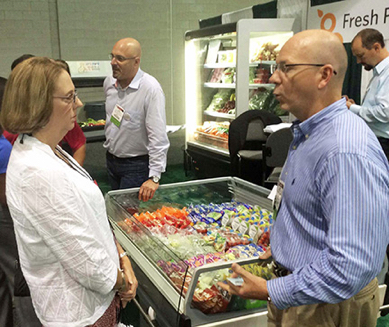
Cindy Jones of the Haralson County Schools in Georgia and John Alpers of Royal Food Service in Atlanta discuss providing fruits and vegetables to the schools at the United Fresh Produce Association booth at the School Nutrition Association’s national conference in Boston. (United Fresh photo)
The debate over healthier food rules for school meals continues this week at the School Nutrition Association’s Annual National Conference in Boston, while First Lady Michelle Obama plans a White House Kids’ State Dinner Friday featuring healthy food recipes submitted from children in all the states and territories. (See following story on the White House event.)
Officials of SNA, which represents school food service directors and the companies that supply foods to schools, have shown no signs of backing down from their support for a Republican House proposal to require USDA to grant a one-year reprieve from healthier food rules to any school that has been losing money in its meals program for six months, according to participants in the meeting.
The provision is included in the House version of the fiscal year 2015 Agriculture Appropriations bill, but House Democrats and many nutrition and medical groups and the Obama administration oppose it. The provision is so controversial it appears to be the reason the House leadership withdrew the bill from floor action and so far has not scheduled it to be brought up again.
SNA has also proposed reducing some rules permanently when school meals come up as part of the scheduled reauthorization of all child nutrition programs next year.
Processed foods companies that have traditionally supplied schools have entertained the school food service directors at big parties, and many are exhibiting at the trade show in Boston.

Meanwhile the United Fresh Produce Association, which represents the fruit and vegetable industry, is exhibiting at the SNA convention for the first time and holding workshops about making efficient fruit and vegetable purchases.
“There was a lot of Interest in the fresh-produce vending machine that had a wide variety of single-serve fresh and fresh-cut produce items to illustrate an innovative approach to smart snacks In schools,” said Lorelei diSogra, United Fresh’s nutrition director.
School food service directors were taking photos of the “Smart Snacks” machine and wanting to know how their school could get one, diSogra said. She added that United Fresh produce distributors exhibiting at the convention were busy answering questions from school food service directors, and that attendance was good at the produce workshops.
SNA officials have complained that the healthier meals rules and the requirement that fruits and vegetables be served at each meal have led some students to reject the new meals or throw food away, and that both problems have led to financial problems with some school meals programs.
Under the 2010 Healthy Hunger-Free Kids Act, school meals have had to offer more whole grains, fruits and vegetables and limit the calories and unhealthy fats in school meals. The rules become stricter on July 1, and snacks served in schools and sold in vending machines and a la carte lines must also limit calories, fat, sodium and portion sizes for foods and beverages.
Although the Agriculture Department has toned down some rules, the SNA has complained the changes are not enough. However, SNA is holding sessions at its conference on how to comply with reduced sodium requirements and how to meet professional standards for food service employees.
But in a pre-meeting news release, SNA included comments from participants that showed the concerns vary dramatically. Some of those quoted in the SNA release praised the processed food companies for coming up with foods that meet the new requirements while others said they had learned how to incorporate more fruits and vegetables into school meals.
In Boston, the school nutrition executives will be looking for ways to “rise above these challenges,” said SNA President Leah Schmidt, director of nutrition services for Hickman Mills schools in Missouri.
“You’ll find familiar brands here in the Exhibit Hall than you see in grocery stores, but prepared with more whole grains, less fat, lower sodium and fewer calories to meet nutrition standards,” said Renee Hanks, director of food services for South Colonie Central Schools in Albany, N.Y. “Exhibitors are offering recipe ideas and culinary demonstrations to incorporate more produce in school meals.”
“The school food service market has been ahead of many retail trends,’ said Gary Vonck, SNA industry representative and vice president of the education division for key impact sales and systems. “Exhibitors have dedicated extensive research and development resources to make these changes work for the unique needs of schools.”
“I’ve been coming to [the conference] for years to get new ideas from exhibitors,” said Jackie Morgan, director of food services for Milton Public Schools in Massachusetts.
“Many offer ingredients with great versatility and provide menu-planning details, which is so important to me as an operator,” Morgan said. “If I am in the market for a chicken filet, I want to see how we can prepare it in 10 different recipes so I can ensure it’s a cost-effective purchase. This year, I’m also searching for a whole-grain elbow pasta that’s lighter in color and soft in texture.”
“My main concern at [the conference] this year is finding daily entrée choices that meet new Smart Snacks in School requirements for students who don’t want to purchase a full meal,” said Sara Gasiorowski, director of Wayne Township Food Services in Indiana. “There are practical challenges, for example, a healthy turkey sub that is popular with my students and meets the Smart Snacks calorie caps and whole grain requirements, but not the sodium limits.”
“We have had success with students choosing a variety of fruits and vegetables, but are still struggling with whole grains,” said Kristin Morello, director of Reading and Wakefield Public Schools Food Service in Massachusetts. “I’m looking for whole grains that don’t look or taste whole grain to students, including pastas that can hold up in batch cooking without getting mushy or chewy.”
“A few years back, I was seriously questioning the viability of adding salad bars in my schools,” said Jessica Shelly, the food services director for the Cincinnati Public Schools. “After extensive discussion and participation with my colleagues in [conference] sessions, I had a complete turn-around on salad bars. I’ve now hosted education sessions on the subject, and this year I am presenting on how to make practical, cost-effective changes in your program to attract students.”
“I work with 28 school districts in Michigan, where many programs are really struggling to manage costs,” said Lori Adkins, child nutrition consultant for the Oakland Schools in Michigan.
“Menus have direct impact on the bottom line, driving labor, food costs and equipment expenses,” Adkins said. “It’s wonderful to put an edamame or kale salad on the menu, but we have to address the reality of costs. Schools need to find ways to balance some of the innovative and more expensive menu items with more affordable options that meet both the standard and appeal to students.”
▪ Associated Press — School officials try healthier cafeteria options
