Vetter receives warm welcome at Senate Finance
May 08, 2014 | 08:36 PM
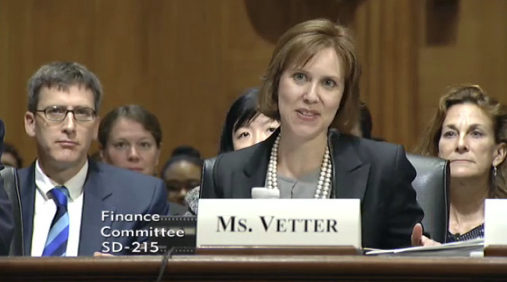 Darci Vetter testified at the Senate Finance Committee this morning as it considered her nomination to become chief agriculture negotiator at the Office of the U.S. Trade Representative. At left is her husband, Jason Hafemeister, who works in the Office of the Chief Economist at USDA. (From Senate Finance Committee video)
Darci Vetter, President Barack Obama’s nominee for chief agriculture negotiator, a position with ambassadorial rank, received a warm welcome today at her nomination hearing before the Senate Finance Committee.
Vetter, a former Senate Finance Committee aide who is now the Agriculture deputy undersecretary for farm and foreign agricultural services, was praised even before she was introduced, presented herself, and discussed issues.
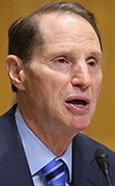
Senate Finance Committee Chairman Ron Wyden, D-Ore., said in his opening statement, “It will be important for the United States to have a skilled hand in these negotiations, and Darci is the right person at the right time.”
“Right now, for example, the U.S. is in the middle of important, yet difficult, negotiations with Japan and other Trans Pacific Partnership participants regarding America’s most important agricultural crops: wheat, dairy, poultry,” Wyden said. “We will be relying on Darci to push for the comprehensive and ambitious outcome that our farmers and producers expect and our economy needs.”
Senate Agriculture Committee Chairwoman Debbie Stabenow, D-Mich., who is also a member of Finance, noted that she had traveled with Vetter in Brazil last year and “noticed her skills. I am very, very confident of Ms. Vetter’s abilities.”
Stabenow also said that 97 food and farm organizations had endorsed her nomination.
Senate Finance ranking member Orrin Hatch, R-Utah, said that Vetter and the other nominees considered today “are extremely well qualified.” Hatch noted the challenges ahead of her are “daunting” and said, “I don’t envy you.”
Vetter, who grew up on a farm in Nebraska, was presented to the committee by Sen. Mike Johanns, R-Neb., who said she would be a “great asset” for the Office of the U.S. Trade Representative.
Sen. Rob Portman, R-Ohio, a U.S. trade representative in the George W. Bush administration, said that when he was at USTR and Vetter and her husband, Jason Hafemeister, worked in that agency, he considered them to be “two of the real stars at USTR.”
Hafemeister now works in the Office of the Chief Economist at USDA.
In her opening statement, Vetter noted that she grew up on a farm “where my family also operates a grain processing business that exposed me to the benefits of trade at a very early age.”
“In the 1980s, at a time when many farmers were moving off the farm, my family found foreign markets to sustain our family business,” she said. “Some of our first foreign customers were tofu makers in Japan, who were willing to pay a premium for our high quality soybeans. Today our family business has nearly 30 employees, thanks, in part, to open and reliable overseas markets.”
Touching on the sensitive issue of executive branch consultation with Congress on trade issues, Vetter promised to “strengthen” the relationship between the executive branch and Congress.
Vetter also said she is “committed to leveling the playing field for our farmers and ranchers, and holding our trading partners accountable by enforcing trade rules to ensure our products are treated fairly.”
“Using all the tools at our discretion, including the dispute settlement body at the World Trade Organization, I intend to press our trading partners to make decisions based on science and eliminate unwarranted sanitary and phytosanitary (SPS) measures that restrict safe, wholesome U.S. agricultural products from entering their markets.”
“The United States is the world’s largest agricultural export economy,” she noted. “U.S. food and agricultural exports reached an all-time high in 2013, accounting for $148 billion in exports. I believe there is much more we can accomplish.”
During the question-and-answer session, Vetter also promised to enforce strong trademarks for U.S. brands, work with the European Union negotiators on geographical indicators but make sure that the U.S. dairy industry can export its products “under generic names” and promote U.S. biotechnology and nanotechnology.
Vetter said she believes there has been some progress in European acceptance of U.S. poultry because the European Safety Agency recently approved a treatment for pathogen reduction in poultry.
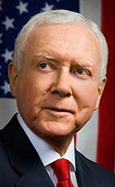
In his opening statement, Hatch told Vetter that the success of the Trans-Pacific Partnership agreement depends on “achieving a full and comprehensive agreement on agricultural products with Japan” and that it “has me concerned.”
Japan, he noted, has sought to exclude more than 500 agricultural products from eventual tariff elimination, which he said would be “unprecedented” because the United States is party to 17 free trade agreements and only 33 tariff lines have ever been excluded from tariff reduction.
“If Japan is allowed to exclude products from liberalization, other TPP countries will soon follow, resulting in an even weaker agreement,” Hatch said, adding that European Union negotiators will be watching the negotiations with Japan to determine how to negotiate in the Trans-Atlantic Trade and Investment Partnership agreement.
Hatch said that with Japan, “It is far more important to get this deal right than to get it done now. I expect that you will continue negotiating until you’ve reached an agreement on full and comprehensive liberalization with Japan.”
Vetter noted that Japan has agreed to negotiate on all agricultural products, including the sensitive topics of wheat, rice, dairy, beef, pork and sugar. She also told Sen. John Thune, R-S.D., that the U.S. negotiators’ goal is to eliminate all tariffs and that they will go “line by line to achieve the most we can.”
Thune also said that the deal with Japan could affect negotiations with Canada, and that, while dairy producers in the Southwest have been able to export to Mexico, South Dakota dairy producers have been “limited” in their ability to export to nearby Canada.
Vetter said that the time has come for Canada to open up to U.S. dairy, poultry and egg products and that achieving that goal “will be one of my top priorities.”
Thune also noted that China’s lack of approval for certain U.S. biotech products has reduced U.S. exports, and Vetter noted that she has been working on that issue at USDA.
Wyden said he would attempt to confirm Vetter and other nominees “expeditiously,” but did not announce a schedule.
Wyden said that all in order to pass trade promotion authority in Congress there needs to be “a big educational job” because there are “only a handful of Democrats still in the House who have voted” for TPA, which is also known as fast-track trade negotiating authority. Wyden also said that trade officials need to “look at ways to bring younger people into this discussion.”
| ▪ |
