Vilsack talks trade and Whole Foods to Council on Foreign Relations
April 11, 2014 | 11:44 AM
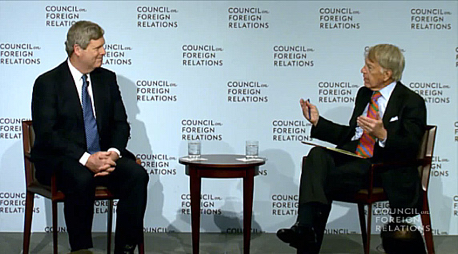
Agriculture Secretary Tom Vilsack discusses the implementation of farm bill, food security, and immigration reform, with Roger C. Altman, founder and chairman of Evercore Partners, Inc., on Wednesday as part of Council on Foreign Relations Renewing America series. (From CFR video)
Japan’s tariff reduction for beef that Australia has accepted in a free trade agreement would not be enough to convince American beef producers to accept it, Agriculture Secretary Tom Vilsack said this week in a wide-ranging discussion at the Council on Foreign Relations in New York City.
The tariff reduction in the Japan-Australia free trade agreement “was not all that significant,” Vilsack said Tuesday when he was interviewed at the CFR headquarters by Roger Altman, an investment banker and former Democratic official. Video of discussion can be viewed on the CFR website. (See link below.)
He added that it is still unclear whether the Trans-Pacific Partnership Agreement with 12 Asian countries will succeed, whether Japan will be a part of it or whether the agreement might be concluded without Japan.
(See preceding story)
It would be good to have a trade agreement, Vilsack said, but it would be better to have no agreement than a bad one, he said.
Vilsack also noted that both Japan and the United States have powerful agricultural lobbies and that even if an agreement is good for manufacturing and services, if it is not good for agriculture “you couldn’t get it through Congress.”
In the Trans Atlantic Trade and Investment Partnership negotiations, Vilsack said, the issues are biotechnology and geographical indicators.
Tom Vilsack
“These are very tough issues in which the EU has taken a very bright line approach,” Vilsack said. If the European Union consists to insist on using its precautionary principle, “Our biotech products would receive very little access to market,” he said.
“I think they need to be more open, especially on the biotechnology side.”
On geographical indicators, which say that certain products must come from the place in which they originated to use the name from that place, he noted that the European Union has begun negotiating “one-offs” with countries that do not produce a lot of that product.
Geographical indicators, he noted are important to the U.S. dairy industry.
Political problems in Ukraine “have not had major influence on markets at this point,” he said.
The United States “should do more business with Russia but they have created artificial barriers that are not scientifically defensible.”
The United States does not object to other countries gaining access to U.S.-produced technology, he said, because its use creates bigger middle classes and more opportunity to sell higher-valued U.S. products.
Some resistance to biotechnology, Vilsack said, comes because countries want to protect their farmers and industry. About 300,000 U.S. farmers produce 85 percent of U.S. food and 33,000 farming operations produce more than half of it while in China there are 60 million farmers and the country does not produce enough food to feed itself.
Noting that the Chinese are not pleased that they import so many soybeans from the United State, Vilsack said, “Food security is a national security advantage and we ought to hang on to that.”
Vilsack said the U.S. challenge is “to create a single message about biotechnology” and that he has urged the Brazilians to join him in talks with the Chinese. The United States, he said, “has farmers and scientists and policymakers talking all over the world.”
But he also said that the Obama administration “has attempted to create an atmosphere in which no single type of agriculture is judged as less effective. All types of agriculture should be celebrated,” including organic production.
But he added that as the world deals with changing climate, more intense weather patterns, expanding cities, less land available for agriculture and a growing population “we have to embrace science.”
Altman noted that most people in the audience “know where their food comes from, it comes from Whole Foods,” which led to a discussion about the conflicts between industrial production and other concerns about agriculture.
Vilsack said that after meeting with a group of ministers about the problem of access to healthy food in cities, he asked a Whole Foods official what the company is doing about providing food “to inner city America.”
The official responded by sending a team to Detroit and later opening a store there. The Whole Foods in inner city Detroit does not have the same variety of some other Whole Foods stores, he said, but it “is doing really well.”
Beneficiaries of the Supplemental Nutrition Assistance Program, better known as SNAP or food stamps, are using their benefit cards in the store, Vilsack said, just as they do in farmers’ markets.
“We shouldn’t segregate them to discount stores,” Vilsack added, noting that foundations are also providing double bucks coupons to increase purchases of fruits and vegetables.
Asked about concerns that industrial agriculture lead to animal welfare concerns and overproduction, Vilsack said, “When you think of agriculture you have to think in thirds. One third is social issues. There is the environment piece and the economics piece.”
Scientists have not found any difference in the health effects of industrial versus organic and locally produced food, he said, but “The market is going to address some of the issues you have raised.”
“This administration has not focused solely on production agriculture, but has spent resources creating a more welcoming atmosphere for the others,” he added.
Asked by a member of the audience to speak about climate change “in Wall Street terms,” Vilsack said he was not sure he could because “I am a Main Street kind of guy.”
But he said, “We ignore climate change at our peril,” noting that farmers are using cover crops and the country has the opportunity to export technology that will deal with many issues associated with climate change.
Vilsack also discussed food stamps at the CFR appearance and on The Rachel Maddow Show on MSNBC the same day, saying an increase in the minimum wage would reduce food stamp participation rates.
