Argentine farm community working to persuade government on ag policies
April 04, 2014 | 02:09 PM
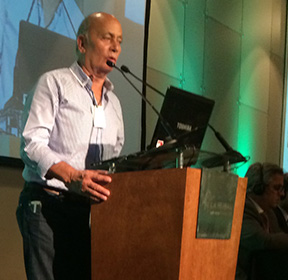 Gerónimo Venegas, secretary general of Unión Argentina de Trabajadores Rurales y Estibadores, the Argentine farmers union, speaks to the World Farmers’ Organization in Buenos Aires last week. (Jerry Hagstrom/The Hagstrom Report)
By JERRY HAGSTROM
BUENOS AIRES — Argentine farm workers, ranchers and farmers have come together to try to convince the Argentine government to establish more pro-agricultural policies, a key farm worker leader told farm leaders from all over the world gathered here last week.
“If politicians don’t understand that with their authority they can change the situation of the country they are in bad shape,” Gerónimo Venegas, secretary general of the Unión Argentina de Trabajadores Rurales y Estibadores (UATRE) told the World Farmers’ Organization in a speech on March 27.
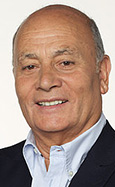
Gerónimo Venegas
“We need jobs, we need corporate profitability. This is a debate that farmers should lead,” Venegas said to the WFO, an organization of 70 farm groups in 50 countries which hope to influence policy at the United Nations and exchange information about farming in each of their countries.
In most countries of the world, farmers and unionized farm workers are often on opposite sides but in Argentina, Venegas said, they have long worked together and jointly recognize that they have problems with the government headed by President Cristina Fernández de Kirchner.
Kirchner and her late husband, Nestor, who was first elected president in 2003, imposed high taxes on agriculture and a ban on beef exports at one point. Both have made it harder for Argentina to be competitive in international markets and to be considered a reliable supplier.
There is a long history leading to this point.
Since the 19th century, agriculture, dominated until recently by beef production, has been Argentina’s internationally competitive industry, the source of both wealth and taxes. The Spanish distributed much of the country’s land in huge estates, and until the 1930s the landowners dominated the Argentine economy and politics.
In that era, Juan Perón and his wife, Evita, took power and shifted government spending toward the impoverished urban masses. Taxes on agricultural exports have been a mainstay of government finances, although economists point out that few other countries impose them because they make the country’s products more expensive and are counterproductive to sales.
Since the Kirschners came to power, urban-rural relations have often been tense and have worsened. The agriculture minister has not met with Argentine farm groups for several years and did not accept an invitation to welcome the WFO to Buenos Aires for its meeting, which was held at the fair grounds and headquarters of the Sociedad Rural Argentina, which represents the largest landowners.
Noting that agriculture is growing faster in neighboring countries than in Argentina, Venegas said, “We have a problem, a political problem. We must make the national government understand that the farmers need to work. Argentina could produce three times what it does.”
Venegas said that he is a member of the Peronist ruling party, but that he does not consider the Kirschners true Peronists.
Venegas, who represents more than a million farm workers, said that he negotiates with the Sociedad Rural and other farm groups over wages and benefits, but works with them to register workers, avoid child labor and for the benefit of the industry over all.
“I know what poverty is,” Venegas said. “I worked on the farm at 9 years old. We have to strive that there are no child workers.”

Luis Etcheverre
Luis Etcheverre, the president of Sociedad Rural, arranged for Venegas to speak and said that the union and the society do work together.
Etcheverre said that within the Peronist Party there are “different lines” and that the farmers have “a very good relationship” with some Peronists. Etcheverre described the Kirschners as “different from Peronists. They are populists.”
In 2008, when the government raised taxes on agricultural exports and the farmers went on strike, refusing to sell their products, the union supported the farmers and there were mass protests, Etcheverre noted. The government eventually pulled back on the export tax increase.
Some Argentine farmers and investors have started operations in Uruguay, Paraguay, Chile, Brazil and even Bolivia, Etcheverre said. Bolivian President Evo Morales is a socialist, but land taxes are lower than in Argentina and there are no export taxes, he added.
“We are exporting people with knowledge and markets,” Etcheverre said.

Adela Nores Bodereau
Still, most Argentine farmers are staying in business in their home country and modernizing along with the rest of the world. Use of genetically modified seed is common in Argentina. Soybean production has increased dramatically in recent years.
Pablo Tagliani, an independent agriculture consultant, confirmed that Argentine farmers and their union really do work together. Despite the political problems, Tagliani said, the farmers still have the advantage of rich, deep soil.
Santiago del Solar Dorrego, a farmer, told the WFO that Argentine farmers have shifted toward no-till farming recent years but without the technical assistance from the government that farmers have gotten in many other countries.
“We are determined,” said Adela Nores Bodereau, the director of institutional relations for the Sociedad Rural and a rancher who lives several hours from Buenos Aires.
