Report says Americans garden more, as first lady starts pollinator plants
April 02, 2014 | 09:33 PM

First Lady Michelle Obama helps school children plant oats, a new crop for the White House kitchen garden. (Jerry Hagstrom/The Hagstrom Report)
Gardening has grown 17 percent in the United States in the past five years, with a huge increase among people 18 to 34, the National Gardening Association reported today as First Lady Michelle Obama and Food Corps volunteers helped school children plant the sixth kitchen garden.
Thirty-five percent of all households — 42 million — now have gardens, and spending on gardening has risen from $2.5 billion in 2008 to $3.5 billion in 2013, a 40 percent increase in five years, according to “Garden to Table: A 5-Year look at Food Gardening in America,” the report published by the National Gardening Association.
But the most interesting statistics in the report are about the young people known as the millennial generation—ages 18 to 34—who are the fastest growing population segment of food gardeners.
In 2008 there were 8 million millennial food gardeners, but there were 13 million in 2013, an increase of 63 percent, the report said. The millenials’ spending on food gardening rose from $632 million in 2008 to $1.2 billion in 2013.
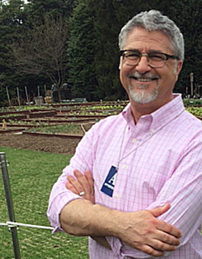
“The 18- to 24-year-olds are re-engaging in where their food is coming from,” said Mike Metallo, president and CEO of the National Gardening Association, based in Williston, Vt. He answered questions on the White House lawn as he waited for Obama to help the students plant this year’s garden.
“National leadership, particularly from the first lady, has certainly been an important factor in the rise in these numbers,” he said. “That consistent message over time makes a tremendous difference and helps fuel more community involvement in gardening.”
Metallo also credited an improving economy and efforts by the Agriculture Department and the Health and Human Services Department to increase awareness of gardening for the increase. The worst period for gardening was after World War II, he noted, when people considered the Victory Gardens they had planted during the war “an obligation” and were happy to leave food production to farmers.
After the first lady walked down the lawn to the area close to the south fence, she called out the names of the schools whose students were invited this year — Harriet Tubman, Kimball, Cleveland and Friendship Public Charter School — and recognized volunteers from FoodCorps, a division of AmeriCorps with a program that sends young people to spend a year after college in a school or community encouraging the planting of gardens and healthy eating.
The first lady also noted that the garden would have a new feature this year.
“We are going to plant something called a pollinator garden,” she said. “A pollinator garden helps to encourage the production of bees and monarch butterflies.”
“And why do we need to do that?” she continued. “They’re dying because of disease — we don’t even know why some beehives are just totally disappearing. But that could be a problem for the planet because if you don’t have insects and great pollinators to pollinate the plants, it could affect our food source, it could affect our ability to continue to grow things.”

Doug McKalip, senior policy adviser for rural affairs with the White House Domestic Policy office, was helping with the garden planting today, and said that the pollinators included Shenandoah switchgrass, willow leaf blue star, purple love grass, lobelia, ceanothus americanus and a paw paw tree, which is indigenous to the southeastern United States.
McKalip said he has been one of the White House aides who have helped maintain the garden, but that this was his first time to help plant it. Including pollinator plants made the experience “extra special,” said McKalip, who had a long career in the Natural Resources Conservation Service at the Agriculture Department.
Ann Burns, a social worker who accompanied the students from Kimball Elementary in Washington D.C., noted that her school has a pollinator garden that attracts monarch butterflies.
The pollinators added a “good science aspect to this garden,” said Lola Bloom, the co-founder of City Blossoms, a Washington nonprofit that encourages gardening in the District of Columbia and has links to FoodCorps.
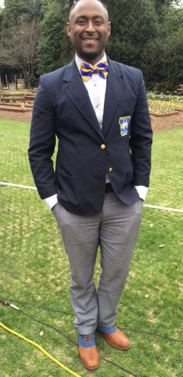
Rictor Craig, the principal at at the Friendship Woodbridge Public Charter School in northeast Washington, said participation at the White House today would provide his students experience for their own garden planting later this month. FoodCorps will provide a full-time employee to help for a year with the garden, the school’s first.
Some students come to school eating pizza at breakfast time because there is a 7-11 convenience store nearby, but Craig said the school is trying to teach them they can buy an apple or something else healthy.
About 65 percent of the students are eligible for free or reduced price lunches, Craig said, and the school offers universal free breakfast and lunch.
About 95 percent of students eat school lunch, he said, adding that “everything we use” is healthy, including the fruits and vegetables and whole grains that have been introduced under the Healthy Hunger-Free Kids Act. The school also offers suppers to children after school and is about to go into partnership with Blessings in a Backpack, a group that provides food packages for the weekends.
The pollinator plants occupy only a small section of this year’s White House kitchen garden.
Under the first lady’s direction, the children planted Lincoln oats for the first time. Sam Kass, the assistant White House chef who cooks for the Obama family, said that if there is a usable crop, he will prepare food with the oats.
The North American Millers Association notes on its website that the Food and Drug Administration allows oats products, including oat bran, rolled oats and whole oat flour, to claim that the type of soluble fiber found in whole oat products (b-Glucan soluble fiber) may lower blood cholesterol levels.
Among the other foods the children planted were rhubarb, radishes, tatsoi, Asian greens, Swiss chard, strawberries, spinach, broccoli and raspberries.
For Bill Yosses, the White House pastry chef who has announced he is leaving, his last garden planting was bittersweet.
“I am sad, but I am going to go out and spread the gospel of healthy cooking and eating,” he told The Hagstrom Report.
▪ National Gardening Association ▪ — Garden to Table: A 5-Year look at Food Gardening in America ▪ FoodCorps, Inc. ▪ City Blossoms ▪ Blessings in a Backpack
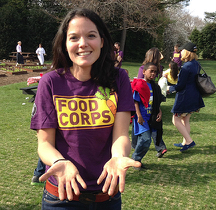
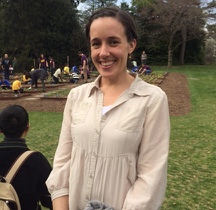 At left: Deb Eschmeyer of FoodCorps shows people can get their hands dirty at the White House. At right: Lola Bloom, the co-founder of City Blossoms, a nonprofit that encourages gardening in Washington. (Jerry Hagstrom/The Hagstrom Report)
White House chefs Chris Comerford and Bill Yosses, right, show the garden to chefs visiting from the San Francisco Bay area who will prepare food for a Greek Independence Day reception Friday evening at the White House. (Jerry Hagstrom/The Hagstrom Report)

Download 2014 White House Vegetable Garden map (The White House)
Planted today in the White House Pollinator Garden
- Amsonia tabernaemontana
- Andropogon virginicus
- Asclepias incarnata
- Asclepias tuberosa
- Asimina triloba
- Aster divericatus ‘Eastern Star’
- Aster lateriflorus ‘Lady in Black’
- Ceanothus americanus
- Chelone glabra
- Clethra alnifolia ‘Paniculata’
- Coreopsis verticillata ‘Moonbeam’
- Eupatorium dubium ‘Little Joe’
- Eragrostis spectabilis
- Helenium ‘Dancing Flames’
- Helianthus salicifolius ‘First Light’
- Heliopsis helianthoides
- Liatris spicata
- Lindera benzoin
- Lobellia cardinalis
- Panicum virgatum ‘Shenendoah’
- Penstemon digitalis
- Phlox maculata ‘Natascha’
- Phlox paniculata ‘Laura’
- Pycnanthemum muticum
- Rudbeckia fulgida var. fulgida
- Rudbeckia laciniata
- Schizachyrium scoparium ‘Prairie Blues’
- Solidago rugosa ‘Fireworks’
- Solidago shortii ‘Solar Cascade’
- Vernonia noveboracensis
- Vaccinium corymbosum ‘Berkeley’
- Vaccinium corymbosum ‘Herbert’
- Vaccinium corymbosum ‘Patriot’
