Quinn: Nominate farmers for World Food Prize
March 27, 2014 | 05:51 PM
BUENOS AIRES — More farmers should be nominated for the World Food Prize, Kenneth Quinn, president of the World Food Prize Foundation, said here today.
“We don’t have any farmers as laureates,” Quinn told the World Farmers’ Organization, composed of 70 farm groups from 50 countries that is holding its annual general assembly here.
Quinn said later in an interview that people interested in nominating farmers for the prize can find information on the foundation website. (See link.)
{I have nothing to do with choosing our winner, but I recruit nominations,” Quinn said, noting that farmer nominations would be particularly appropriate this year because the United Nations is celebrating the “International Year of Family Farming.”
Farmers have been nominated in the past, but not selected, Quinn said. Among the candidates, he said, might be the pioneers of no-till farming or animal breeders.
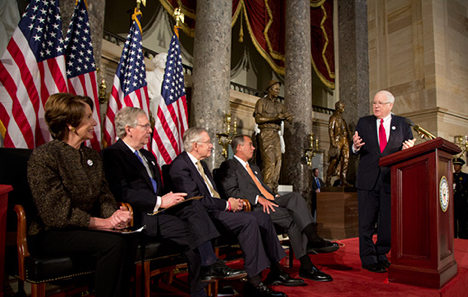
World Food Prize Foundation President Kenneth Quinn spoke at the ceremony unveiling the statue of Norman Borlaug in the U.S. Capitol on Tuesday as, from left, House Minority Leader Nancy Pelosi, D-Calif., Senate Minority Leader Mitch McConnell, R-Ky., Senate Majority Leader Harry Reid, D-Nev., and House Speaker John Boehner, R-Ohio, looked on. (World Food Prize)
Quinn flew here from the unveiling in the U.S. Capitol of the statue of Norman Borlaug, the plant breeder responsible for the Green Revolution. He said the ceremony “could not have been more wonderful,” particularly because congressional leaders decided that the statue could be placed permanently in Statuary Hall.
Each state is allowed two statues of prominent citizens in the Capitol, and Iowa chose to replace one of its statues with the statue of Borlaug.
There has been no monument anywhere to American agricultural production but the statue of Borlaug, who founded the World Food Prize, “is that monument,” Quinn said.
In his speech Quinn noted that the foundation in 2013 awarded the prize to three founders of the biotechnology, a decision that proved controversial. But he said the award was appropriate because the founders had made major contributions to agriculture.
The WFO has taken no position on genetic modification because its members are so divided on the subject, but Quinn told the delegates he believes farmers in developing countries should not be denied genetically modified seeds because they will be the farmers most affected by climate change, and the genetically modified seeds can help them.
In the interview, Quinn said that drought-resistant seeds had kept up food production in the United States in recent years despite a drought and that he believes other seeds are being developed that could help smallholder farms in poor countries deal with floods, drought and salt water intrusion.
Although one WFO participant said today that too much attention is devoted to the development of seeds and that more attention should be paid to other parts of food production including fish, Quinn said improvements in seeds could help smallholder farmers double or quadruple their yields.
“In the end, Norm Borlaug always discussed the question of feeding the 9 billion people in terms of cereal production, “ Quinn said. “That will not be the only but one of the ultimate measures.”
But Quinn also said that decreasing food waste “is the fastest way to cut into the amount we have to produce by 2050.”
With some estimates that one-third of the food produced in the world is wasted in transportation, improper storage, and other inefficiencies, cutting waste “is an absolute imperative finally getting the attention it needs,” Quinn said.
“We don’t have any farmers as laureates,” Quinn told the World Farmers’ Organization, composed of 70 farm groups from 50 countries that is holding its annual general assembly here.
Quinn said later in an interview that people interested in nominating farmers for the prize can find information on the foundation website. (See link.)
{I have nothing to do with choosing our winner, but I recruit nominations,” Quinn said, noting that farmer nominations would be particularly appropriate this year because the United Nations is celebrating the “International Year of Family Farming.”
Farmers have been nominated in the past, but not selected, Quinn said. Among the candidates, he said, might be the pioneers of no-till farming or animal breeders.
Quinn flew here from the unveiling in the U.S. Capitol of the statue of Norman Borlaug, the plant breeder responsible for the Green Revolution. He said the ceremony “could not have been more wonderful,” particularly because congressional leaders decided that the statue could be placed permanently in Statuary Hall.
Each state is allowed two statues of prominent citizens in the Capitol, and Iowa chose to replace one of its statues with the statue of Borlaug.
There has been no monument anywhere to American agricultural production but the statue of Borlaug, who founded the World Food Prize, “is that monument,” Quinn said.
In his speech Quinn noted that the foundation in 2013 awarded the prize to three founders of the biotechnology, a decision that proved controversial. But he said the award was appropriate because the founders had made major contributions to agriculture.
The WFO has taken no position on genetic modification because its members are so divided on the subject, but Quinn told the delegates he believes farmers in developing countries should not be denied genetically modified seeds because they will be the farmers most affected by climate change, and the genetically modified seeds can help them.
In the interview, Quinn said that drought-resistant seeds had kept up food production in the United States in recent years despite a drought and that he believes other seeds are being developed that could help smallholder farms in poor countries deal with floods, drought and salt water intrusion.
Although one WFO participant said today that too much attention is devoted to the development of seeds and that more attention should be paid to other parts of food production including fish, Quinn said improvements in seeds could help smallholder farmers double or quadruple their yields.
“In the end, Norm Borlaug always discussed the question of feeding the 9 billion people in terms of cereal production, “ Quinn said. “That will not be the only but one of the ultimate measures.”
But Quinn also said that decreasing food waste “is the fastest way to cut into the amount we have to produce by 2050.”
With some estimates that one-third of the food produced in the world is wasted in transportation, improper storage, and other inefficiencies, cutting waste “is an absolute imperative finally getting the attention it needs,” Quinn said.
