House Ag Committee leaders: Compromise the key to House passage of farm bill
January 29, 2014 | 05:11 PM


Right: House Agriculture Committee Chairman Frank Lucas, R-Okla., gives a final push for the farm bill. (From C-SPAN video)
Why did the House of Representatives finally pass the farm bill today? What finally garnered the votes?
House Agriculture Committee Chairman Frank Lucas, R-Okla., and House Agriculture ranking member Collin Peterson, D-Minn., for the most part agreed on what happened. Both shared their views on the floor and with reporters after the vote.
The miracle of compromise
“Miracles do occur,” Lucas told reporters, adding that he believed that his House committee and the conference committee had proceeded properly by working together, and should be considered a model for the House in the future.
Peterson, noting that the process had begun four years ago when he still chaired the Agriculture committee, said that the committee members “did what we always did, we worked together. This represents a compromise.”
“I didn’t get everything I wanted,” Peterson said, noting that he really wanted farm payments to be made on currently planted acres. The bill makes them on a farmer’s base acreage, although it can be updated.
Lucas said this week that his greatest regret was that the 2014 law will not become permanent law, but both the Senate and House Democrats wanted the permanent laws from 1938 and 1949 to be a trigger for another farm bill in five years.
Both were obviously thrilled today at the completion of the bill.
“This is a major event for me personally,” Lucas said after he left the House floor.
Peterson said this was the hardest farm bill on which he had ever worked, including the 2008 bill that President George W. Bush vetoed twice. Peterson sounded pleased enough that he is likely to run for re-election. (See following story.)
H.R. 2642 votes compared to H.R. 194
7Today’s House vote on H.R. 2642 — the Agricultural Act of 2014 — was 251 in favor of the bill, 166 opposed and 14 not voting.
In June when the House took up the first comprehensive farm bill, H.R. 1947 — the Federal Agriculture Reform and Risk Management Act — the vote was 195 in favor, 234 opposed and 6 not voting.
The big difference between the vote last June and today's vote was that more Democrats supported the the bill today. Eight-nine Democrats voted for H.R. 2642 compared with the 24 Democrats who voted for H.R. 1947, a bill that lost Democratic support after Republicans added objectionable amendments on the dairy program and food stamps.
Still, 103 Democrats voted against the bill today, and eight did not vote. Rep. Jim McGovern, D-Mass., led the opposition to the bill on the grounds that it increases hunger, and Rep. Rosa DeLauro, D-Conn., and others joined him.
But House Minority Leader Nancy Pelosi, D-Calif., and Rep. Marcia Fudge, D-Ohio, who was Pelosi’s personal representative on the conference committee, called the bill “a good compromise” and voted for it. Peterson credited the two, along with House Minority Whip Steny Hoyer, D-Md., with bringing enough Democratic votes for the measure to pass.
House Agriculture Appropriations Subcommittee ranking member Sam Farr, D-Calif., said he strongly supported the decision to force the states to pay $20 per year in Low-Income Heat and Energy Assistance Program payments for a household to qualify for a higher food stamp payment. The states, Farr said, “were ripping us off” and if state officials “care about poor people they can increase their payments.”
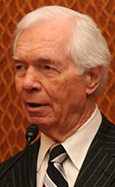
Sen. Thad Cochran, R-Miss.
The SNAP factor
Peterson credited Senate Agriculture Committee ranking member Thad Cochran, R-Miss., with bringing down the level of the cut to food stamps, formally known as the Supplemental Nutrition Assistance Program or SNAP.
In a call to rural reporters, Peterson noted that when Sen. Pat Roberts, R-Kan., was ranking member of the Senate Agriculture Committee he favored a food stamp cut of $36 billion over 10 years, but that Cochran, whose state has one of the highest percentages of people on food stamps, started out with a public position of no cut.
Stabenow had been willing to consider a cut larger than the $8 billion on which the conferees settled until Cochran replaced Roberts as ranking member, Peterson said.
Peterson and Farr both said that an acceptable dairy provision and programs to help the fruit and vegetable and organic food industries played a role in increasing the Democratic votes. More California Democratic members voted for the bill than California Republicans, Farr pointed out.
Today’s Republican vote went down compared to the summer vote because more Republicans did not vote today.
In June, 171 Republicans voted for the bill, 62 voted against it and one did not vote. Today 162 Republicans voted for the bill, 63 voted against it and six did not vote.
The reduction in the food stamp cut from the $39 billion that the House wanted to the $8 billion in the conference report and the elimination of a number of popular Republican amendments did not matter much in the final vote amongst Republicans.
Some differences set aside
Rep. Steve King, R-Iowa, who had sponsored the amendment forbidding states from banning the sale of food produced in another state over objections to production methods, saw his amendment eliminated but he voted for the bill, just as he did last June.
“This was a good, bipartisan effort and I am grateful for the hard work and efforts of Chairman Frank Lucas and my fellow Agriculture committee members,” King said in a news release. “I was honored to be a voice at the table for Iowans throughout this process and I will continue my work to support sound agriculture policy moving forward.”
The Republican Agriculture Commissioners Committee, a caucus headed by Florida Agriculture Commissioner Adam Putnam, a former congressman, praised the House passage of the bill.
“This bill has a direct impact on the products that end up on America’s, and the world’s, shelves and dinner plates,” the group said in a statement. “In short, final passage of this bill matters not only to America, but to the world.”
The group’s motto is “sowing solutions today to prevent problems tomorrow” and its mission is to elect Republicans and to actively support their appointed Republican colleagues in the states where the position is not elected, according to its news release.
But that level of Republican support did not convince farm program and food stamp critics Rep. Marlin Stutzman, R-Ind., or Rep. Tim Huelskamp, R-Kan., who voted against the bill today as they did in June.
Dairy title agreement a turning point
Lucas and Peterson both said that the key turning point was the agreement on dairy legislation.
Peterson said Lucas supported his proposal that included the program to discourage more production in the case of an oversupply, but when House Speaker John Boehner, R-Ohio, said he considered this market stabilization “Soviet-style” supply management and that he would not bring the bill to the floor if it was included, Lucas sided with him.
Lucas’s switch caused Senate Agriculture Committee Chairman Debbie Stabenow, D-Mich., to become “nervous,” Peterson said, and led him to look at alternatives even though the National Milk Producers Federation wanted the original plan.
Peterson said he John Goldberg, a Republican aide, worked out the dairy plan, but that USDA Chief Economist Joe Glauber “was also in the room.”
Peterson also said that a key element in the plan will allow the Agriculture Department to buy dairy products for government feeding programs rather than just commodities, an idea that appealed to the International Dairy Food Association because it will mean buying the products of its members.
Asked by a reporter if that didn’t amount to buying off the processors, and if the dairy title didn’t still amount to supply management, Peterson said he would not use those terms and that he had only been trying to “smooth the rough edges” of the situation.
Peterson acknowledged that the combination of the margin protection program without the market stabilization element and the dairy purchasing program increased the dairy baseline to almost $1 billion. But he said he believed the proposal by Reps. Bob Goodlatte, R-Va., and David Scott, D-Ga., would have cost $5 billion, even though the Congressional Budget Office had scored the Goodlatte-Scott proposal as costing the same as his original market stabilization proposal.
Once the Republicans decided to add a program of payments-in-lieu-of-taxes for western communities surrounded by federal land to the farm bill, he said, increasing the cost of dairy “didn’t seem to be a factor.”
- The Hagstrom Report House Farm Bill Roll Call
- H.R. 2642 — Agricultural Act of 2014 — To provide for the reform and continuation of agricultural and other programs of the Department of Agriculture through fiscal year 2018 and other purposes
- Joint Explanatory Statement of the Committee of Conference (Statement of Managers)
- Congressional Budget Office Cost Estimate H.R. 2642, Agricultural Act of 2014
