Farm Bureau: California needs long-term water solutions
January 24, 2014 | 12:38 PM
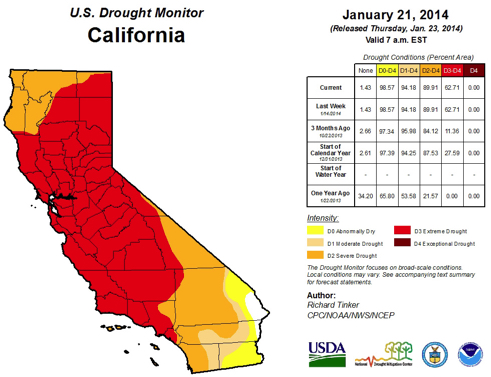
SAN DIEGO — While state and federal officials said in the past week they will try to help with California’s severe drought, a California Farm Bureau official here said more storage facilities are needed in the northern part of the state to avoid water shortages in the future.

Eric Larson
Eric Larson, executive director of the San Diego County Farm Bureau, said here Thursday that southern California agriculture has also suffered from drought but has not faced the same crisis level because the region has invested in storage facilities that provided enough water for this year’s crops.
“We actually have enough water in a dry year,” Larson said in a speech about California agriculture to the National Biodiesel Board convention here. “We have to go back to the mentality in the ’60s and ’70s and realize we can engineer solutions.”
“We need to build more storage north of the Sacramento Delta and more south” and to “fix the Delta … it is fragile,” Larson said, but he added that there is a lot of opposition due to environmental concerns and costs.
Larson acknowledged that the price of agricultural water in Southern California is high, with farmers in San Diego County paying $1,000 to $1,700 per acre foot and and as high as $2,000 per acre foot for water that is bought from farmers in the Imperial Valley and transported to San Diego County.
“It is expensive water, but it is wet,” he noted.
He said Southern Californians have “armored ourselves” against shortages by diversifying their sources. The main source is the Colorado River, but a desalinization plant is under construction. Storage only works if there is water to store, however. If the drought in the western states goes for another year, he noted, Southern California agriculture could be in trouble.
The reason Southern California agriculture can afford such high water costs is that its agricultural production is mostly “food, not feed,” and nursery plants, Larson said.
San Diego County is the No. 1 county in the nation in small farmers, with more than 6,000 farms growing high value crops, and it is also the No. 1 county in organic production. About 75 percent of the farm and ranch land in San Diego County is devoted to livestock, he noted, with locally raised beef so popular that once Whole Foods Markets decided to sell it, there has not been enough for local restaurants.

Stephen Kaffka
Stephen Kaffka of the University of California at Davis also told the biodiesel group that “There is a political contest with environmentalists and agriculture has not necessarily been successful.”
The Great Central Valley of California, Kaffka said, is the largest piece of “Mediterranean farm land” in the world, and “it is usually well watered.”
California Farm Bureau President Paul Wenger praised the declaration of a drought emergency by Gov. Jerry Brown because it will give state agencies more flexibility in managing water, but he also called for long-term action.
Brown, a Democrat, declared a drought emergency last Friday, and a federal drought declaration for the western states is already in place.

Paul Wenger
“Farmers across California face wrenching decisions today, as well as in coming months,” Wenger said in a news release.
“Will they have enough water to plant crops, to water their livestock, and keep trees and vines alive? An additional concern is how many people they may have to lay off as a result of water shortages. Any way the state and federal governments can provide assistance in adding water to the system will help,” he said.
But he added, “We don’t know if this is Year 3 of a three-year drought or Year 3 of a longer drought,” he said. “We do know that long droughts can be a feature of the California climate — and we know one way to insulate ourselves from droughts is to store more water when we can.”
Wenger said the state continues to increase water efficiency, but added, “Conservation alone won’t solve our chronic water supply problems. California must commit to improve its water system — and new storage, both above ground and underground, provides more flexibility to respond to more volatile weather patterns.”
He noted that California has an opportunity to invest in new supply by recrafting a water bond scheduled for the ballot this year.
Rep. John Garamendi, D-Calif., and other California House members noted this week that the Omnibus Appropriations Act, voted on this week and now on President Barack Obama’s desk, restores the federal government’s emergency drought programs.
House Speaker John Boehner, R-Ohio, joined three California Republican House members — Majority Whip Kevin McCarthy and Reps. David Valadao and Devin Nunes — in a field outside Bakersfield this week to back a bill that would temporarily halt restoration of the San Joaquin River, designed to bring back the historic salmon flow, among other measures, the AP reported.
“How you can favor fish over people is something people in my part of the world would never understand,” Boehner said.
(During his visit to California, Boehner also told NBC’s Jay Leno that he doesn't plan to run for president, partly because he doesn’t want to give up smoking or drinking red wine.)
Tom Nassif
Tom Nassif, CEO of Western Growers, whose members produce half the fruits and vegetables in the country, praised the Republican effort.
“Federal regulatory decisions made last year in the Delta made this situation much worse, by failing to pump and store more than 800,000 acre feet of winter runoff,” he said.
“The federal agencies charged with implementing fish species protections in the Delta declined to use their available discretion to capture that water, instead letting it flow out to sea,” Nassif said.
“There are very moderate and reasonable steps available, such as federal legislation giving the regulatory agencies clear direction to allow the state and federal water project pumps in the Delta to operate at higher levels than they have in recent years. We must capture water runoff when it is available and store it for the protection of our farms and communities.”
Zeke Grader
But the Golden Gate Salmon Association, a coalition of commercial and recreational fishermen and other businesses and communities that rely on salmon, said the proposed legislation was an attempt “to use drought as subterfuge to seize more salmon water.”
“Let’s get real. Pulling the plug on the Endangered Species Act or turning the Delta spigots wide open is not going to get San Joaquin agribusiness and frackers the water they need; all it will do is destroy Central Valley salmon and the state’s salmon fishery,” said GGSA vice chairman Zeke Grader.
“What we need is rain and snow not demagoguery on the part of the speaker and some of his fringe members who deny climate change and drought for their own ideological purposes.”
“Salmon and families that depend on them are the ones we need to act to save now,” added GGSA executive director John McManus.
“Salmon are dying in the drought-stricken Central Valley rivers and soon that will translate into lost jobs on the coast and inland waterways. This is where the help is needed. If Speaker Boehner would like to understand the full story of California’s drought we’d be more than happy to introduce him to our coastal and inland families that rely on salmon to pay the bills.”
The gubernatorial declaration also said that the California Department of Food and Agriculture will launch a one-stop website that provides updates on the drought and connects farmers to state and federal programs addressing the drought.
The site includes guidance on crop insurance sign-up dates and sources of conservation technical assistance.
