Cornell professor: TPP offers challenges for dairy
December 06, 2013 | 01:22 PM
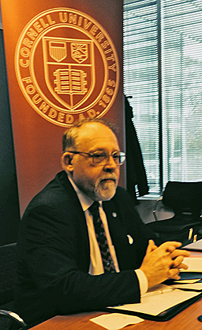
Andrew Novakovic (Jerry Hagstrom/The Hagstrom Report)
The Trans-Pacific Partnership negotiations, which begin Sunday in Singapore, offer “quite interesting” challenges for the dairy industry in the proposed member countries, Andrew Novakovic, a Cornell University professor told reporters in Washington on Thursday.
Novakovic, a former chairman of the Agriculture Department’s Dairy Industry Advisory Committee, said he does not expect much out of the World Trade Organization’s Doha round of multilateral negotiations, despite the meeting of trade ministers that is scheduled to conclude in Bali, Indonesia, today. (See story below.)
He said he sees more potential in the TPP regional agreement.
“The remnants of Doha are still very much in a coma,” Novakovic said, because “the basic issues in Doha haven’t been resolved.”
Bilateral and regional agreements like TPP “are simpler,” he noted, but for dairy TPP is complicated because the TPP group includes two of the most protectionist countries on dairy policy — Japan and Canada — and two of the most free-market oriented — Australia and New Zealand.
If the TPP agreement is concluded with complete freedom in dairy, he said, there would be much more trade between the United States and Canada.
The United States has not restricted internal movement in dairy, he noted, and the industry has been moving westward while Canada has had “very rigid supply control at the provincial levels.”
If the dairy market were opened in North America, Novakovic said, dairy products from Quebec and Ontario would flow southward into the eastern United States while products from California and Washington state would flow northward to western Canada.
When the Uruguay Round agreement was established, he noted, Canadian negotiators argued that they were already providing 5 percent access to the U.S. market through cross-border shopping because so many Canadians cross the border and bring back groceries.
But the biggest issue for U.S. negotiators in the TPP, he said, is to figure out “whether it is better to have access to Japan or to worry about New Zealand.”
