James Beard Foundation honors sustainable food leaders
October 25, 2013 | 12:53 PM
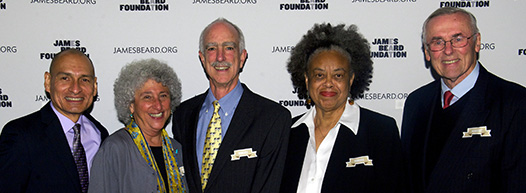 The 2013 James Beard Foundation Leadership Award recipients, from left: Ricardo Salvador, Union of Concerned Scientists; Marion Nestle, Department of Nutrition, Food Studies and Public Health, New York University; Hal Hamilton, Sustainable Food Laboratory; Cynthia Hayes, Southeastern African-American Farmers Organic Network, and Gus Schumacher, Wholesome Wave. (Kent Miller/Kent Miller Studios)
NEW YORK CITY — The James Beard Foundation this week presented awards to five people its leaders consider “visionairies creating a more healthful, sustainable and safe food world.”
At a dinner Monday at the Hearst Tower in Manhattan, the foundation, which honors the legacy of chef and cook book author James Beard, presented its 2013 Leadership Awards to:
Richardo Salvador, the son of a German American mother and American Indian father, who grew up in Mexico and was a professor of agronomy at Iowa State University specializing in sustainability.
He worked for the W.K. Kellogg Foundation before becoming senior scientist and director of the Food and Environment Program at the Union of Concerned Scientists.
“The food system should be simultaneously healthy, green, fair and affordable,” Salvador said.
Marion Nestle, the New York University professor who transformed a department of home economics into a pioneering program in food studies now called the Department of Nutrition, Food Studies and Public Health.
Nestle noted in an interview that when she arrived at NYU in 1988, the department still had a living room, a kitchen and sewing machines for students to learn to serve, cook and sew, but that she was hired to bring the curriculum into the 20th and 21st century.
Now well known for her criticism of junk food marketing, Nestle said, “There is a lot of food politics going on right now, perhaps a little bit more than we would like. Students are deeply, deeply questioning the present system.”
Hal Hamilton, a one-time Kentucky dairy farmer who developed the alliance among tobacco farmers and public health organizations that led to the investment of hundreds of millions of dollars of tobacco settlement funds in rural communities.
He more recently established the Vermont-based Sustainable Food Laboratory, which helps major corporations such as Unilever, PepsiCo and Sysco Corporation devise sustainability plans.
Hamilton noted that he had once been anti-corporate and concerned with farm bills, but finds the complex world in which he now functions more interesting.
Cynthia Hayes, who was raised in Ohio but moved back to Kentucky where her family had a tobacco farm to found the Southeastern African-American Farmers Organic Network (SAAFON) in 2006.
Hayes said her organization is about pride and respect and erasing the belief that the entire story of black farmers is their abuse by white landowners.
Black farmers, she noted, were organic growers because they could not afford commercial “soil amendments.” Her uncle, she said, had a “stinky pile” used for fertilizer and her grandmother had the equivalents of community supported agriculture and roadside stands before they were called that.
“These are people who have brought to the table some important information about agriculture. They have innovative and historical perspectives on how to grow,” she said.
Gus Schumacher, the great-grandson of a farmer on New York’s Upper West Side, who spent most of his career working on agriculture at the World Bank, but served as Massachusetts Agriculture secretary and Agriculture undersecretary for farm and foreign agriculture services in the Clinton administration.
From those positions he championed local production and farmers’ markets, before being a co-founder of Wholesome Wave, a group of chefs that launched the double-value coupon program to make locally produced fruits and vegetables more accessible to food stamp beneficiaries.
Schumacher said he was inspired by a low-income woman he saw picking up discarded fruit from the gutter.
“People who are poor understand good food and they want to get that,” Schumacher said, adding that the country needs “a healthy food system” that doesn’t give people heart disease and diabetes, and a “fair system in which farmers get a fair return and restaurants where the workers can be adequately paid.”
