Fish and Wildlife Service endorses lesser prairie-chicken plan
October 24, 2013 | 12:34 AM
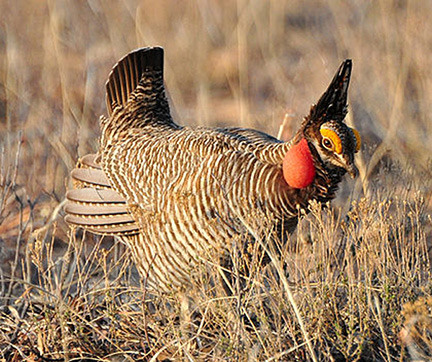
A lesser prairie-chicken, Tympanuchus pallidicinctus, in New Mexico.
The U.S. Fish and Wildlife Service, Wednesday endorsed the Western Association of Fish and Wildlife Agencies’ Lesser Prairie-Chicken Range-Wide Conservation Plan, a collaborative planning effort to conserve a species proposed for listing under the Endangered Species Act (ESA).
Republicans generally praised the Fish and Wildlife Service’s endorsement of the plan, but noted that listing on the ESA is still a possibility.
Under the range-wide plan, Texas, New Mexico, Oklahoma, Kansas and Colorado will attempt to conserve the lesser prairie-chicken.
“After an extensive review, the service found the plan is consistent with criteria proposed last May for conserving the species, which is proposed for listing under the ESA,” USFWS, a division of the Interior Department, said in a news release.
“The plan calls for providing financial incentives to landowners who voluntarily manage their lands to benefit the species. It also includes a framework for mitigating the potentially harmful effects to lesser prairie-chicken habitat from development activity throughout its range.”
“The unprecedented collaborative efforts of WAFWA and the five state wildlife agencies have produced a sound conservation plan for the lesser prairie-chicken,” said USFWS Director Dan Ashe. “We applaud the states’ commitment to lead conservation actions across the bird’s range.”
But the news release also said, “The service’s endorsement is not a decision by the service that implementing the plan will preclude the need to protect the lesser prairie-chicken under the ESA. The service will carefully consider the plan, its implementation and effectiveness when it makes a final determination on whether to list the lesser prairie-chicken under the ESA in March, 2014.”
Under the plan, agreements with participating landowners will aim to improve habitat conditions for the lesser prairie-chicken, increase populations and provide for long-term conservation of the species. The plan also establishes a framework for mitigating impacts from a wide range of activities with a goal of providing a net conservation benefit to the species.
“We are encouraged to see U.S. Fish and Wildlife Service endorsement of the five-state, range-wide plan to conserve this iconic grassland bird and its native prairie habitat,” said Carter Smith, speaking on behalf of the Western Association of Fish and Wildlife Agencies (WAFWA) and the five state agencies. Smith is WAFWA president and Texas Parks and Wildlife Department executive director.,
WAFWA, founded in 1922, consists of 23 member states and provinces that have primary responsibility and authority for protecting and managing fish and wildlife in the western United States and Canada.
“Years of due diligence have gone into this plan, guided by scientific research and monitoring, and developed with input from landowners, agriculture, wind and oil and gas interests and other stakeholders,” Smith said. “We can now work at the local level to implement the plan, facilitate more conservation for the bird while allowing sustainable land use and responsible economic development, and hopefully preclude the need to list this species.”
But if the listing should occur, USFWS said, the proposed 4(d) rule that will specifically identify the range-wide conservation plan “would provide a mechanism for ESA compliance.”
“Linking the plan to a 4(d) special rule would offer participating landowners and industry participants regulatory certainty, as actions carried out in accordance with the plan would be in compliance with the ESA, even if the species requires ESA protection.”
“The lesser prairie-chicken is a species of prairie grouse commonly recognized for its colorful spring mating display and orange eye combs,” the agency said.

“Once abundant across much of Texas, New Mexico, Oklahoma, Kansas and Colorado (the five range states), the lesser prairie-chicken’s historical range of native grasslands and prairies has been reduced by an estimated 84 percent.
“The substantial decrease in the range of the species is primarily a result of habitat fragmentation and loss caused by development and conversion of the species’ native grassland habitat to other uses. Last year, the population declined by an estimated 50 percent, primarily due to drought conditions in the West.”
Farmers fear that the listing of the lesser prairie-chicken could lead to habitat preservation requirements that would interfered with farming operations.
Although the Agriculture Department’s Natural Resources Conservation Service has provided farmers and ranchers assistance to improve Lesser Prairie Chicken habitat through the Environmental Quality Incentives Program, the Wildlife Habitat Program and the Grassland Reserve Program, NRCS had no comment today, a spokeswoman for Agriculture Secretary Tom Vilsack said.
“It’s encouraging that after a year of review the U.S. Fish and Wildlife Service is finally endorsing a voluntary five-state conservation plan for the lesser prairie-chicken,” said House Natural Resources Committee Chairman Doc Hastings, R-Wash.
“Encouraging state and local conservation efforts is one of the best ways to protect species and help keep them off the endangered species list. That’s why I am still deeply troubled by the Obama administration’s decision to leave open the possibility of listing the lesser prairie-chicken under the Endangered Species Act.”
Rep. Randy Neugebauer, R-Texas, a member of the House Agriculture Committee, also offered comment.
“Given FWS support, the range-wide conservation plan should absolutely prevent the need to list the lesser prairie-chicken,” Neugebauer said. “I strongly encourage the FWS to act quickly, and deliver a ‘not warranted’ decision on the proposed listing.”
