San Franciscans spend double to savor corn smut at Alemany Farmers Market
August 12, 2013 | 04:43 PM
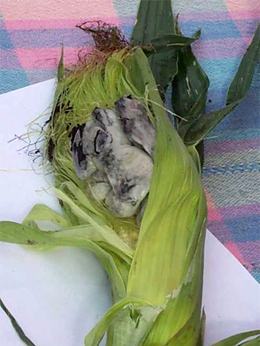
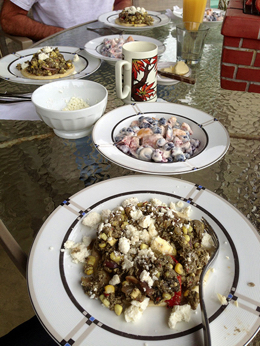
Left: Corn smut — the fungus Ustilago maydis — on a cob. (Stu Spivack) At right: Scrambled eggs with the fungus, known in the kitchen as huitlacoche. (Tony Russomanno)
SAN FRANCISCO — Most American farmers think of corn smut as a disease that ruins their crops, but at the Alemany Farmers’ Market here, sweet corn cobs festooned with the fungus sell for $1 a piece — twice the regular price — because there is an appreciation of the smut as an edible delicacy called huitlacoche.
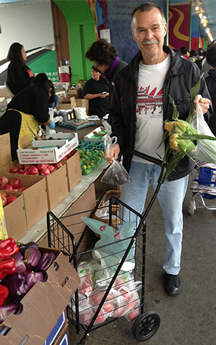
On Saturday morning, as National Farmers’ Market Week was coming to an end, retired TV producer Fritz Lichty was thrilled to find huitlacoche available on the weekly trip he has been making to the market for almost 30 years. It was one of the many food discoveries that Lichty has made at Alemany, which was founded on August 12, 1943 to create an outlet for surplus and distressed crops from neighboring counties. It is the oldest farmers’ market in California.
“I discovered huitlacoche in Mexico when it started started appearing in the nouvelle Mexican cuisine restaurants,” Lichty said. “Then one a day a few years ago an Asian farmer showed up with an ear of it at Alemany.”
The farmer was showing the diseased cob to his customers to demonstrate why some of his cobs were short that year and offered to give the useless ear to Lichty for free. But Lichty told him he could charge $1 per cob for it, and now the farmer regularly offers it when he finds some in his field.
The farmer told The Hagstrom Report that he wishes the hutilacoche wouldn’t show up in his fields or at least would concentrate in one area. Instead he finds the cobs at random.
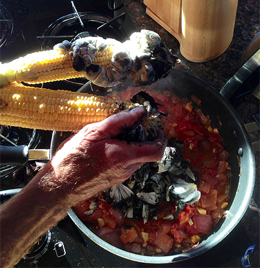
On Saturday evening, Lichty tore pieces of the huitlacoche — technically a fungus that grows in the ovaries of the corn plant and stops the top of the cob from developing properly — and sprinkled them into a dish of garlic, onions, fresh tomatoes, epazote (a popular Mexican herb he grows in his garden), and corn kernels shaved from the same cob and mixed with cilantro. Lichty said he finds it hard to describe the contribution of huitlacoche to the dish but that the taste is a mixture of a mushroom and corn.
On Saturday night the huitlacoche-infused vegetable dish accompanied skirt steak and handmade tortillas spread with crema Mexicana. On Sunday morning Lichty scrambled the leftover concoction with eggs and a bowl of fresh California fruit for breakfast.
Huiltlacoche has never taken off on a large scale in the United States, but it is available canned from Mexico and is served in some East Coast restaurants where it is called the maize mushroom, Mexican caviar or Mexican truffles (a name apparently developed by the James Beard Foundation.)
The Agriculture Department has put most of its efforts on corn smut into teaching farmers how to prevent its development by rotating crops and planting resistant varieties, but it’s also possible to inject the spores into corn plants to encourage its growth.
The addition of huitlacoche is only one of the changes that Lichty has seen at the Alemany Market. When he first starting going there in 1984, most of the farmers were white, and Italian-American farmers predominated, he said. Since then waves of Asian farmers, particularly Vietnamese and Hmong refugees, and Latino farmers have opened stalls.
The market is open year round rain or shine from dawn to dusk, and in the winter the Asian vegetables are the best, Lichty said. The market also offers certified organic produce, but Lichty noted that many farmers just show signs saying they do not spray pesticides because they find the process of organic certification too bureaucratic.
The Alemany Market is the only one in San Francisco operated by the city and is known as the “people’s market.” Its administrative office has a machine to process the electronic benefit transfer cards that are used for the distribution of Supplemental Nutrition Assistance Program benefits, better known as SNAP or food stamps. The SNAP beneficiaries get tokens they take to the farmers who are otherwise paid mostly in cash.
Business with SNAP beneficiaries has gone up, a market administrator said, since the state of California began a program that provides the beneficiaries an additional $5 in fruits and vegetables when they redeem $10 in SNAP benefits. As the official was speaking, a woman walked in asking to redeem $60 in SNAP benefits for the tokens, proving that SNAP benefits help both the hungry and local farmers.
