Democratic farm aides say congressional staff needs direction from conferees
August 09, 2013 | 11:28 AM
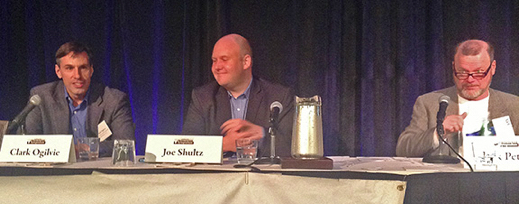
NAPA, Calif. — Democratic aides on the House and Senate Agriculture committees said here this week that congressional staff from both parties need direction from conferees in order to achieve agreement on a conference report on the farm bill.
In presentations to the American Sugar Alliance’s International Sweetener Symposium, Clark Ogilvie, a professional member of the House Agriculture Committtee staff and Joe Shultz, the chief economist for the Senate Agriculture Committee staff, said that aides will work on what is known as “pre-conferencing” during the August break, but that their work will be limited unless conferees can tell them what goals to achieve.
Since congressional aides do not publicly express views that are different from the members for whom they work, Ogilvie’s and Shultz’s views reflect those of their bosses, House Agriculture Committee ranking member Collin Peterson, D-Minn., and Senate Agriculture Committee Chairman Debbie Stabenow, D-Mich.
The Senate has named conferees on the farm bill, but House Speaker John Boehner, R-Ohio, has delayed naming them until Congress returns in September.
“What we need is some direction — what do the members want us to do,” Ogilvie said. “The key part for us to do that is to have the conferees.”
The conference report, he noted, must be signed by majority of members of the conference committee in each body.
And there’s still a question of who Boehner will name. If he follows seniority, Ogilvie said, the first person on the list would be Rep. Bob Goodlatte, R-Va., who did not vote for the comprehensive farm bill on the grounds that it did not have a big enough cut in the Supplemental Nutrition Assistance Program, better known as SNAP or food stamps.
Ogilvie also noted that the rules allow Boehner to choose House members who do not sit on the House Agriculture Committee. In 2008, he noted, then-House Speaker Nancy Pelosi, D-Calif., put Rep. Rosa DeLauro, D-Conn., on the conference committee to monitor nutrition funding.
If the Senate insists on a low level of cuts for food stamps, Ogilvie said, it’s possible that the conference report could be signed only by the Democrats and House Agriculture Committee Chairman Frank Lucas, R-Okla.
“We are not going to be able to make the big decisions,” Shultz added. “We need conferees to do that.”
Ogilvie noted that the difference between this farm bill and recently passed farm bills is that one of the goals now is to save money. The nutrition bill that is expected on the House floor in September will probably result in a lengthy debate, he said, noting that it took six hours to pass the farm-program-only bill because the Democrats protested it.
“Putting this bill on the floor is like putting gasoline on the fire,” Ogilvie said. If it passes, getting votes for a final bill with lower cuts will be difficult.
Shultz noted that Congress has passed only 15 bills this year and joked that he tells his father, “I work really hard to accomplish so little.”
Stabenow has focused on passing the bill by talking about reform and appealing to senators whose interests are outside the commodity title, he said. When it comes time to try to pass the conference report, “The question is whether what happens broadens the coalition to get it done or does it narrow it?”
The need for that coalition, Shultz said, means that Lucas’s proposal to make the commodity title of the 2013 bill the new permanent law won’t work. The Lucas proposal, he noted, would not make conservation and other programs such as the farmers’ market promotion program permanent.
“We need those folks outside the commodity title,” Shultz said. “If we have new permanent law, we really risk losing those folks.”
Making the new commodity title permanent would make the basic sugar program permanent, but the feedstock flexibility program under which the U.S. government can buy sugar and sell it to ethanol producers “may be the real key” to dealing with the surplus of sugar caused by imports from Mexico, he said.
The feedstock flexibility program, which he noted is not in the commodity title but in the energy title, would expire at the end of the new farm bill, he said.
Clark agreed that keeping the current permanent law “is important to getting a farm bill done.” The current permanent laws are important in bringing the agriculture community together to pass a bill every five years, he added.
Shultz also said he could “not reiterate enough” how hard it will be to go to conference on the bill if the House votes for big cuts to nutrition, and also how hard it would be to get votes in the House for a conference report with smaller cuts.
Shultz also noted that in order to allow the Senate to appoint conferees, Sen. Jeff Flake, R-Ariz., had insisted on a colloquy on the Senate floor, in which he voiced opposition to any extension of the direct payments that crop farmers get whether prices are high or low, and in which Stabenow said she would continue to fight to end the direct payment program.
The simple extension of the 2008 farm bill that occurred last January under which both direct payments and food stamps were continued “won’t happen that way this time,” Shultz said.
Ogilvie also pointed out that 42 percent of the House members “were not here three years ago,” and that educating them has proven difficult.
“You have a lot of people who think there should be no federal role in the farm safety net,” Ogilvie noted. “It is hard to negotiate with people who don’t believe there should be any government role.
Shultz said there are “two different conversations” going on in Congress.
“The Senate had a conversation about the farm bill, the House had a conversation about cutting entitlements,” he said. “As long as this farm bill is a proxy war for cutting entitlements and gets politicized and gets so partisan, we are not going to get it passed.”
Ogilvie said Peterson and his staff have concluded that at least half the votes for the farm bill may have to come from Democrats, and that House Minority Leader Nancy Pelosi, D-Calif., has said she will work to get the votes if the nutrition cut is close to the Senate level.
He noted that Boehner did allow passage of the Hurricane Sandy relief legislation and the Violence Against Women act with mostly Democratic votes.
Shultz said that Sen. John Hoeven, R-N.D., had been helpful on the farm bill and that Stabenow was pleased the Republicans picked him as a conferee. There was a possibility, he said, that Senate Minority Leader Mitch McConnell, R-Ky., was going to take that spot.
It would be possible to add the farm bill to a continuing resolution, Ogilvie said, but it would be more logical to add it to a bill dealing with the debt ceiling.
Peterson doesn’t care whether the farm bill complies with U.S. obligations to the World Trade Organization, Ogilvie said, but Shultz added that it is important to write a cotton program that addresses the case that Brazil won against the United States over cotton and that it is important to write a bill that would not encourage more cases in the future.
For that reason, Shultz said, the conferees should agree to a commodity program using historic acreage rather than current planted acres as the House bill does.
“We are concerned about what we are setting up in this bill in terms of future problems,” Shultz said.
