Obama continues to talk agriculture in Africa
July 01, 2013 | 07:03 PM
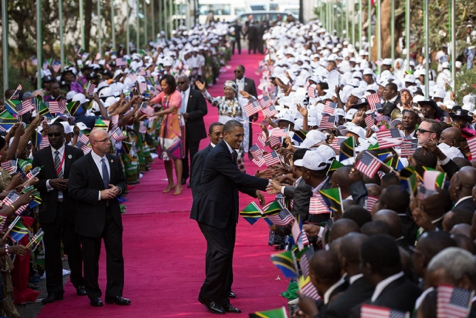
President Barack Obama and First Lady Michelle Obama shake hands as they arrive at the State House in Dar es Salaam, Tanzania, today. (White House/Pete Souza)
As President Barack Obama’s trip in Africa continued to Tanzania today following a weekend stop in South Africa, Obama continued to highlight agriculture and the U.S. Agency for International Development’s Feed the Future program, whose evaluation was released Friday. (See link.)
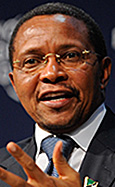
Jakaya Kikwete
Tanzanian President Jakaya Kikwete at news conference with Obama in Dar Es Salaam referred to Feed the Future as “your own brainchild,” saying that it along with the Partnership for Growth, which is focused on energy and roads, and the New Alliance for Food and Nutrition Security had “proven to be very useful in supporting the development efforts.”
Obama responded that Kikwete had “agreed to keep tackling the hurdles of greater economic growth, starting with the sector where the vast majority of Tanzanians work, and that’s in the agricultural sector.”
Obama noted that Feed the Future helped 14,000 Tanzanian farmers to better manage their crops and increase their yields by almost 50 percent.
“That means higher incomes and a ladder for families and communities to greater prosperity,” he said. “And we’re very proud of the work we’ve done with the Tanzanian government.”
Kikwete also noted that the U.S. government had agreed to help Tanzania build roads when other donor governments would not help them — and that this has implications for food availability and for trade.
“We chose those roads, because these roads are actually in our breadbasket areas. This is where we get the corn — Ruvuma, Rukwa, Mbeya,” Kikwete said.

President Barack Obama
Later at a business leaders forum, Obama said that to tap the full potential of Africans working in agriculture, “we need country-led plans that can attract private capital so we’re boosting the income of small farmers, which can fuel broad-based economic growth and lift 50 million Africans from poverty, putting some money in the pockets of the agricultural sector — small farmers, small shareholders.”
If that happens, Obama said, “suddenly, you’ve got customers for a whole range of products, and that gives additional opportunities for African manufacturers or telecom companies or insurance.”
On Sunday at the University of Cape Town in South Africa, Obama also emphasized the importance of U.S. assistance for agricultural development rather than food aid.
“To empower individual Africans,” Obama said, “we believe that countries have to have the power to feed themselves, so instead of shipping food to Africa, we’re now helping millions of small farmers in Africa make use of new technologies and farm more land.”
“And through a new alliance of governments and the private sector, we’re investing billions of dollars in agriculture that grows more crops, brings more food to market, give farmers better prices and helps lift 50 million people out of poverty in a decade,” Obama said. “An end to famine, a thriving African agricultural industry — that’s what opportunity looks like. That’s what we want to build with you.”
Earlier, in Senegal, Obama announced that Tanzania, along with Ethiopia, Ghana and Mozambique, would benefit from the Scaling Seeds and Technologies Partnership through a $47 million U.S. Agency for International Development grant to the Alliance for a Greener Revolution in Africa (AGRA), an organization started by the Rockefeller Foundation and the Bill & Melinda Gates Foundation.
The partnership will help governments strengthen their seed sectors and promote the commercialization, distribution and adoption of improved seeds and other key technologies. It aims to increase production of high-quality seeds by 45 percent in three years and ensure that 40 percent more farmers gain access to innovative agricultural technologies.
