Obama honors FFA member at White House Science Fair
April 23, 2013 | 10:18 AM
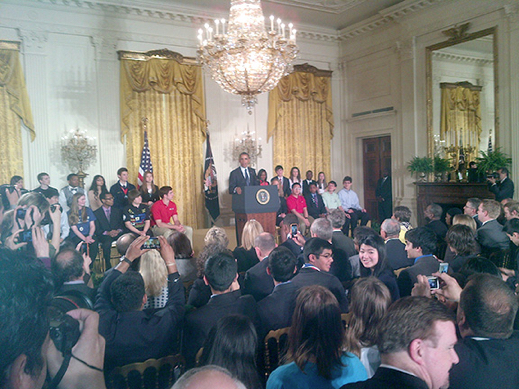
Students making presentations at the White House Science Fair on Monday listen to remarks from President Barack Obama in the East Room. (Jerry Hagstrom/The Hagstrom Report)
An FFA member from Wyoming who wrote a paper on an anerobic digester and students who bred algae in a bedroom and created a bicycle-powered water sanitation system were among the 100 students from around the country honored at the White House Science Fair on Monday.
President Barack Obama toured the exhibits and spoke to the students. In an East Room ceremony, Obama said the country needs to make it a priority “to train an army of new teachers in these subject areas, and to make sure that all of us as a country are lifting up these subjects for the respect that they deserve.”
“One of the things that I’m concerned about is that, as a culture, we’re great consumers of technology, but we’re not always properly respecting the people who are in the labs and behind the scenes creating the stuff that we now take for granted,” he added.
“And we’ve got to give the millions of Americans who work in science and technology not only the kind of respect they deserve but also new ways to engage young people.”
The students came from more than 40 states, representing 45 different science, technology, engineering and math competitions and organizations that recognize the talents of America’s next generation of scientists, engineers, inventors and innovators.
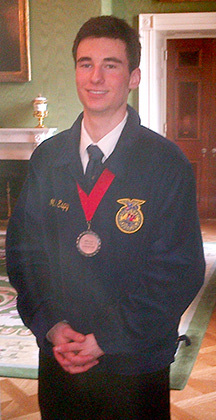
Mike Espy, a rancher's son from Savery, Wyo., sat in his FFA jacket on the stage with the president and some other students. (FFA is now the official name of the organization that started out as the Future Farmers of America.)
In an interview, Espy said he had written a paper on anaerobic digesters for the DuPont Challenge. The paper focused on the different ingredients that can be used in a digester, including chokecherries and juniper needles. He had based his paper on a science project that involved putting cow manure from his ranch in a plastic bag along with hay, juniper needles and other items to test how much methane gas each produced.
Obama pointed out that two students from Little Egg Harbor, N.J., Jon Kubricki and Bridget Zarych, along with their classmate Mikaeli Crowley, had designed an inexpensive press that can recycle garbage like banana peels into briquettes as an alternative to using wood for fuel. A display of their work in the White House garden noted that cooking with wood is a significant cause of global deforestation and that peanut shells, sugar cane, pine needles and corn stalks can also be used as biomass materials.
Obama also highlighted the work of Sara Volz, a Colorado Springs, Colo., student who has been breeding new types of algae to produce cheaper biofuels. “She stores this in a lab in her bedroom,” Obama said, adding that she has very supportive parents.
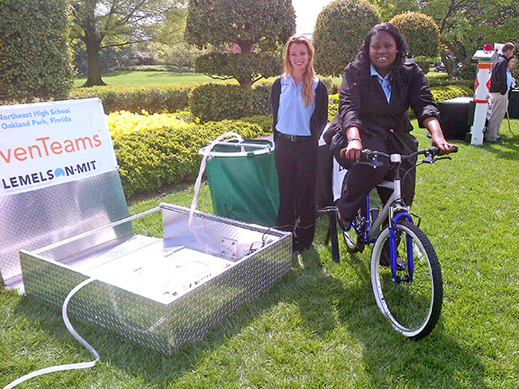
Payton Karr and Kiona Elliot of Overland Park, Fla., demonstrate their bicycle-powered water-sanitation station in the garden of the White House. (Jerry Hagstrom/The Hagstrom Report)
Two other teens at the fair, Payton Karr and Kiona Elliot from Oakland Park, Fla., led a team of inventors who designed a collapsible, transportable, bicycle-powered emergency water-sanitation station that filters E. coli and other harmful pathogens from contaminated water. In emergencies, the device can be assembled and disassembled in under an hour, and can produce enough water to hydrate 20 – 30 people during a 15-hour period.
In an interview, they said that they had been inspired by one of their teammates who traveled to Haiti and came back with reports that drinking water and even shower water was unclean.
