Shah promotes Obama food aid proposal
April 11, 2013 | 07:26 PM
U.S. Agency for International Development Administrator Rajiv Shah on Wednesday promoted the Obama administration’s proposal to shift the Food for Peace program from commodity purchases to cash assistance, but said convincing Congress to keep up the budget for cash assistance would depend on the program’s performance.
“The president’s 2014 budget includes reforms to food aid that will enable us to feed an estimated four million more hungry children every year with the same resources,” Shah said in a speech Wednesday at the Center for Strategic and International Studies.
While critics have focused on the proposal’s shift from buying U.S. commodities and shipping them overseas to local and regional purchases of food aid, Shah emphasized that the proposal would allow USAID to provide more electronic cash transfers and vouchers to people in conflict areas where displaced persons do not have purchasing power but apparently food is available.
Shah said USAID used cash transfers successfully at the world’s largest refugee camp in Somalia last year, but needs more authority for such transfers.
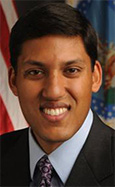 Rajiv Shah
“This year, 155,000 fewer children will receive support in Somalia because we do not have enough flexibility to use cash to address the ongoing emergency in areas where our food aid cannot go,” he said. “Each one of these children — even if only moderately malnourished — is three to four times more likely to die than a well-nourished child.”
“Today, there are 18 million hungry people in the Sahel — where tackling vast vulnerability across eight countries demands such flexibility and innovation,” Shah said
“And every day, we see the need for life-saving aid grow more pressing in Syria, where the Assad regime’s brutality makes importing large quantities of food aid dangerous and impossible in certain areas.”
While American food aid started at a time of commodity surpluses in the United States, Shah said, “Today, agriculture is the second most productive aspect of the American economy, and we just experienced the strongest four years in history for agricultural trade.”
The higher commodity prices have increased USAID’s cost of doing business by 200 percent while the cost of shipping has risen to 16 percent of the food aid budget, he said.
Studies have shown that “buying food locally — instead of in the United States — costs much less, as much as 50 percent for cereals and as much as 31 percent for pulses,” Shah said.
“That’s because the average prices of buying and delivering American food across an ocean has increased from $390 per metric ton in 2001 to $1,180 today.”
Buying food locally, he added, can also speed the arrival of life-saving aid.
Shah said USAID would continue to buy 55 percent of food in the United States, although he did not mention that the proposal calls for the agency to re-evaluate that percentage in future years.
Through Feed the Future, USDAID’s agriculture development program, he said, “we will expand this program and continue to build new partnerships with land-grant universities, agricultural companies, and faith based organizations.”
He also maintained that even though the proposal calls for the end of monetization of food aid, USAID would continue to work through American nongovernmental organizations. He said USAID will support the maritime industry through a $25 million grant.
The American merchant marine has delivered food to dangerous regions for decades, “ably and safely,” he said. “But let’s do it only when it makes good sense.”
Shah said he felt that previous efforts to change the food aid program had failed because there has been “the persistence of myths, misinformation, and fears.”
“I’ve heard that our food aid won’t be branded and we’ll lose one of the most powerful visible images of American generosity,” Shah said.
But he held up a bag of grain that had been procured locally in the Democratic Republic of the Congo and said it was an example of how U.S. food aid will be branded in the future.
“And I’ve heard the myth that, without agricultural earmarks, we won’t be able to protect funding for food aid in the years ahead,” Shah said.
“It’s true there’s no guarantee for the future. But in my last three years as administrator, I’ve seen the support that Americans have for our work grow, not diminish.”
The audience was generally sympathetic to the proposal, but there was an acknowledgment that the proposal would result in food aid funding being shifted from the agriculture appropriations subcommittees to the foreign operations subcommittees, and that there was no guarantee of long-term support from subcommittees that have other priorities.
Shah said he believed congressional support for the program would depend on performance, and that the new programs would be more efficient than the old ones. Everyone involved in the issue has asked for efficient, business like results, Shah said, concluding “One thing that is inexcusable is to promote inefficiency.”
“The president’s 2014 budget includes reforms to food aid that will enable us to feed an estimated four million more hungry children every year with the same resources,” Shah said in a speech Wednesday at the Center for Strategic and International Studies.
While critics have focused on the proposal’s shift from buying U.S. commodities and shipping them overseas to local and regional purchases of food aid, Shah emphasized that the proposal would allow USAID to provide more electronic cash transfers and vouchers to people in conflict areas where displaced persons do not have purchasing power but apparently food is available.
Shah said USAID used cash transfers successfully at the world’s largest refugee camp in Somalia last year, but needs more authority for such transfers.
“This year, 155,000 fewer children will receive support in Somalia because we do not have enough flexibility to use cash to address the ongoing emergency in areas where our food aid cannot go,” he said. “Each one of these children — even if only moderately malnourished — is three to four times more likely to die than a well-nourished child.”
“Today, there are 18 million hungry people in the Sahel — where tackling vast vulnerability across eight countries demands such flexibility and innovation,” Shah said
“And every day, we see the need for life-saving aid grow more pressing in Syria, where the Assad regime’s brutality makes importing large quantities of food aid dangerous and impossible in certain areas.”
While American food aid started at a time of commodity surpluses in the United States, Shah said, “Today, agriculture is the second most productive aspect of the American economy, and we just experienced the strongest four years in history for agricultural trade.”
The higher commodity prices have increased USAID’s cost of doing business by 200 percent while the cost of shipping has risen to 16 percent of the food aid budget, he said.
Studies have shown that “buying food locally — instead of in the United States — costs much less, as much as 50 percent for cereals and as much as 31 percent for pulses,” Shah said.
“That’s because the average prices of buying and delivering American food across an ocean has increased from $390 per metric ton in 2001 to $1,180 today.”
Buying food locally, he added, can also speed the arrival of life-saving aid.
Shah said USAID would continue to buy 55 percent of food in the United States, although he did not mention that the proposal calls for the agency to re-evaluate that percentage in future years.
Through Feed the Future, USDAID’s agriculture development program, he said, “we will expand this program and continue to build new partnerships with land-grant universities, agricultural companies, and faith based organizations.”
He also maintained that even though the proposal calls for the end of monetization of food aid, USAID would continue to work through American nongovernmental organizations. He said USAID will support the maritime industry through a $25 million grant.
The American merchant marine has delivered food to dangerous regions for decades, “ably and safely,” he said. “But let’s do it only when it makes good sense.”
Shah said he felt that previous efforts to change the food aid program had failed because there has been “the persistence of myths, misinformation, and fears.”
“I’ve heard that our food aid won’t be branded and we’ll lose one of the most powerful visible images of American generosity,” Shah said.
But he held up a bag of grain that had been procured locally in the Democratic Republic of the Congo and said it was an example of how U.S. food aid will be branded in the future.
“And I’ve heard the myth that, without agricultural earmarks, we won’t be able to protect funding for food aid in the years ahead,” Shah said.
“It’s true there’s no guarantee for the future. But in my last three years as administrator, I’ve seen the support that Americans have for our work grow, not diminish.”
The audience was generally sympathetic to the proposal, but there was an acknowledgment that the proposal would result in food aid funding being shifted from the agriculture appropriations subcommittees to the foreign operations subcommittees, and that there was no guarantee of long-term support from subcommittees that have other priorities.
Shah said he believed congressional support for the program would depend on performance, and that the new programs would be more efficient than the old ones. Everyone involved in the issue has asked for efficient, business like results, Shah said, concluding “One thing that is inexcusable is to promote inefficiency.”
