USDA releases ‘Smart Snacks in Schools’ rule
February 01, 2013 | 11:13 AM
Snacks sold in school vending machines would be limited to 200 calories and beverages would be controlled for sugar content and size, but these standards would not apply to a limited number of school fundraisers under a long-anticipated rule the Agriculture Department released today to bring the foods sold in school vending machines and a la carte lines nutritionally in line with regular school meals.
The rule, titled “Smart Snacks in Schools,” is expected to be controversial, although it appears the standards will not be as strict as those set in West Virginia and some other states and cities. USDA’s rule will establish a national baseline, but states and localities with higher standards will be allowed to maintain them, USDA said.
The rule will be published in the Federal Register next week and at that time UDSA will open a 60-day comment period. USDA has not set a deadline for writing a final rule, but said in a news release that after it is written, schools will have another year to implement it.
The rule was written under the authority of the Healthy Hunger-Free Kids Act of 2010, which required USDA to establish improved nutrition standards for the federally supported school meals programs and for other food sold in the schools.
USDA officials have emphasized that the rule follows a statement that First Lady Michelle Obama has made in her “Let’s Move” campaign: that at a time when the health of nearly one-third of the nation's children is in danger because they are overweight or obese, parents should expect that the nutritional standards in schools should be as high those in their homes.
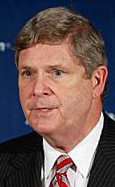 Tom Vilsack
“Parents and teachers work hard to instill healthy eating habits in our kids, and these efforts should be supported when kids walk through the schoolhouse door,” Agriculture Secretary Tom Vilsack said in a news release.
“Good nutrition lays the groundwork for good health and academic success,” Vilsack said. “Providing healthy options throughout school cafeterias, vending machines, and snack bars will complement the gains made with the new, healthy standards for school breakfast and lunch so the healthy choice is the easy choice for our kids.”
 Margot Wootan
Margo G. Wootan, director of the nutrition policy at the Center for Science in the Public Interest, who lobbied hard for the Healthy Hunger-Free Kids Act, told The Hagstrom Report today that “the rule looks good.”
“The standards are sensible and look familiar; most of the criteria are based on what local school districts and states have implemented, and what the industry already has agreed to,” Wootan said.
“They include strong criteria for calories, fats, sugars, and sodium for foods, and would allow water, low-fat milk and 100 percent juice in all schools, plus lower-calorie beverages in high schools.”
Wootan noted that two-thirds of elementary school students and almost all high school students can buy foods and beverages outside of the meal programs in their schools, and that studies show that unhealthy snacks and drinks sold in schools undermine children’s diets and increase their weights.
But critics — including members of Congress — who have charged that the Obama administration restrictions of calories in school meals amounts to “nanny state” intervention in children’s lives are expected to criticize and oppose the rule.
Officials anticipate that the controversy over the alternative foods rule may be even greater than over schools meals because this is the first time the federal government has regulated in this area. Until now the decisions about foods sold in vending machines have been largely left up to school districts and local governments that have often used the income to fund sports and other school activities.
But officials also said they believe that the food industry will have time to adjust its product lines.
Earlier this week, the Centers for Disease Control and Prevention issued a report that analyzed state policies for food and beverages served outside the school lunch line which noted that 39 states already have a state law, regulation or policy in place related to the sale or availability of snack foods and beverages in schools. In many cases, local policies and practices exceeded state requirements or recommendations, the report said.
The rule, titled “Smart Snacks in Schools,” is expected to be controversial, although it appears the standards will not be as strict as those set in West Virginia and some other states and cities. USDA’s rule will establish a national baseline, but states and localities with higher standards will be allowed to maintain them, USDA said.
The rule will be published in the Federal Register next week and at that time UDSA will open a 60-day comment period. USDA has not set a deadline for writing a final rule, but said in a news release that after it is written, schools will have another year to implement it.
The rule was written under the authority of the Healthy Hunger-Free Kids Act of 2010, which required USDA to establish improved nutrition standards for the federally supported school meals programs and for other food sold in the schools.
USDA officials have emphasized that the rule follows a statement that First Lady Michelle Obama has made in her “Let’s Move” campaign: that at a time when the health of nearly one-third of the nation's children is in danger because they are overweight or obese, parents should expect that the nutritional standards in schools should be as high those in their homes.
“Parents and teachers work hard to instill healthy eating habits in our kids, and these efforts should be supported when kids walk through the schoolhouse door,” Agriculture Secretary Tom Vilsack said in a news release.
“Good nutrition lays the groundwork for good health and academic success,” Vilsack said. “Providing healthy options throughout school cafeterias, vending machines, and snack bars will complement the gains made with the new, healthy standards for school breakfast and lunch so the healthy choice is the easy choice for our kids.”
Margo G. Wootan, director of the nutrition policy at the Center for Science in the Public Interest, who lobbied hard for the Healthy Hunger-Free Kids Act, told The Hagstrom Report today that “the rule looks good.”
“The standards are sensible and look familiar; most of the criteria are based on what local school districts and states have implemented, and what the industry already has agreed to,” Wootan said.
“They include strong criteria for calories, fats, sugars, and sodium for foods, and would allow water, low-fat milk and 100 percent juice in all schools, plus lower-calorie beverages in high schools.”
Wootan noted that two-thirds of elementary school students and almost all high school students can buy foods and beverages outside of the meal programs in their schools, and that studies show that unhealthy snacks and drinks sold in schools undermine children’s diets and increase their weights.
But critics — including members of Congress — who have charged that the Obama administration restrictions of calories in school meals amounts to “nanny state” intervention in children’s lives are expected to criticize and oppose the rule.
Officials anticipate that the controversy over the alternative foods rule may be even greater than over schools meals because this is the first time the federal government has regulated in this area. Until now the decisions about foods sold in vending machines have been largely left up to school districts and local governments that have often used the income to fund sports and other school activities.
But officials also said they believe that the food industry will have time to adjust its product lines.
Earlier this week, the Centers for Disease Control and Prevention issued a report that analyzed state policies for food and beverages served outside the school lunch line which noted that 39 states already have a state law, regulation or policy in place related to the sale or availability of snack foods and beverages in schools. In many cases, local policies and practices exceeded state requirements or recommendations, the report said.
- Proposed Nutrition Standards for All Foods Sold in School as Required by the Healthy, Hunger-Free Kids Act of 2010
- Competitive Foods and Beverages in U.S. Schools: A State Policy Analysis
- Healthy Hunger-Free Kids Act of 2010
- Let’s Move!
